
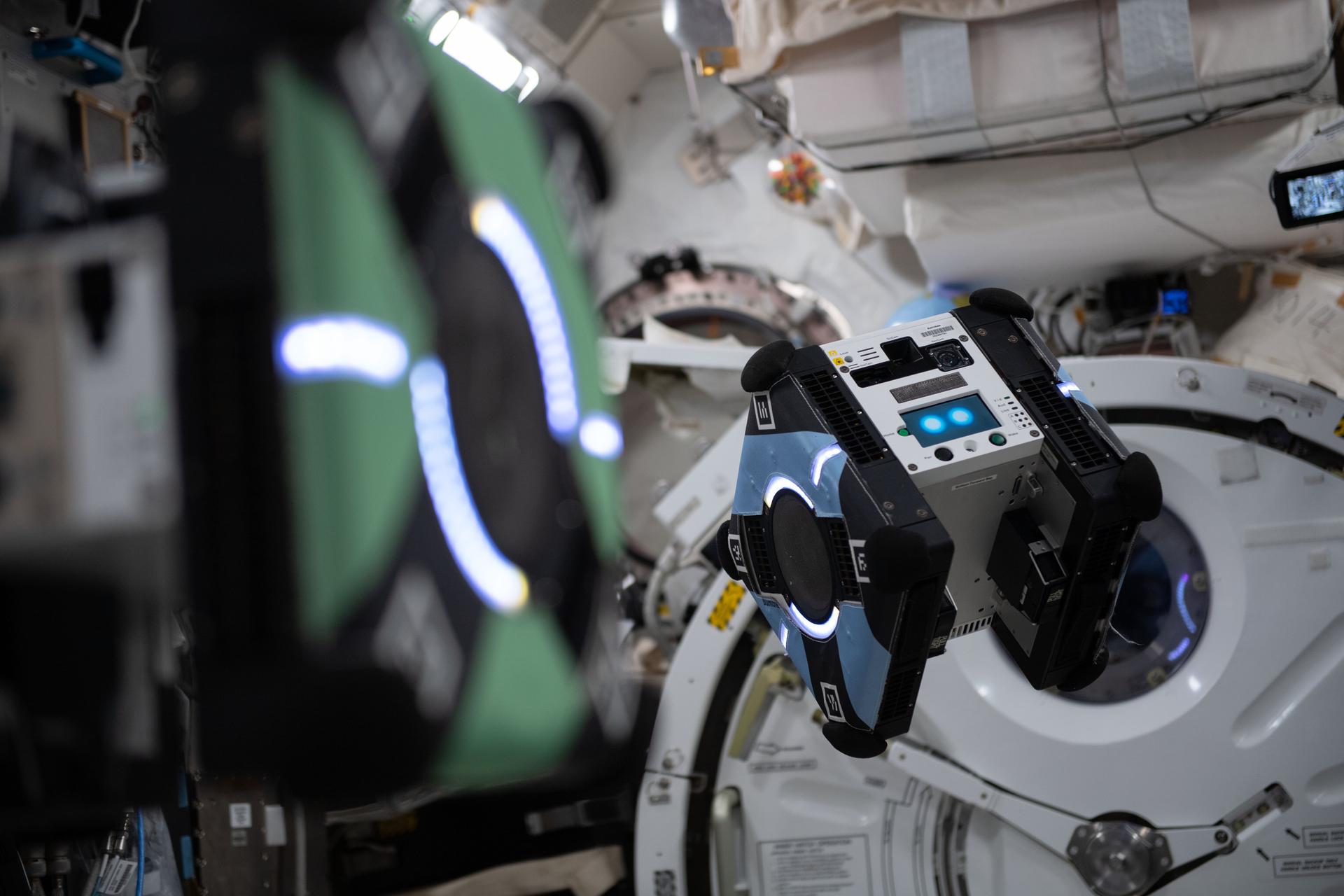
The National Aeronautics and Space Administration (NASA) has addressed a crucial challenge in space exploration by enhancing the navigation capabilities of its autonomous robots aboard the International Space Station (ISS). Working in collaboration with Professor Pyojin Kim from the Gwangju Institute of Science and Technology (GIST), the team has developed an innovative algorithm that significantly reduces navigation errors, allowing robots to operate without human intervention.
Robots like the free-flying Astrobee are designed to assist astronauts by performing routine tasks, yet they often struggle to maintain orientation in the microgravity environment of space. Traditional navigation systems, reliant on gravity, can become ineffective when applied in this unique context. As a result, astronauts have been required to step in and recalibrate the robots, leading to interruptions in their meticulously planned schedules.
Professor Kim explained that terrestrial navigation algorithms are typically designed with gravity in mind. This limitation became evident when trying to implement these systems aboard the ISS, where the absence of a distinct gravity vector leads to accumulating errors that can cause robots to lose their bearings. To combat this issue, the research team explored Visual-Based Navigation (VBN), enabling the robots to ascertain their position by analyzing their surroundings through cameras.
The ISS presents a particularly challenging environment for navigation due to its cluttered interior, filled with cables and equipment. Initial attempts to simply apply existing earthbound technology yielded unreliable results. “We thought we could apply Earth-based technology,” Professor Kim recalled, noting that the unpredictable visual landscape of the ISS hindered standard navigation systems.
Innovative Solutions with Digital Twins
The breakthrough came with the introduction of digital twins, which are precise 3D replicas of the ISS’s physical space. By utilizing NASA’s blueprints, the team constructed a virtual model devoid of transient clutter. The robot could then compare real-time footage from its cameras with these pristine images from the digital twin, effectively filtering out visual noise and recalibrating its position.
“The digital twin serves as a ground truth, enabling the robot to filter out visual noise and recalibrate its position,” explained Professor Kim. This approach allowed the robot to interpret its surroundings as a collection of geometric features, effectively providing a “visual compass” to maintain its orientation.
The new navigation system achieved an average rotational error of just 1.43 degrees, a significant improvement that ensures the robot can perform its tasks autonomously for extended periods without human assistance. This advancement not only enhances the efficiency of operations aboard the ISS but also has potential applications on Earth, particularly in environments where GPS signals are unavailable.
The technology could guide drones and robots in urban settings, making it applicable beyond just space exploration. Professor Kim emphasized that “orientation techniques based on these structural features are applicable not only to space stations but also to typical urban settings.”
A Vision for the Future of Space Exploration
Reflecting on the importance of space exploration, Professor Kim expressed a straightforward perspective: “Because space now holds real economic and industrial value, showing commercial potential.” As private companies like SpaceX pave the way for a commercial space industry, NASA’s foundational technologies and expertise play a critical role in this emerging sector.
Professor Kim’s journey into this innovative collaboration began with an internship at NASA’s Ames Research Center, where he contributed to the development of the Astrobee robot. His background in drone technology equipped him with the necessary skills to tackle the challenges of navigation in microgravity. Through his experience at NASA, he recognized the universal principles underlying navigation technology, whether on Earth or in space.
His work has evolved over nearly a decade, leading to the successful joint research that resulted in the recent technological breakthroughs. Professor Kim acknowledged the invaluable support he received from mentors and colleagues at NASA, highlighting the agency’s culture that embraces experimentation and learning from failure.
As NASA continues to invest in space research and technology, the collaboration with GIST serves as a prime example of how international partnerships can drive innovation. The advancements made in navigation technology not only improve the functionality of robots in space but also set the stage for future developments in various industries on Earth.
For aspiring researchers and engineers, Professor Kim offers practical advice: “You must excel at mathematics and your studies in general. While it is good to dream big, making that dream a reality requires overwhelming competence.” His words resonate with the ethos of hard work and dedication that underpin success in the competitive field of space exploration.
In summary, NASA’s partnership with GIST has led to significant advancements in robot navigation technology, enhancing the efficiency of operations aboard the ISS and paving the way for future innovations both in space and on Earth.