
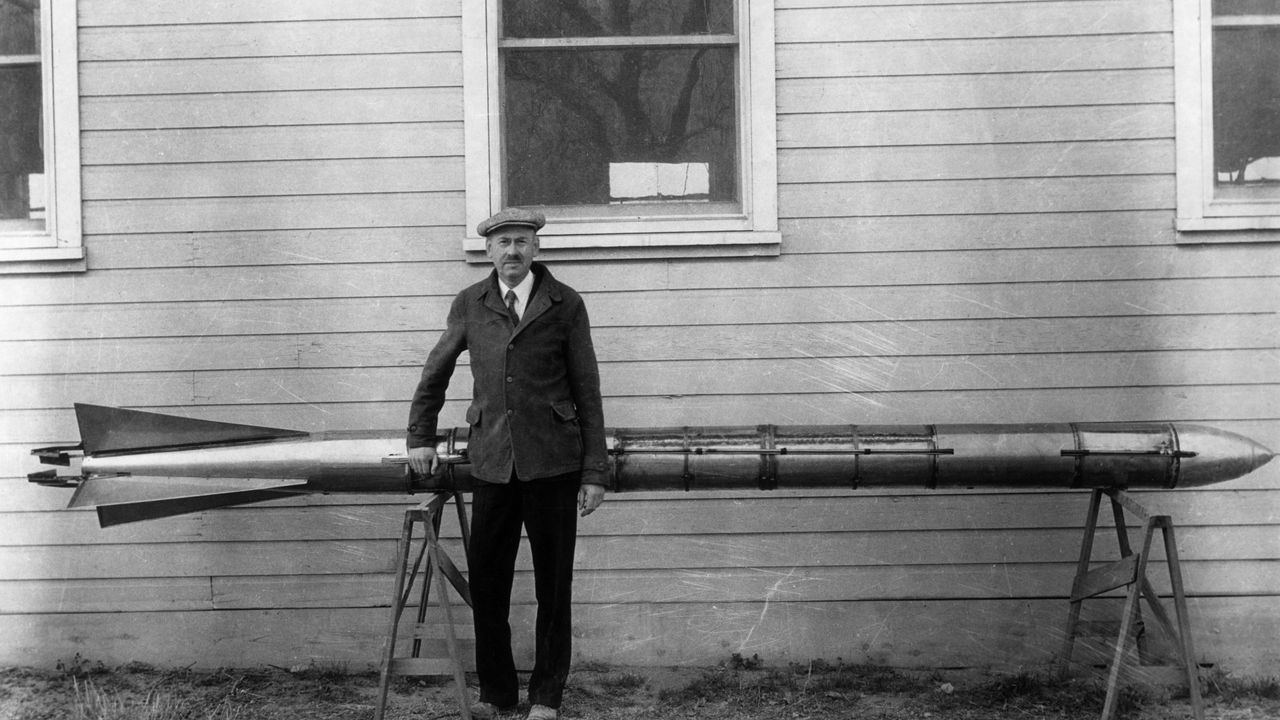
NASA is on the brink of returning astronauts to the Moon, marking a significant milestone on the centennial of the first successful liquid-fueled rocket launch by Robert Goddard. On March 16, 1926, Goddard, a physics professor at Clark University, launched his revolutionary rocket from a cabbage field in Auburn, Massachusetts. Although it only reached a height of 40 feet, this event initiated an era of modern rocketry that would eventually lead to humans landing on the Moon.
Over the next century, Goddard’s innovations transformed the field of aerospace. His pioneering work laid the foundational technologies that underpin nearly all major rocket systems today. These advancements include essential components like turbopumps, gimbaling engines, and gyroscopic guidance systems, which played critical roles during NASA’s space missions in the 1960s. From the Mercury and Gemini programs to the Apollo missions, Goddard’s legacy is evident in every aspect of space exploration.
As we commemorate Goddard’s achievements, NASA is preparing for the launch of the first crewed mission of the Artemis program. This mission, known as Artemis 2, is set to launch on a rocket that is 30 times larger than Goddard’s original design. Scheduled for no earlier than April 1, 2024, the Space Launch System (SLS) will carry an Orion spacecraft with astronauts Reid Wiseman, Victor Glover, Christina Koch, and Jeremy Hansen on a 10-day journey around the Moon.
Goddard’s first rocket, standing a mere 10 feet (3 meters) tall, utilized liquid oxygen and gasoline—an innovative approach at a time when solid propellant rockets dominated. Solid boosters, like those assisting the SLS, have limitations; once ignited, they cannot be extinguished. In contrast, liquid propellants provide engineers with the capacity to control thrust more precisely, generating significantly more power than solid alternatives. The fundamental principle remains unchanged: a mixture of pressurized liquid fuel and oxidizer is ignited to produce a high-speed expulsion of gas, propelling the rocket skyward.
Artemis 2 is a crucial step toward establishing a sustainable human presence on the Moon. While the crew will not be landing, their mission will serve as a test of Orion’s life support systems in preparation for future lunar landings. Following Artemis 2, NASA plans to launch Artemis 3, which will focus on rendezvous and docking maneuvers with lunar landers, expected to take place in 2027. The first crewed lunar landing is scheduled for 2028.
As preparations intensify, the SLS is set to roll out from the Vehicle Assembly Building at NASA’s Kennedy Space Center in Florida on March 19, 2024. The agency aims to ready the rocket for launch within a window that spans from April 1-6. The journey that began with a small-scale experiment in Massachusetts has evolved into a comprehensive plan for lunar exploration, illustrating the remarkable progress in rocketry over the past century.
In the intervening years, rockets have transitioned from experimental models to the essential instruments of space exploration, enabling humanity to reach every planet in the solar system and beyond. As NASA embarks on this new chapter with Artemis, the influence of Goddard’s original liquid-fueled rocket continues to resonate throughout the cosmos.