
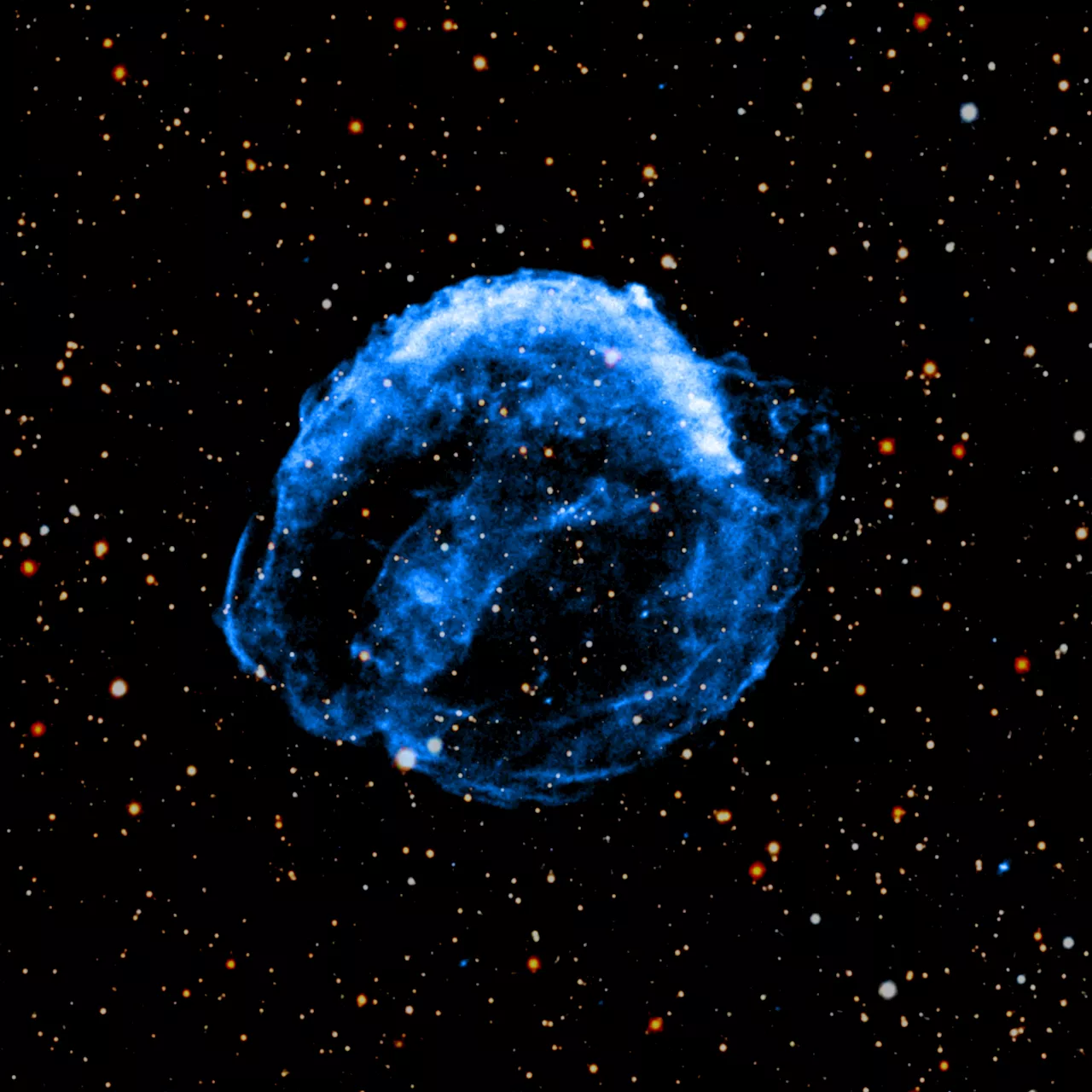
NASA has released a groundbreaking video showcasing over 25 years of data on Kepler’s Supernova Remnant, captured by the Chandra X-ray Observatory. This remarkable project compiles observations taken from 2000, 2004, 2006, 2014, and the anticipated data from 2025, making it the longest-spanning video ever produced by Chandra.
Kepler’s Supernova Remnant, named in honor of the German astronomer Johannes Kepler, was first documented in 1604. Astronomers have since determined that the remnant originated from a white dwarf star that exploded after accumulating mass from a companion star or merging with another white dwarf. This type of explosion, known as a Type Ia supernova, is crucial for measuring the expansion of the universe.
The video combines X-ray data from Chandra with optical images from the Pan-STARRS telescope, illustrating the dramatic changes in the remnant over time. Supernova remnants, which consist of the debris from stellar explosions, emit strong X-ray light due to the intense heat generated by the explosion, reaching millions of degrees.
The remnant is located approximately 17,000 light-years from Earth, allowing scientists to capture detailed images of the debris and monitor its evolution. Jessye Gassel, a graduate student at George Mason University and the lead researcher on this project, stated, “The plot of Kepler’s story is just now beginning to unfold. It’s remarkable that we can watch as these remains from this shattered star crash into material already thrown out into space.”
Insights from the Data
Gassel presented the findings at the 247th meeting of the American Astronomical Society in Phoenix. The video reveals that the fastest portions of the remnant are expanding at about 13.8 million miles per hour (approximately 22.2 million kilometers per hour), while the slowest sections are moving at around 4 million miles per hour (about 6.4 million kilometers per hour). This disparity in speed is attributed to the varying densities of the gas that the remnant encounters; the denser gas is located toward the top of the image, while the less dense gas is at the bottom.
Brian Williams, principal investigator of the new Chandra observations and a researcher at NASA’s Goddard Space Flight Center, emphasized the significance of supernovae in cosmic evolution. “Supernova explosions and the elements they hurl into space are the lifeblood of new stars and planets. Understanding exactly how they behave is crucial to knowing our cosmic history.”
In addition to tracking the remnant’s expansion, the research team also examined the widths of the blast wave that formed during the explosion. This blast wave is the initial front of the explosion and is the first to interact with the surrounding material. By measuring the width of this wave and its velocity, astronomers gain further insights into both the nature of the explosion and the environment in which it occurred.
The Chandra X-ray Observatory, managed by NASA’s Marshall Space Flight Center in Huntsville, Alabama, has been instrumental in advancing our understanding of astronomical phenomena. The scientific operations are controlled by the Smithsonian Astrophysical Observatory from Cambridge, Massachusetts.
The new release features a ten-second silent video of Kepler’s expanding Supernova Remnant, showcasing its ethereal appearance in X-ray light. The remnant resembles a cloudy neon blue ring, with the video illustrating its expansion in a timelapse format. As the video cycles through the five datasets, viewers can observe the remnant’s slow but definitive growth, akin to a balloon gradually inflating.
Upon closer examination, researchers determined that the remnant is expanding more rapidly at the bottom than at the top, with the lower parts reaching speeds of approximately 13.8 million miles per hour, or 2% of the speed of light. In contrast, the slower sections at the top are moving at about 4 million miles per hour, which is roughly 0.5% of the speed of light.
This extensive collection and analysis of data over the decades have provided invaluable insights into the environment into which the white dwarf star exploded, enhancing our understanding of how supernova remnants evolve over time. The findings underscore the importance of long-term astronomical observations in piecing together the narrative of our universe’s history.