
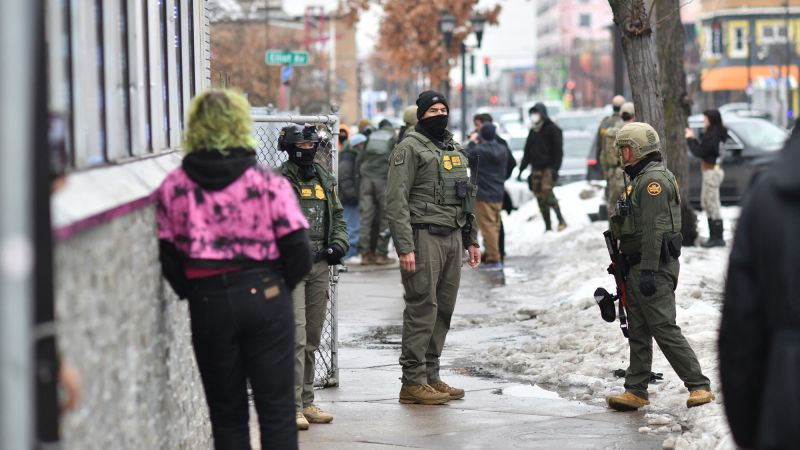
Federal immigration agents have significantly impacted local businesses in Minneapolis and St. Paul, Minnesota, causing a sharp decline in customer traffic and sales. The presence of unmarked vans and masked agents has instilled fear in both customers and employees, prompting many to stay home. This situation has threatened the future of established businesses like El Burrito Mercado, a beloved Mexican supermarket and restaurant. CEO Melissa Silvia-Diaz described the situation as dire, stating, “ICE is using my business as a hunting ground.”
The Trump administration’s recent immigration enforcement operations have led to over 2,000 arrests in the Twin Cities, according to the Department of Homeland Security. This aggressive approach has caused legal and undocumented immigrants to avoid public spaces, resulting in a chilling effect on spending and commerce. Many business owners have reported sales declines ranging from 50% to 80% since the operations began last month.
Economic Fallout and Community Impact
The economic fallout has been immediate and severe. Following the tragic death of Renee Good, a 37-year-old U.S. citizen, at the hands of an ICE agent, numerous businesses have temporarily closed their doors. Notably, comedian John Mulaney postponed his performance in the area, and local events like an arts festival and Pride celebration have been canceled. Silvia-Diaz reported that El Burrito Mercado could only operate for four hours on one recent day due to staff shortages and dwindling customer numbers.
In response to the deteriorating situation, the Twin Cities and Minnesota have filed a lawsuit against the Trump administration, aiming to halt these operations. The legal action underscores the urgency of the matter, as many businesses fear lasting damage to their livelihoods and the local economy.
Immigrant Businesses Under Threat
The economic landscape of Minnesota is heavily reliant on immigrant businesses. The Twin Cities, particularly neighborhoods like District del Sol, have seen growth thanks to the contributions of immigrant communities. Silvia-Diaz, whose family opened El Burrito Mercado nearly five decades ago, emphasized the importance of these businesses: “This country is built on immigrant businesses. You wipe them out and then what?”
Other local business owners are echoing her concerns. Miguel Lopez, who owns Homi, a Mexican restaurant, has shifted to pickup-only orders out of safety concerns. “I don’t feel safe either in my house or my business,” he remarked, illustrating the broader anxiety within the community.
Target, a major retailer headquartered in Minneapolis, has also found itself at the center of this crisis. With approximately 50 stores in the metro area, the company has faced scrutiny as immigration agents have made arrests within its locations. Local leaders are urging Target to take a stand to protect its employees and customers from ICE actions.
Minnesota’s economy is at risk due to these enforcement measures. The state has already been experiencing a slowdown in population growth and relies heavily on immigrant labor to fill job vacancies. The Minnesota Chamber of Commerce noted that nearly 94% of Minnesota’s net population growth from 2020 to 2024 has been driven by immigration.
As local leaders and business owners grapple with the fallout, Mike Logan, CEO of the Minneapolis Regional Chamber of Commerce, voiced concerns about the long-term implications for talent retention in the region. “For the sake of the economy, businesses, and the community, the sooner this can come to a civil conclusion, the better,” he stated.
The current situation in Minneapolis and St. Paul serves as a stark reminder of the delicate balance between immigration policies and local economic health. As businesses fight to survive, the future of many immigrant-owned enterprises hangs in the balance.