
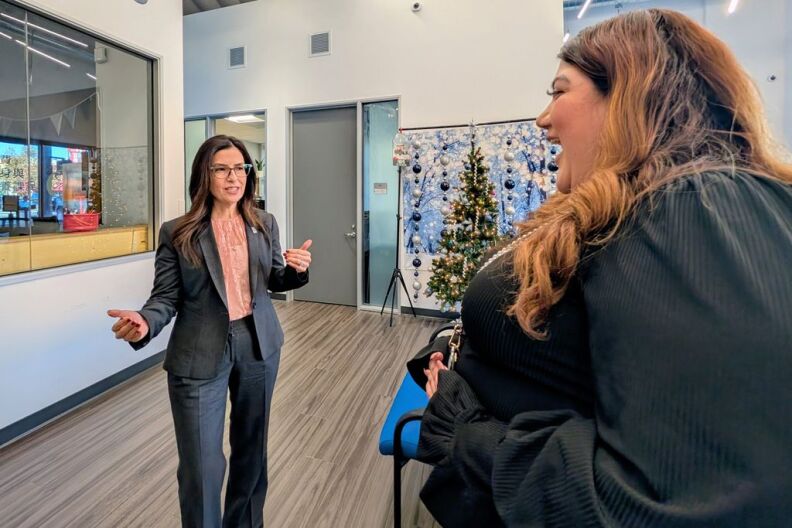
The CEO of L.A. Care, the largest publicly operated health plan in the United States, has raised alarm over potential federal cuts to Medicaid, warning that such changes could severely impact enrollment and health services for millions of Americans. Martha Santana-Chin, who grew up on California’s Medi-Cal program, emphasizes the personal stake she has in the future of Medicaid as her organization navigates financial challenges stemming from the GOP’s One Big Beautiful Bill Act, also known as HR 1.
With over 2.2 million enrollees, L.A. Care surpasses Medicaid and Children’s Health Insurance Program enrollments in 41 states, making its financial stability crucial for many low-income families. Santana-Chin remarked, “If it weren’t for safety nets like the Medi-Cal program, many people would be stuck in poverty without an ability to get out.” She recalled how access to health care enabled her to focus on her education, an experience she aims to replicate for the members of her health plan.
As she enters her second year as CEO, Santana-Chin faces significant challenges. The implementation of HR 1 is projected to result in a loss of 650,000 enrollees from L.A. Care’s Medi-Cal rolls by the end of 2028. This decline in enrollment will likely strain the plan’s finances, as revenues are expected to decrease alongside the number of covered individuals. In the last fiscal year, L.A. Care generated revenues of $11.7 billion.
The federal cuts outlined in HR 1 could total more than $900 billion from Medicaid funding over the next decade, with California potentially losing upwards of $30 billion, according to the California Department of Health Care Services. This financial strain follows California’s recent cuts to Medicaid, including a freeze on new enrollments for immigrants without legal status and the reintroduction of an asset limit, further complicating the state’s ability to provide essential services.
Santana-Chin, who previously managed Medi-Cal and Medicare operations for the for-profit insurer Health Net, took charge of L.A. Care in January 2025. Her leadership comes on the heels of a significant fine of $55 million levied against the organization by state regulators for violations that jeopardized member safety. In response, L.A. Care paid $27 million in penalties and committed to contributing $28 million to community health initiatives.
In an interview with KFF Health News senior correspondent Bernard J. Wolfson, Santana-Chin discussed the financial pressures facing L.A. Care and her stance on healthcare access, particularly for vulnerable populations.
She explained how her upbringing shapes her leadership approach. “What really motivates me is knowing that many of the people that we’re serving are just like my family. They’ve struggled and have had to have their own children translate things that were very difficult to translate,” she said. “Basic human dignity requires that you have access to health care.”
The implications of HR 1 are severe, according to Santana-Chin, who believes the funding cuts will destabilize the healthcare delivery system across California. “The state obviously isn’t going to be able to make up for the shortfalls in federal funding. Over the next several years, funding is going to be less and less, and the people we cover are going to decrease significantly,” she warned.
With a projected loss of over a quarter of L.A. Care’s Medi-Cal enrollment, the financial ramifications will extend to healthcare providers and hospitals. “The reductions in payment and the rise in uncompensated care are really going to impact our delivery system,” she stated. As healthcare facilities face closures or reductions in services, access to care will diminish not only for those losing coverage but for all individuals relying on these services.
In light of these challenges, Santana-Chin is focusing on operational efficiency and leveraging technology to enhance service delivery. “We’re looking at creative ways to use technology to empower our people to do higher-level work,” she noted. This includes supporting call center agents with improved technology and automating claims payment processes to enhance efficiency.
Addressing congressional Republicans who championed HR 1, Santana-Chin cautioned about the long-term consequences of such legislation. “We are at a point of inflection in the health care delivery system,” she remarked. “Some components of HR 1 will have long-term unintended consequences.” She emphasized the need for lawmakers to reconsider specific measures, such as work requirements, which could disproportionately affect those who qualify for coverage.
The freezing of Medi-Cal enrollment for immigrants without legal status is another area of concern for Santana-Chin. “It doesn’t matter what immigration status you are. If you are a human being and you need health care, you’re going to try to access health care wherever you can,” she said. This situation could lead to an increased strain on the healthcare delivery system as uninsured individuals seek care.
L.A. Care has made significant investments in improving its infrastructure to address past concerns regarding delays in care authorization and patient grievances. “There’s been quite a bit of investment in our IT platforms, our data, and adding new capacity to our teams,” Santana-Chin explained.
The broader community has also felt the impact of federal immigration raids, with many L.A. Care members expressing fear about seeking medical attention. “Families are afraid to come in. They’re not taking their children to get vaccinated,” Santana-Chin shared. Reports from emergency departments indicate a decline in patient volume as individuals forego necessary treatment due to fear of repercussions.
As L.A. Care navigates these turbulent times, the focus remains on ensuring access to healthcare for vulnerable populations and advocating for changes that will safeguard their needs.