
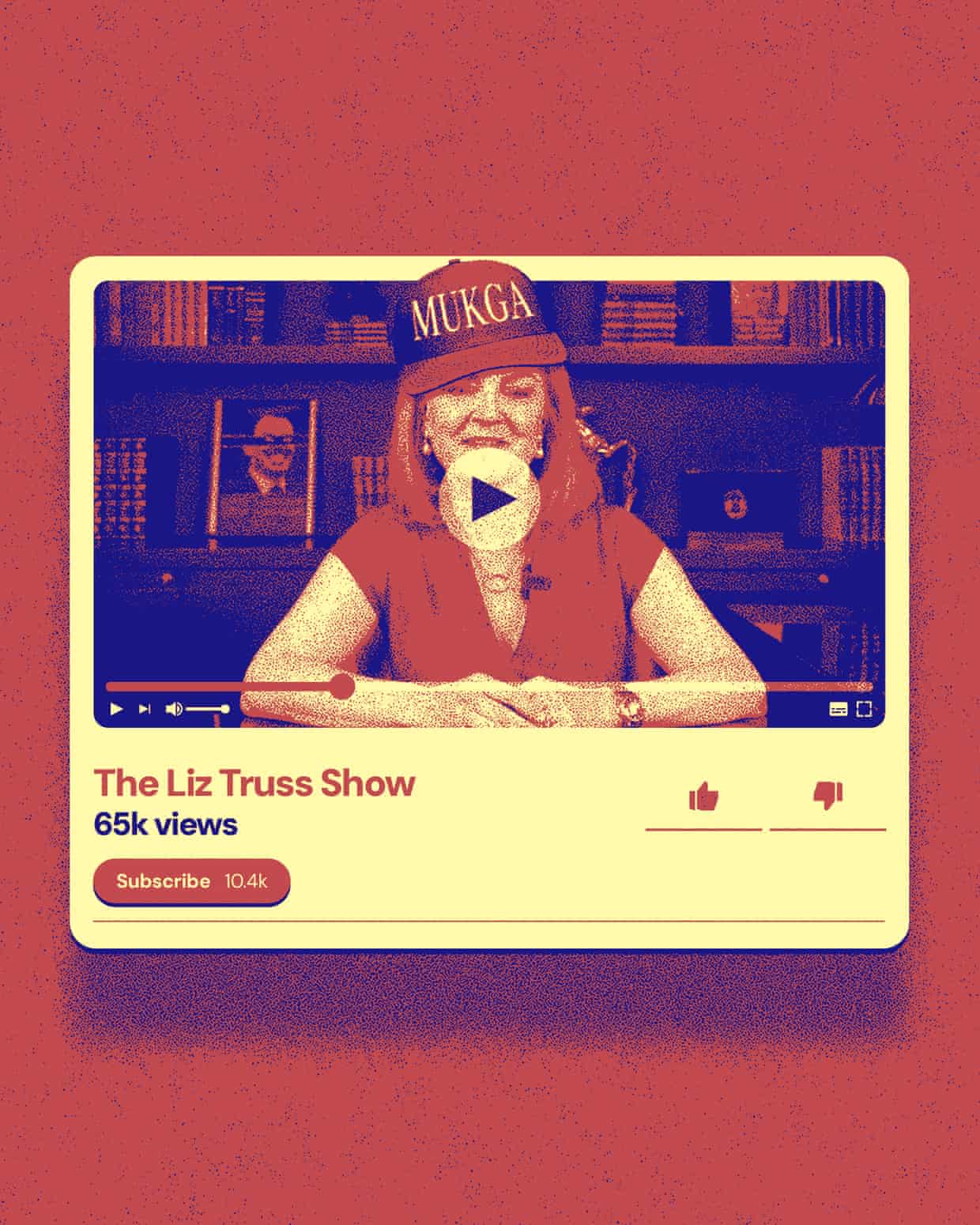
Former British Prime Minister Liz Truss has embarked on a new venture with the launch of her YouTube show, where she aims to expose what she describes as “the evil-doers” seeking to undermine democracy in Britain, the United States, and Europe. In her inaugural episode, Truss declared her intent to highlight the influence of an “international network of leftists” and promote the ideals of the MAGA movement, specifically referencing the “Trump revolution” as a model for her audience in the UK.
The show, hosted on the conservative platform Just the News, has garnered significant attention, amassing over 67,000 views in its first week and attracting 10,000 subscribers. Truss’s collaboration with John Solomon, a controversial figure in the conservative media landscape, positions her within a well-established ecosystem that promotes MAGA ideologies, often centered around claims of media censorship and a so-called “deep state.”
Solomon, whose work has previously faced scrutiny for promoting unfounded narratives, expressed enthusiasm for Truss’s efforts, calling it the start of a “revolution.” He is known for his appearances on platforms that cater to MAGA supporters, including a show alongside Steve Bannon and Tucker Carlson on Real America’s Voice. Truss has already interviewed Bannon on her podcast, further cementing her ties within this network.
The connections between Truss and figures like Solomon raise questions about the influence of MAGA media in the UK. According to Alex Hinton, a professor at Rutgers University, the MAGA movement has become a significant force in global conservative discourse. He noted that the online right’s growth in the UK parallels conditions that have allowed similar movements to thrive in the United States.
Truss’s attempts to align with MAGA talking points have not been without criticism. Observers in the UK have noted her stilted presentation style and the political baggage she carries from her brief tenure as prime minister. Critics argue that her efforts to reinvent herself as a voice for conservative media may fall flat, with Craig Oliver, former communications chief for David Cameron, suggesting that charisma is crucial for success in such roles.
Despite the skepticism, there is a growing recognition that the alternative media landscape has the potential to reshape political narratives. Rob Flaherty, a deputy campaign manager for Kamala Harris, emphasized the importance of understanding the impact of MAGA media in shaping conversations both in the US and abroad.
The production quality of Truss’s show reflects a basic but competent approach, and its launch is seen as a strategic move to enhance her political image. Her advisor, Joseph Robertson, has been instrumental in guiding her efforts, advocating for a strong stance against what they view as an administrative “deep state.”
As Truss seeks to carve out a niche within the MAGA ecosystem, she faces the challenge of overcoming public perception and establishing credibility in a highly polarized media environment. The future of her show and its impact on the UK political landscape remains to be seen, but its connection to prominent figures in the MAGA movement signals a deliberate effort to engage with a growing conservative audience.
In a world where digital media crosses borders, Truss’s foray into MAGA territory highlights the interconnected nature of conservative movements globally, with implications that could resonate well beyond the UK.