
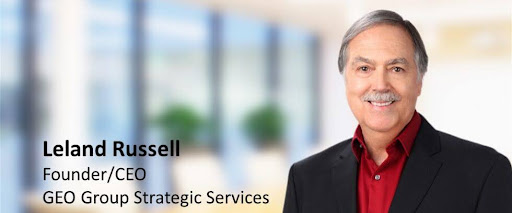
Leland Russell, a prominent leadership advisor, author, and founder, is reshaping how organizations approach human-centered leadership in the age of artificial intelligence. With a career that spans over three decades, Russell integrates strategy, creativity, and technology to help leaders navigate complex environments and foster collaborative decision-making.
Russell’s journey began before his consulting career, rooted in a strong foundation in the arts. He worked as a songwriter, performer, and concert producer, creating original songs such as “Future’s Got Your Back.” This experience taught him the power of storytelling in conveying ideas. “I learned that when I could translate ideas into emotion and story, people connected with them differently,” Russell explains. This understanding has influenced his approach to leadership, where emotional engagement is vital.
In 1990, Russell founded GEO Group Strategic Services with a focus on how leaders think together, rather than merely on planning or performance. His structured collaborative processes helped organizations align strategic thinking with execution, ensuring diverse perspectives were considered. As technology evolved, Russell posed a critical question: how can technology enhance meaningful conversations instead of promoting superficial interactions?
This inquiry led to the creation of a virtual collaboration system aimed at facilitating real-time dialogue among large groups. Russell emphasizes the importance of inviting dissent in discussions, asserting, “Without that, speed becomes recklessness. With it, speed becomes a strategic advantage.” This philosophy underpins his approach, known as Leadership in FastTime, which merges strategy, planning, and continuous learning.
Throughout his advisory career, Russell has worked with corporate leadership teams, public interest initiatives, and global collaborations. His experiences have reinforced the belief that maintaining momentum is crucial for effective leadership. “Speed matters, and not just urgency,” he states. This insight has shaped his ongoing writing, including co-authoring Winning in Fast Time and producing a series of eBooks focused on virtual leadership and strategic thinking.
Russell’s exploration of leadership has recently turned to the implications of artificial intelligence. As organizations embrace AI technologies that can execute tasks, he argues that leadership must adapt fundamentally. “AI is the engine, but the soul has to come from human beings,” he notes. He emphasizes the need for clear ethical guidelines and human judgment to navigate the accelerated pace of decision-making that AI enables.
A critical distinction Russell makes is between individual control of AI and collaborative stewardship. He believes that tapping into a team’s collective intelligence enhances decision quality and ethical oversight. “When AI is guided by a single individual, the perspective available can be narrower than what a broader group might offer,” he asserts. This collaborative approach could significantly influence how organizations harness the potential of AI.
In response to these evolving challenges, Russell established GeoALX Strategic Services and developed the ALX Leadership System, a three-part framework tailored for an AI-enabled environment. The ALX Gateway provides open-access tools, while GeoNexus facilitates collective dialogue among teams. ALX Academy serves as an immersive learning platform, allowing leaders to test new tools and engage in reflective discussions about ethical implications.
Russell believes that humanity is entering uncharted territory, making it imperative for leaders to draw upon human qualities such as empathy, intuition, and ethical judgment. “The leader’s role is slowly shifting from managing people to integrating different types of intelligence, both human and AI,” he explains. This shift underscores the importance of safeguarding the character and purpose of organizations as they adopt automation.
Currently, Russell is focused on his next writing project, which will explore the themes of Desert Storm and strategic leadership. He plans to connect these themes to his previous work, Winning in Fast Time, with the goal of helping readers leverage human-centric skills in rapidly evolving technological landscapes. “In this new project, I’m looking at how people can leverage their human-centric skills during times when technology is moving quickly,” he states, aiming to share his insights later this year.
Leland Russell’s commitment to enhancing leadership through strategy, creativity, and technology invites leaders to engage deeply with their teams and the challenges of the future. His work emphasizes the necessity of a human-centered approach in a world increasingly influenced by artificial intelligence.