
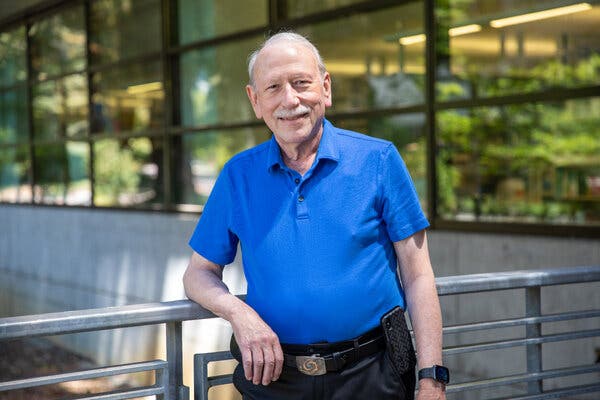
Joel R. Primack, a distinguished physicist renowned for his contributions to our understanding of the universe, passed away on November 13, 2023, in Palo Alto, California. He was 80 years old. His wife, Nancy Ellen Abrams, confirmed that pancreatic cancer was the cause of his death.
Throughout his career, Dr. Primack served as a professor of physics and astrophysics at the University of California, Santa Cruz. He played a pivotal role in a groundbreaking study published in the journal Nature in 1984. This landmark paper detailed how minute quantum fluctuations at the universe’s inception contributed to the formation of galaxies and larger cosmic structures.
At the time the paper was released, scientists had already begun to acknowledge that ordinary matter — the particles forming stars, gas clouds, and planets — represented only a fraction of the total mass in the universe. Observations indicated that the outer regions of galaxies were rotating at such high speeds that additional unseen mass was necessary to generate the gravitational forces required to hold the stars in place. This elusive substance became known as dark matter.
Despite decades of research, the exact nature of dark matter remains a mystery. However, Dr. Primack, alongside colleagues George Blumenthal and Sandra Faber at Santa Cruz, and Martin Rees from the University of Cambridge, identified critical properties of dark matter essential for explaining the observable universe.
Dr. Saul Perlmutter, an astrophysicist at the University of California, Berkeley, reflected on Primack’s contributions, stating, “That became part of this whole foundation that we’ve been using now for years.” His insights helped shape the field of astrophysics, influencing countless studies and theories about the cosmos.
As news of his passing spreads, many in the scientific community are remembering Dr. Primack not only for his academic achievements but also for his dedication to education and mentorship. His work will continue to inspire future generations of physicists and astronomers as they seek to unravel the mysteries of the universe.
In recognition of his legacy, the scientific community is likely to commemorate his contributions through ongoing research and exploration into the cosmos, ensuring that his impact endures long beyond his passing.