
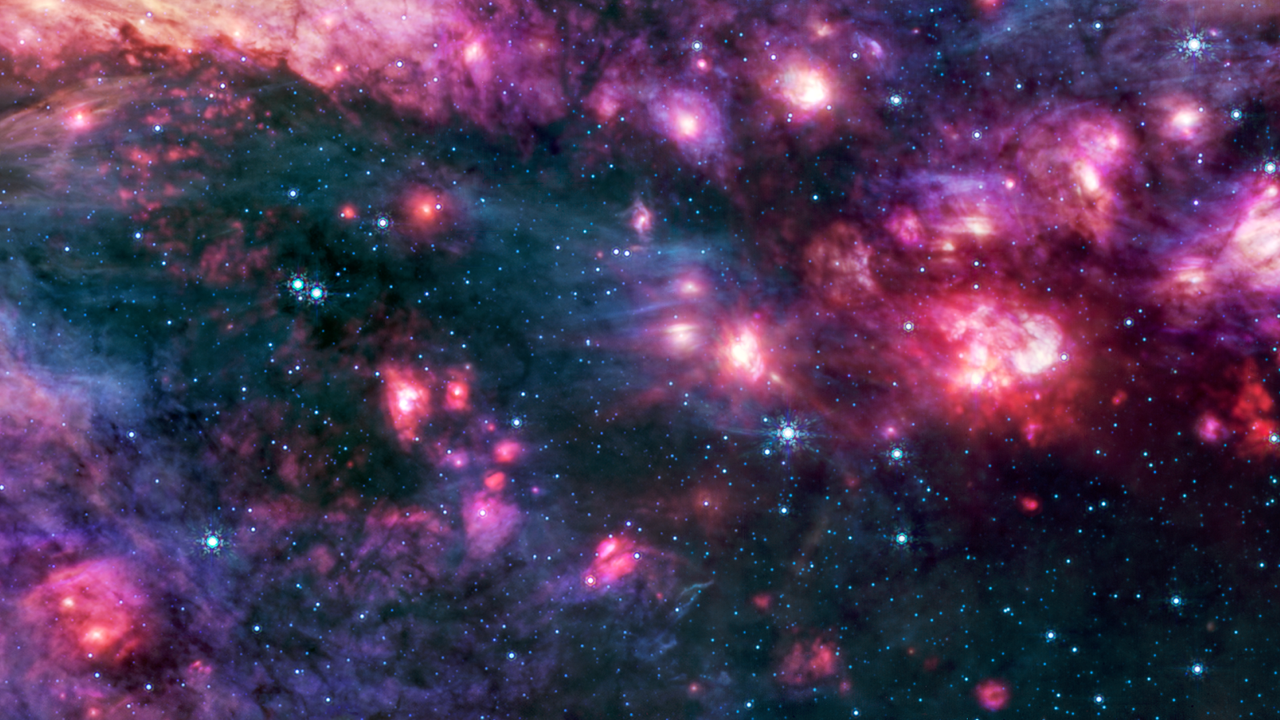
The James Webb Space Telescope (JWST) has captured stunning images of the Sagittarius B2 (Sgr B2) molecular cloud, revealing a remarkable region in the Milky Way that plays a crucial role in star formation. Located approximately 26,000 light-years from Earth in the constellation Sagittarius, this cloud is a significant area of interest for astronomers as it is responsible for creating around 50% of the stars in the Milky Way’s central region.
The Sagittarius B2 molecular cloud has a mass estimated between 3 million and 10 million times that of the sun, stretching across 150 light-years. It is not only massive but also chemically rich, with various complex molecules detected within its depths. Despite its abundance of star formation, the cloud contains only about 10% of the gas found in the galactic center, raising questions about its efficiency in stellar production.
Using the JWST’s Mid-Infrared Instrument (MIRI), researchers have obtained images highlighting the cloud’s structure. The captured view showcases clumps of dust and gas glowing in vibrant shades of pink, purple, and red. Surrounding these luminous areas are darker regions, which do not signify emptiness but rather indicate dense dust that obstructs light from reaching the instrument.
Insights from the Mid-Infrared and Near-Infrared Views
In addition to MIRI, JWST’s Near-Infrared Camera (NIRCam) simultaneously captured a near-infrared image, revealing a wealth of stars that emit more strongly in this part of the spectrum. The contrast between the two images provides valuable insights into the star-forming processes occurring within Sgr B2.
Notably, the redder clumps on the right side of the MIRI image correspond to one of the most chemically complex regions identified so far, as noted in previous observations made by other telescopes. Researchers believe this area may hold key information about why Sgr B2 exhibits such high efficiency in star formation compared to other regions of the galactic center.
An in-depth analysis of the masses and ages of the stars within this molecular cloud could further elucidate the mechanisms behind star formation in the Milky Way. By studying these stellar dynamics, astronomers aim to gain a clearer understanding of the processes that govern the birth of stars in our galaxy.
As the JWST continues to provide breathtaking views of the universe, its findings on the Sagittarius B2 molecular cloud not only highlight the telescope’s capabilities but also deepen our understanding of the cosmos. The ongoing exploration of such regions promises to uncover more mysteries and enhance our knowledge of star formation and the evolution of galaxies.
For those interested in further exploring the wonders of space, the JWST’s remarkable images and findings continue to be a significant resource in cosmic research and discovery.