
Recent observations from the James Webb Space Telescope (JWST) have revealed a significant presence of organic molecules in the nearby galaxy IRAS 07251-0248. This ultra-luminous infrared galaxy has become a focal point for researchers aiming to understand the potential origins of life beyond Earth. The findings, announced by an international team from the Consejo Superior de Investigaciones Científicas (CSIC) along with various universities, indicate that both gaseous and solid forms of organic matter are abundant within this galaxy.
The research team utilized Webb’s advanced capabilities to explore the galaxy’s core, which is obscured by dense gas and dust. Such conditions typically hinder traditional telescopes from effectively studying the central supermassive black hole (SMBH). However, by using infrared observations, the JWST can penetrate this material, allowing scientists to gather critical data about the chemical processes occurring in this extreme environment.
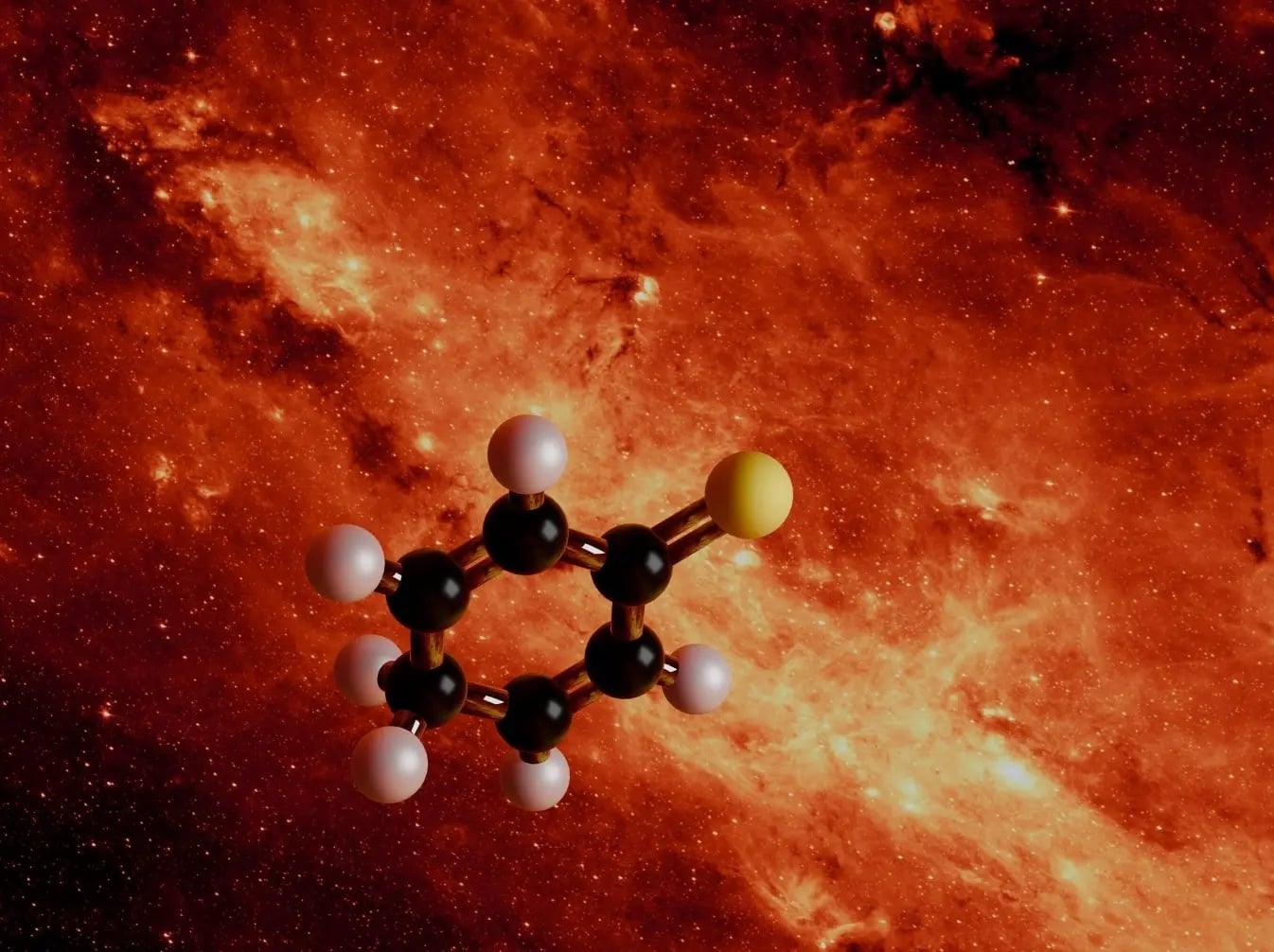
Combining data from the JWST’s Near-Infrared Spectrometer (NIRSpec) and Mid-Infrared Instrument (MIRI), the researchers were able to identify a variety of chemical species within the galaxy’s nucleus. Notably, they detected hydrocarbons, which are essential components in the formation of complex organic chemistry. Among the organic molecules identified were the methyl radical (CH3), benzene (C6H6), methane (CH4), acetylene (C2H2), diacetylene (C4H2), and triacetylene (C6H2).
The study revealed not only gaseous organic molecules but also a substantial presence of organics in solid forms, including carbonaceous grains and water ices. Dr. Ismael García Bernete, the lead author and researcher at CAB, noted, “We found an unexpected chemical complexity, with abundances far higher than predicted by current theoretical models.” His observations suggest a continuous source of carbon is present in these galactic nuclei, which fuels the rich chemical network observed in IRAS 07251-0248.
Co-author Professor Dimitra Rigopoulou from the University of Oxford emphasized the implications of these findings for prebiotic chemistry. “Although small organic molecules are not found in living cells, they could play a vital role in prebiotic chemistry, representing an important step towards the formation of amino acids and nucleotides,” she explained.
The research team also leveraged theoretical models developed by Oxford researchers regarding polycyclic aromatic hydrocarbons (PAHs). Their results challenge the notion that the observed organic molecules are solely a product of high temperatures or turbulent gas motions. Instead, the data suggests that PAHs and carbon-rich dust grains have been fragmented by cosmic-ray exposure, releasing these molecules into the gaseous state. This interpretation aligns with previous studies indicating a correlation between the presence of gaseous hydrocarbons and cosmic-ray ionization intensity in similar galaxies.
These findings not only highlight the potential for dusty galactic nuclei to produce organic molecules in abundance but also showcase the JWST’s effectiveness in exploring environments that were previously inaccessible to scientists. The implications of this research are significant, as they open new avenues for studying the formation and processing of organic molecules in extreme environments.
As these discoveries add to the growing body of evidence that the building blocks of life can be found in space, they offer encouragement to scientists engaged in the search for extraterrestrial life. The ability to study such complex chemical processes enhances our understanding of how galaxies may be seeded with the essential ingredients for life.
Further details on this groundbreaking research can be found in the journal Nature Astronomy.