
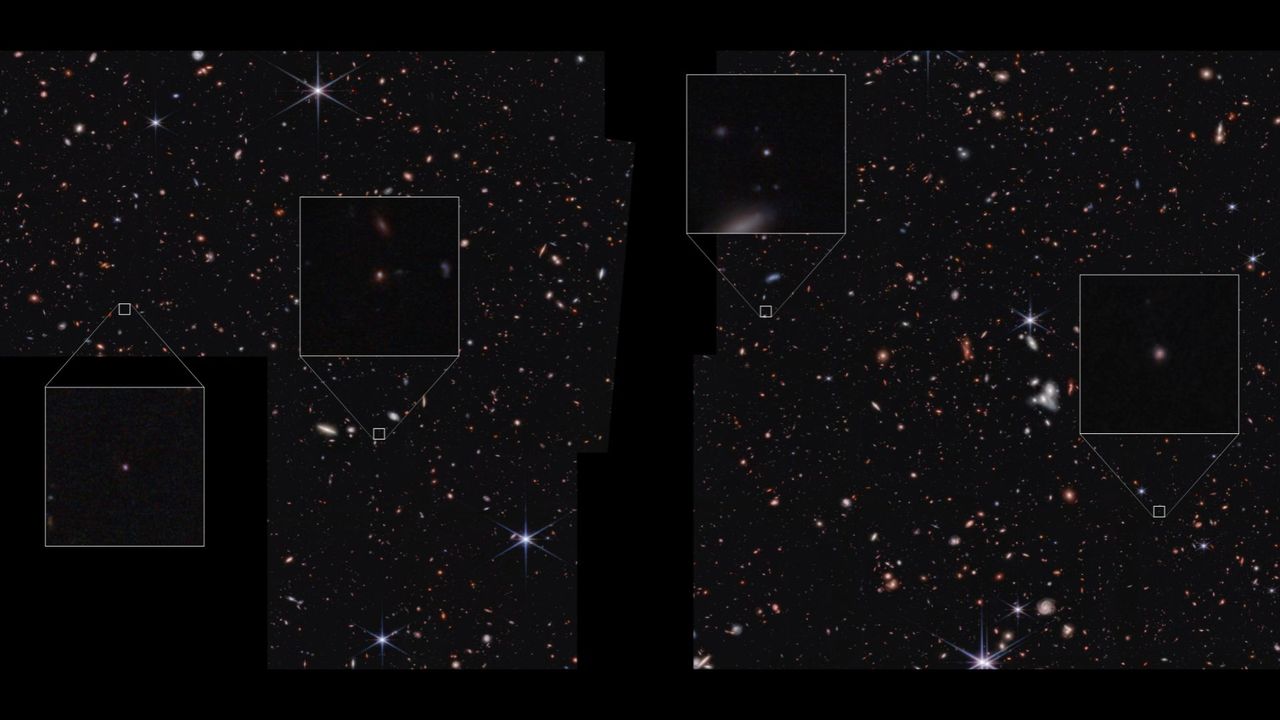
NASA’s James Webb Space Telescope (JWST) has identified a series of enigmatic cosmic objects that are intriguing astronomers and challenging existing classifications in the field of astrophysics. Dubbed “platypus” galaxies, these objects exhibit characteristics reminiscent of both stars and galaxies, leading researchers to explore their origins and implications for our understanding of the universe’s early formation.
During a news conference on January 6, 2024, at the annual meeting of the American Astronomical Society in Phoenix, astronomer Haojing Yan from the University of Missouri elaborated on these peculiar findings. The objects initially appeared as small points of light in JWST data, resembling stars. However, upon closer inspection, they revealed more galaxy-like features, prompting researchers to conduct further investigations.
Yan, alongside his students, analyzed approximately 2,000 compact sources in search of anomalies. This effort led to the identification of nine unusual objects that were slightly larger than typical point sources. Traditionally, such compact entities are classified as stars, but the researchers found evidence indicating that these objects were larger and more diffuse. “It’s very close to a point source, but not exactly,” Yan explained.
The researchers discovered that instead of the broad emission lines typical of stars, these objects displayed narrower lines associated with active star formation, a characteristic often found in galaxies. This finding directed their attention toward quasars—compact, bright objects powered by supermassive black holes at the centers of galaxies. Although the newfound objects exhibited some similarities to known quasars, they did not fit the established classification. For instance, they were dimmer than expected, and their spectral fingerprints showed narrower lines than those typically associated with even narrow-line quasars.
“Our objects are not quasars,” Yan stated firmly. Visual evidence from JWST data supports this conclusion, showing that the spectral peaks of these objects differ significantly from those of typical quasars.
The possibility remains that these mysterious objects could belong to a different category known as narrow-line active galactic nuclei (AGN). However, known narrow-line AGNs usually appear as point sources rather than point-like. If the newfound objects do fall within this classification, Yan believes they might represent a new type of astronomical object.
Another hypothesis suggests that these peculiar objects could be young star-forming galaxies. Star-forming galaxies, which create new stars at an accelerated rate, also produce narrow emission lines, akin to the diverse bill of a platypus. According to Bangzheng Sun, also from the University of Missouri, if these objects are indeed star-forming galaxies, they are likely no older than 200 million years. “They are still in their infancy,” Sun remarked.
Interestingly, the slightly expanded size of these objects poses further questions. Sun noted that if they are galaxies, the process of star formation appears to be occurring from the inside out, a phenomenon that has not been previously observed. “This is a process we have not seen before,” he stated.
Yan elaborated on the implications of this inside-out process, suggesting that it could occur in multiple galaxies. While typical stellar production is often chaotic and violent, the behavior of these objects implies that they may undergo star formation in a more orderly manner, preserving their point-like appearance.
Though the researchers believe they have identified a new population of these cosmic entities, the debate continues over whether they represent a novel form of AGN or unusual young galaxies. They express hope that ongoing observations with JWST will yield further insights. “These nine objects are special,” Yan concluded, referring to them as their “platypuses.”
As astronomers continue to unravel the mysteries of these cosmic oddities, the findings could offer new perspectives on galaxy formation and the evolution of the universe in its formative years.