
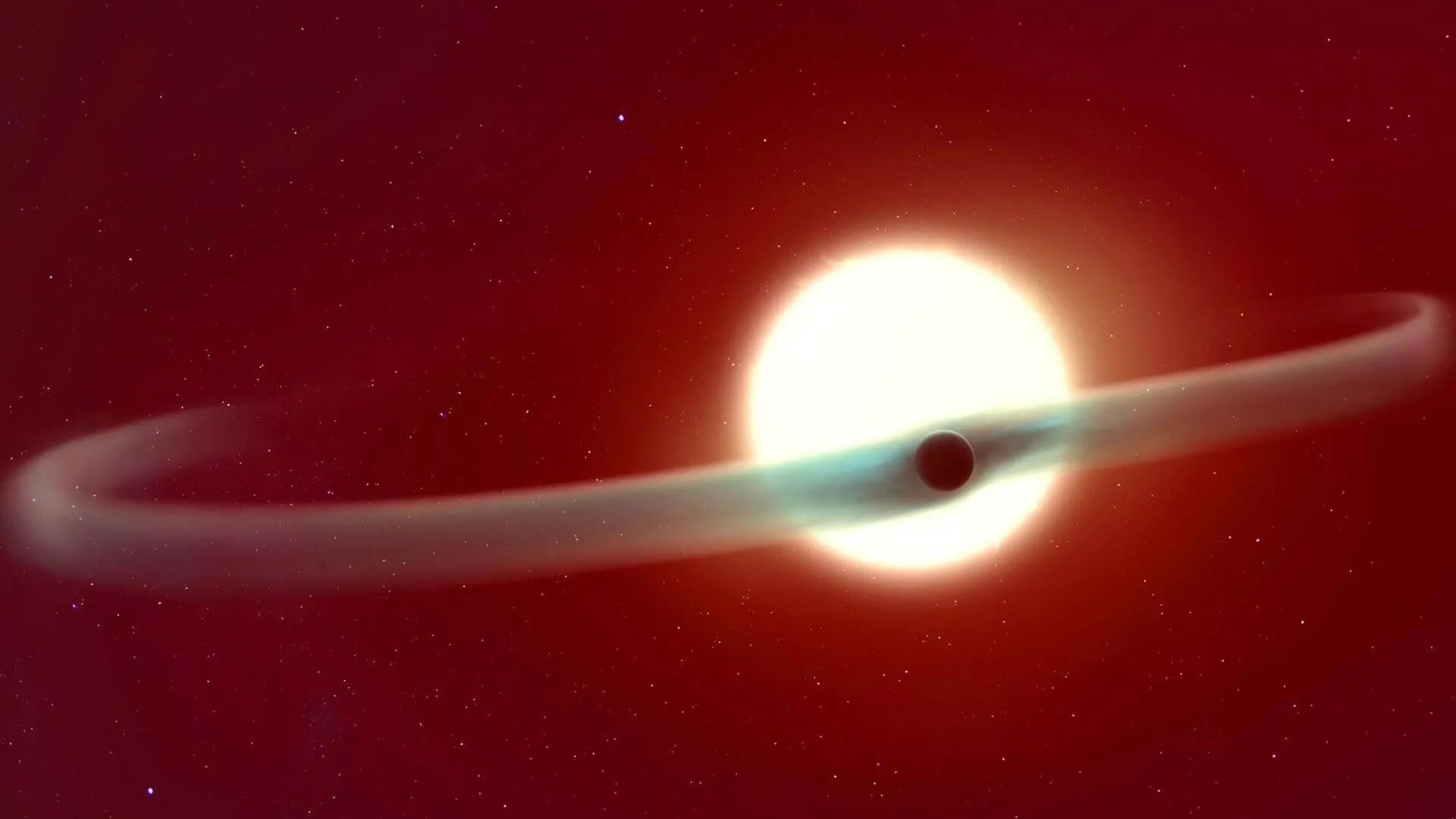
Astronomers have made a groundbreaking observation of an exoplanet losing its atmosphere in real time, focusing on the ultra-hot gas giant WASP-121b. Utilizing the advanced capabilities of the James Webb Space Telescope (JWST), researchers tracked the planet for nearly 37 hours, marking the first continuous observation of atmospheric escape around an exoplanet.
The study, conducted by teams from the University of Geneva (UNIGE), the National Centre of Competence in Research PlanetS, and the Trottier Institute for Research on Exoplanets (IREx) at the University of Montreal (UdeM), revealed an unexpected structure: rather than a single stream of escaping gas, WASP-121b is enveloped in two massive helium tails. This discovery provides an unprecedented view of how exoplanets interact with their stellar environments.
A Dramatic Discovery of Helium Tails
WASP-121b is classified as an ultra-hot Jupiter, a category of gas giants that orbit very close to their stars. With an orbital period of just 30 hours, the planet experiences intense radiation, heating its atmosphere to several thousand degrees. This extreme temperature allows lighter elements such as hydrogen and helium to escape into space. Over time, such atmospheric loss can significantly alter a planet’s size and composition.
Until now, atmospheric escape studies were limited to brief observations during planetary transits, which provided only a snapshot of the phenomena. This latest research breaks new ground by enabling scientists to monitor the atmospheric escape throughout an entire orbit. The data, published in Nature Communications, offers a detailed view of the mechanisms affecting exoplanet atmospheres.
By employing the Near-Infrared Spectrograph (NIRISS) aboard the JWST, the research team identified that the helium escaping from WASP-121b spreads far beyond the planet itself. The helium signal persists for more than half of the planet’s orbit, revealing two distinct tails. One tail trails behind the planet, propelled by stellar radiation, while the other extends forward, likely influenced by the star’s gravitational pull. Together, these helium streams stretch over a distance greater than 100 times the planet’s diameter, significantly more than three times the distance between WASP-121b and its star.
Implications for Exoplanet Research
Romain Allart, a postdoctoral researcher at the University of Montreal and lead author of the study, expressed surprise at the extended duration of helium escape. He stated, “This discovery reveals the complexity of the physical processes that sculpt exoplanetary atmospheres and their interaction with their stellar environment.”
The findings challenge existing numerical models that have traditionally described atmospheric escape in simpler, comet-like terms. According to Yann Carteret, a doctoral student at UNIGE and co-author of the study, the double-tailed structure suggests that both gravitational forces and stellar winds play a role in shaping these escaping gases. This underlines the need for a new generation of three-dimensional simulations to better understand these dynamics.
Helium has emerged as a valuable tool for tracking atmospheric loss, and the sensitivity of the JWST now allows for unprecedented detection capabilities. Future observations will be essential in determining whether the twin-tail structure seen around WASP-121b is a rarity or a common phenomenon among hot exoplanets.
Vincent Bourrier, a lecturer and researcher at UNIGE, concluded, “New observations often reveal the limitations of our numerical models and push us to explore new physical mechanisms to enhance our understanding of these distant worlds.” As astronomers continue to delve deeper into the complexities of exoplanet atmospheres, the insights gained from WASP-121b may pave the way for significant advancements in the field.