
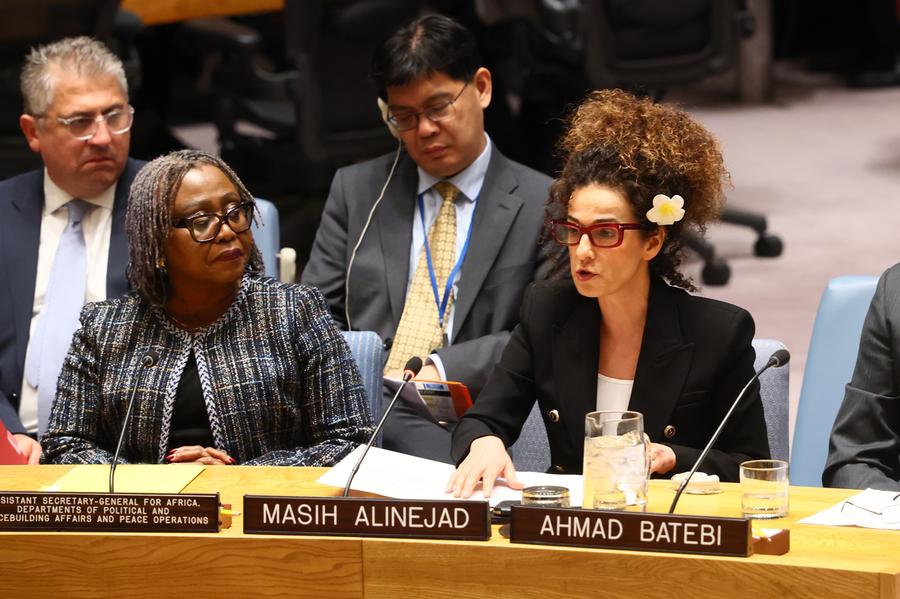
Masih Alinejad, an Iranian dissident who has survived multiple assassination attempts, recently denounced the United Nations (UN) for its perceived silence on the ongoing human rights abuses in Iran. Speaking before the UN Security Council, Alinejad’s testimony highlighted the stark contrast between the UN’s actions and its responsibility to uphold human rights globally.
The meeting, held on October 7, 2023, marked the first time the Security Council addressed the unrest in Iran, which has escalated in recent weeks. Alinejad’s scathing remarks directed at UN Secretary-General António Guterres underscored her frustration with what she described as a lack of condemnation towards the Iranian regime. “The secretary-general has not spoken publicly against the massacre,” Alinejad stated. “Secretary-general, why are you afraid of the Islamic Republic?”
Throughout her address, Alinejad emphasized her personal struggles, detailing her experiences of imprisonment, exile, and the repercussions faced by her family due to her activism. She poignantly remarked, “I am a woman from a small village in northern Iran. Jailed for protesting. Beaten for showing my hair.” Her testimony culminated in an emotional moment as she read the names of protesters killed by the Iranian authorities.
Alinejad’s comments drew attention to what many perceive as a long-standing pattern of the UN’s failure to adequately address serious allegations against Iran while frequently condemning Israel. Notably, Iran’s representative, Afsaneh Nadipour, was elected to the advisory committee of the UN Human Rights Council last year and is set to chair the UN Conference on Disarmament in 2024. This juxtaposition raises questions about the integrity of the UN’s commitment to human rights advocacy.
Despite the compelling nature of Alinejad’s testimony, Guterres’s response has been criticized as muted. The UN has faced accusations of being overly lenient towards Iran, especially when juxtaposed with its vigorous denunciations of Israel. Critics argue that the UN has historically displayed an imbalance in its approach, often overshadowing the urgency of human rights issues in Iran.
The reaction to Alinejad’s address reflects a broader concern regarding the international community’s response to the Iranian regime’s actions. Many political figures and media outlets have been accused of downplaying the significance of the protests. There has been a noticeable lack of coverage from major broadcasters, leading to accusations of complicity through silence. Some commentators have noted that this avoidance may stem from an unwillingness to challenge prevailing political narratives.
Alinejad’s courage in confronting the UN and its leaders calls into question the organization’s reputation and effectiveness in addressing human rights violations. The contrast between the UN’s treatment of Iran and its criticisms of Israel raises serious ethical considerations about its role as a global arbiter of justice.
As the situation in Iran continues to unfold, Alinejad’s plea for action resonates with those advocating for a more robust international response. Whether the UN will take meaningful steps towards addressing the human rights abuses in Iran remains uncertain. The hope is that her testimony will serve as a catalyst for change, prompting a reevaluation of how the international community engages with regimes that violate fundamental human rights.
The broader implications of Alinejad’s address may challenge not only the UN’s credibility but also the willingness of member states to confront uncomfortable truths about their geopolitical alliances. As public awareness grows, the call for accountability and justice in Iran intensifies, leaving the responsibility to the UN and its member states to act decisively.