
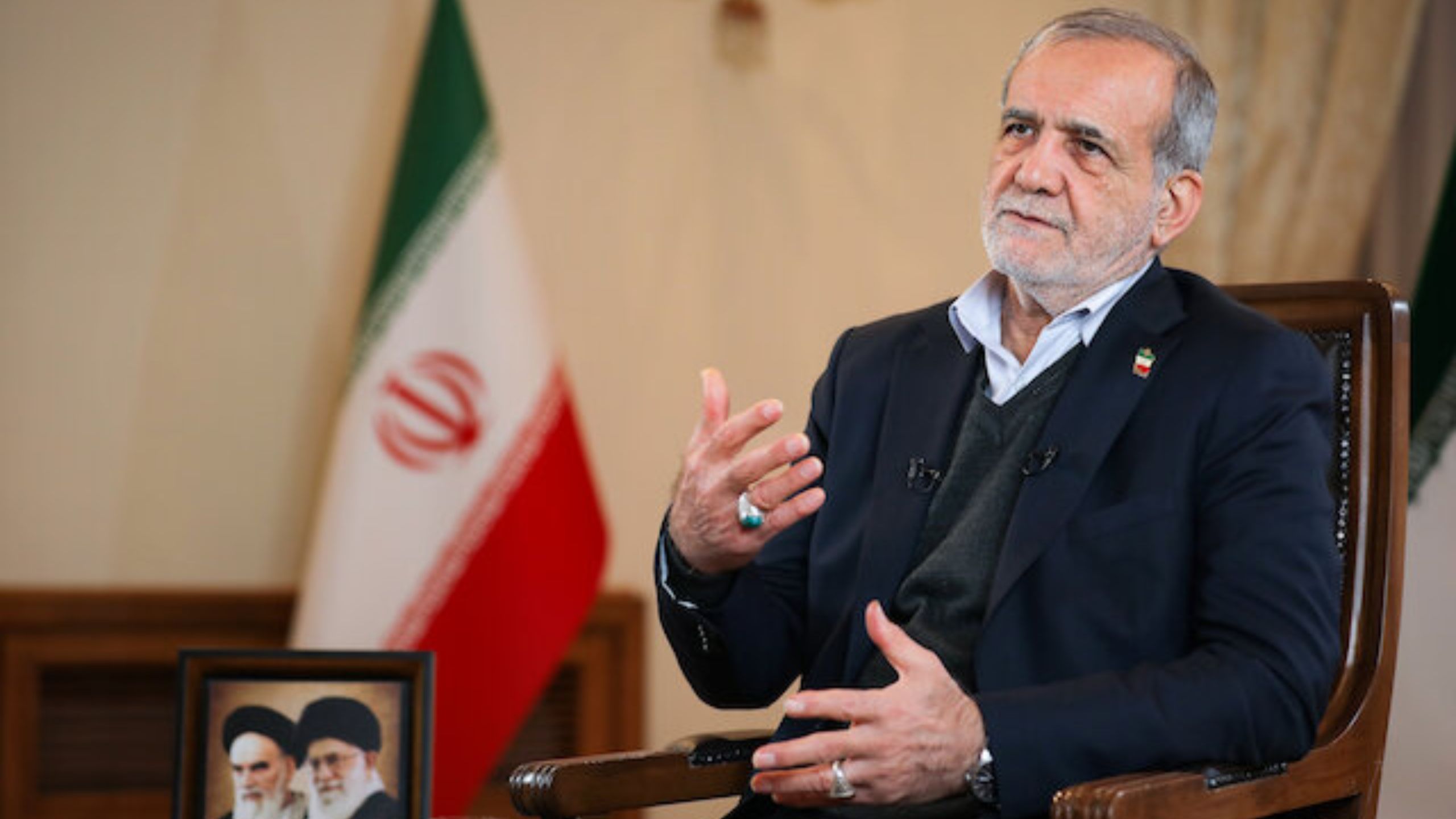
UPDATE: Iranian President Masoud Pezeshkian has declared that Iran is in a state of ‘total war’ with the United States, Israel, and Europe, heightening global security concerns. This alarming statement was made in an interview published on December 27, 2025, where Pezeshkian accused Western powers of attempting to destabilize Iran through various means, including diplomatic and economic pressures.
The president’s remarks, which underscore a profound shift in Tehran’s rhetoric, were featured on the official website of Iran’s Supreme Leader, Ayatollah Ali Khamenei. Pezeshkian asserted, “In my opinion, we are at total war with the United States, Israel, and Europe; they want to bring our country to its knees.” This declaration signals a marked escalation in hostilities, particularly following the recent June 2025 conflict that resulted in over 1,000 deaths in Iran and 28 fatalities in Israel due to missile exchanges.
The timing of Pezeshkian’s statement coincides with impending meetings between US President Donald Trump and Israeli Prime Minister Benjamin Netanyahu, where Iran’s actions are expected to dominate discussions. Following direct hostilities with US forces, the situation has rapidly evolved, with recent US strikes targeting Iranian nuclear facilities deemed crucial to neutralizing perceived threats.
Iran’s ongoing nuclear ambitions have led to renewed sanctions from France, Britain, and Germany reinstated in September 2025. Tehran has condemned these actions as further evidence of Western hostility and interference. Historically, relations between Iran and Western nations have been fraught since the 1979 revolution, characterized by resistance to US influence in the Middle East.
As the economic pressures intensify, Pezeshkian’s harsh rhetoric reflects both external tensions and significant internal challenges. Iran is grappling with rampant inflation and a sinking currency, which have severely impacted the cost of living. Official statistics show that everyday essentials have skyrocketed, adding to the strain on Iranian families. In response, Pezeshkian has proposed a 20-point economic plan aimed at stabilizing the economy and supporting lower-income families, though details on implementation remain vague.
Internationally, the declaration of ‘total war’ has raised alarms among Western capitals, who interpret this rhetoric amidst a backdrop of recent military confrontations. While the US government maintains that negotiations regarding Iran’s nuclear program could be possible, they assert that stringent conditions must be met, including limits on uranium enrichment, which Tehran firmly rejects.
The planned discussions between Trump and Netanyahu are framed as crucial opportunities to devise new strategies to counteract what is perceived as Tehran’s destabilizing actions in the region. Iran’s alliances with non-state actors such as Hamas and Hezbollah further complicate the landscape, as these relationships are factored into regional security assessments and strategic planning.
As tensions mount and the rhetoric intensifies, the world watches closely. The implications of Pezeshkian’s statements could reshape not only regional dynamics but also global security strategies in the face of escalating threats. Stay tuned for more updates as this developing situation unfolds.