
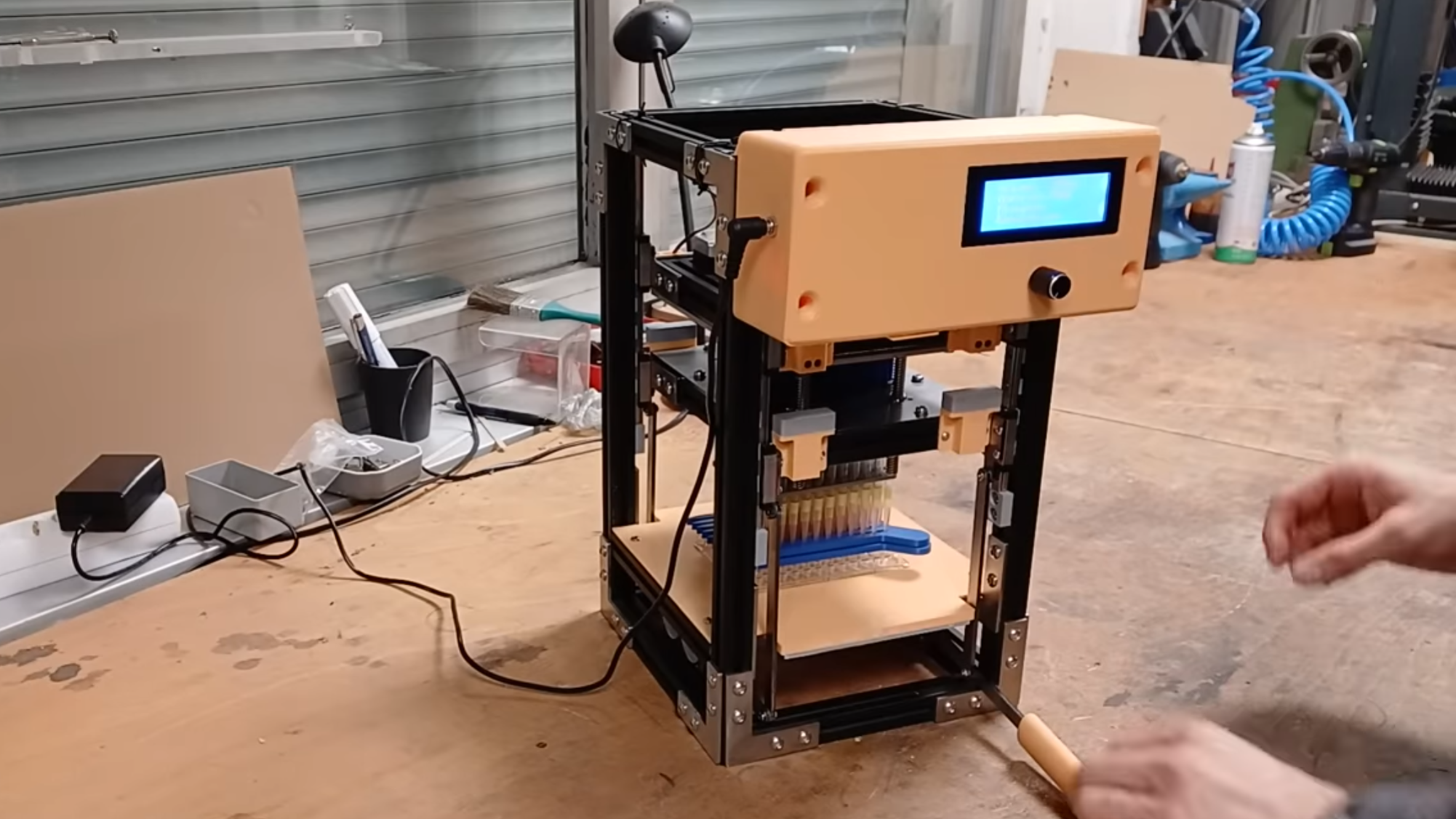
A new innovation in laboratory technology has emerged, as inventor Triggy has successfully developed a 96-channel multi-pipette that significantly reduces costs for parallel experimentation. Traditional multi-channel pipettes can range up to $18,000, while Triggy’s design comes in at just $300. This breakthrough aims to make scientific experimentation more accessible for individuals conducting their own research.
The high cost of drug development and chemical testing is largely attributed to the extensive number of experiments required. Developing a new drug often necessitates the synthesis and testing of hundreds, if not thousands, of chemical compounds. To streamline this process, conducting multiple experiments in parallel can save both time and resources. A multi-channel pipette simplifies this by allowing researchers to collect and dispense liquids into numerous vessels simultaneously.
Triggy’s design features an eight-by-twelve grid of syringes, all assembled on a sturdy aluminum frame. The innovative dispensing mechanism utilizes four stepper motors to actuate the plungers, allowing for precise control during liquid dispensing. The entire assembly is designed to move vertically, enabling easy placement of a multi-well plate underneath the dispensing tips.
Testing the accuracy of the multi-pipette presented some challenges for Triggy, as he lacked sophisticated testing equipment. However, preliminary tests showed promising results. To demonstrate the functionality of his invention, Triggy 3D-printed two plates with parallel channels filled with varying concentrations of watercolors. This experiment showcased the multi-pipette’s capability to blend colors seamlessly, producing a smooth gradient across the wells.
The potential applications of Triggy’s multi-channel pipette extend beyond simple demonstrations. It allows users to test up to 96 variations of a single experiment concurrently, which could prove invaluable for researchers and hobbyists alike. Nevertheless, it is crucial to note that this device was specifically designed for home use and would require extensive validation and certification before being deployed in professional settings.
The need for affordable laboratory solutions has been highlighted in recent discussions on the challenges facing scientific research. While Triggy’s innovation addresses cost, the broader issue of precision and regulatory compliance remains significant in the medical development field. The high expenses associated with drug development also stem from the rigorous standards that must be met to ensure safety and efficacy.
This initiative reflects a growing trend towards miniaturization in biology and laboratory automation. Innovations in this space not only enhance accessibility for budding scientists but also contribute to the democratization of scientific research. Many similar projects, including homemade robots capable of automating lab tasks, demonstrate the potential for individuals to engage in high-level scientific inquiry without the constraints of traditional funding and resources.
As the scientific community continues to explore cost-effective solutions, Triggy’s multi-channel pipette serves as a testament to creativity and resourcefulness. This development could inspire further innovations in laboratory technology, making experimentation more feasible for those outside the confines of institutional research.
Thanks to Mark McClure for highlighting this impressive achievement.