
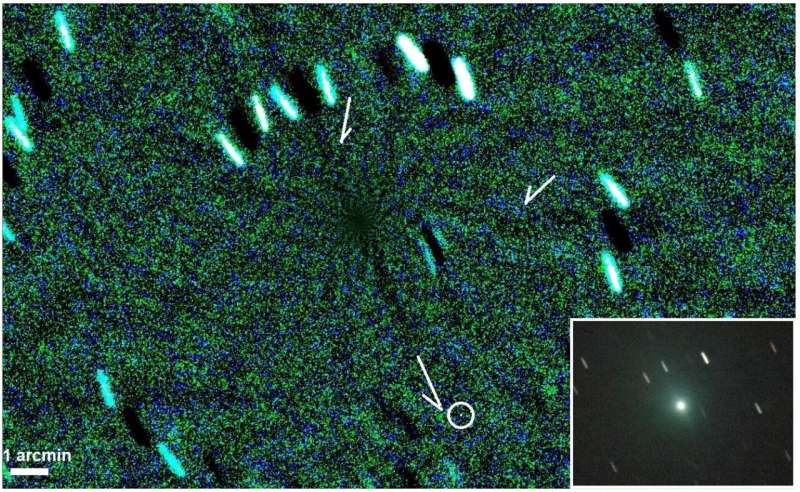
Recent analysis of the interstellar object known as Comet 3I/ATLAS suggests that its surface may be covered in erupting icy volcanoes, or cryovolcanoes. This finding could significantly alter our understanding of how comets formed within our own solar system. The comet, which was observed from July to November 2025, provides a unique opportunity to study an object that originated from another star.
Comet 3I/ATLAS is particularly valuable for research due to its pristine condition. Having never approached a star closely enough to experience heating or melting, it remains nearly unchanged since its formation billions of years ago. This characteristic makes it an exceptional specimen for examining the processes that govern comet formation and evolution.
Significant Observations
The research team documented a notable surge in brightness from Comet 3I/ATLAS when it reached approximately 2.5 times the Earth’s distance from the sun, or 2.5 astronomical units (au). Rather than a sudden explosion, this increase in brightness was sustained, indicating widespread activation of the water-ice layer across the comet’s surface.
Scientists attribute this phenomenon to cryovolcanism, which differs from traditional volcanic activity found on Earth. Unlike other comets that possess a protective dust mantle, Comet 3I/ATLAS lacks this feature, allowing the global activation of its icy surface.
The researchers analyzed the light reflected from the comet and compared it to the spectral data of meteorite samples on Earth. They found a match with a rare type of meteorite known as a carbonaceous chondrite (CR), which is rich in metals such as iron and nickel. This correlation suggests that Comet 3I/ATLAS has a similar metal-rich composition.
Implications for Comet Formation
The findings have implications for our current models of comet formation. Traditionally, comets are thought to consist of ice, rock, and low metal concentrations, with their activity driven by solar heating. The new research indicates a more complex formation process, where the presence of metal within the comet fuels its cryovolcanic activity.
As the comet’s surface warms, ice transforms into water, which may corrode the fine metal grains inside the comet. This chemical reaction can release additional energy and gases, such as carbon dioxide, further driving the cryovolcanism observed.
The study’s authors, including researcher Josep M. Trigo-Rodríguez, noted that interstellar visitors like Comet 3I/ATLAS challenge and refine our understanding of how planetary systems form and evolve. As more data emerges from such unique objects, scientists can expect to gain deeper insights into the diversity of celestial bodies and their origins.
This research was published on December 3, 2025, and is available on the arXiv preprint server, contributing to the growing body of knowledge about interstellar phenomena. The ongoing study of this comet underscores the importance of international collaboration in space research and the need for continued exploration of our cosmic neighborhood.