
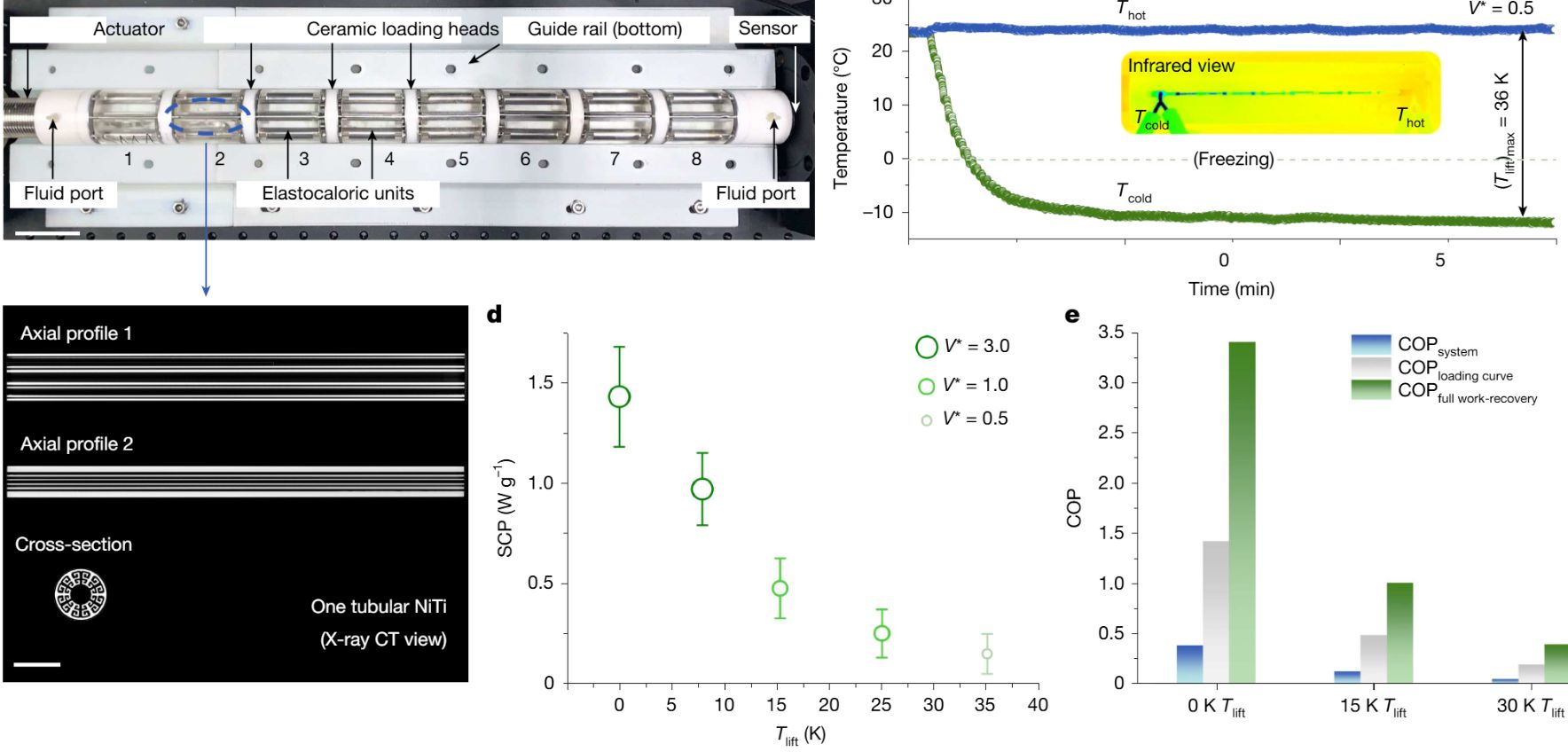
Elastocaloric materials have taken a significant leap forward, demonstrating the ability to reach freezing temperatures in a newly developed cooling device. Researchers, led by Guoan Zhou, have successfully utilized nickel-titanium (NiTi) shape-memory alloys to construct a solid-state cooler capable of achieving temperatures as low as -12°C within just 15 minutes from room temperature. This innovation could pave the way for alternatives to traditional vapor-compression refrigeration systems and Peltier coolers.
Breakthrough in Solid-State Cooling Technology
The recent study, published in Nature, details a cascade cooler that consists of eight stages, each featuring three tubular, thin-walled NiTi structures. This design allows for efficient thermal energy transfer by absorbing and releasing heat as the mechanical stress is applied. A ceramic head exerts a pressure of 900 MPa, which is crucial for facilitating this energy transfer. The innovative use of calcium chloride (CaCl2) as a heat-exchange fluid further enhances the system’s efficiency.
Historically, the challenge of reaching freezing temperatures with elastocaloric materials has been significant. Conventional methods often fell short, but this new approach addresses that limitation. The research indicates that the NiTi alloys are particularly well-suited for elastocaloric applications, suggesting a robust future for this technology in stationary refrigeration.
Future Implications and Development
As researchers explore the potential applications of this cooling technology, the implications for various industries could be substantial. The solid-state nature of the elastocaloric cooler presents an environmentally friendly alternative to conventional refrigerants, which often have detrimental effects on the environment.
While the initial results are promising, the extent to which this technology can be further developed remains to be seen. The research team is optimistic about the possibilities, but further testing and refinement will be necessary to fully understand the long-term viability of elastocaloric systems in real-world applications.
In summary, the work of Guoan Zhou and his team marks a pivotal moment in cooling technology, opening the door to more sustainable and efficient refrigeration solutions. The findings from this study will likely inspire continued research and development in the field, with the potential to transform how we approach temperature control in various settings.