
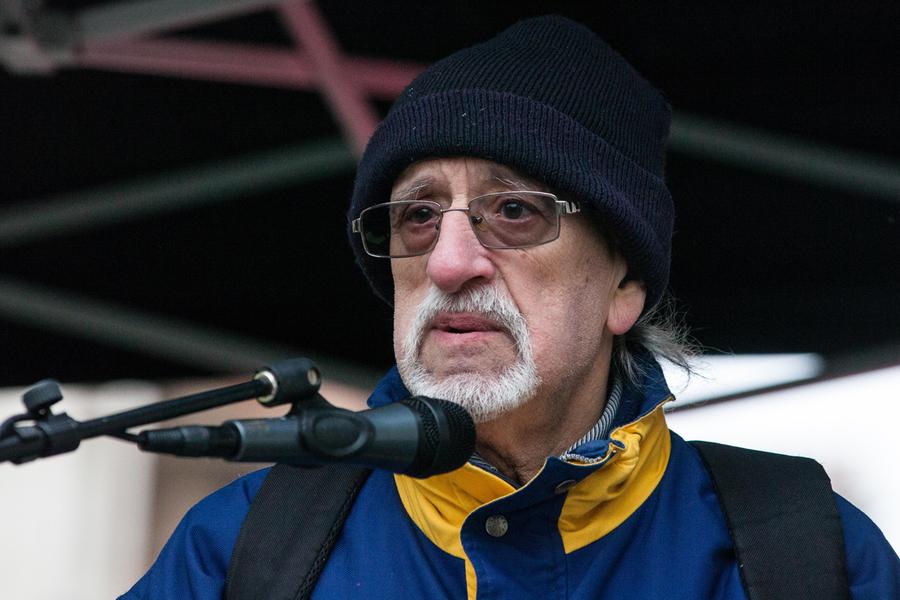
Gerry Gable, a prominent journalist and anti-fascist campaigner, passed away on January 3, 2026, at the age of 88. Renowned for his unwavering commitment to defending democracy and exposing the threats posed by far-right extremism, Gable’s life was marked by numerous challenges, including death threats and legal battles. His legacy as one of the most vocal advocates against fascism spans nearly five decades and extends to both national and international arenas.
Born on January 27, 1937, in the East End of London, Gable was raised in a family with a diverse religious background, having a Jewish mother and an Anglican father. His deep-rooted pride in his Jewish heritage influenced his lifelong activism. Initially a member of the Young Communist League and the Communist Party, Gable’s political alignment shifted in the 1960s due to concerns over the party’s anti-Israel stance. He famously stated, “I have first and foremost always been a Jewish trade unionist.”
Career and Impact
Gable’s activism took shape in the 1960s when he became involved with the 62 Group, a militant anti-fascist organization formed in response to the rise of fascist street violence. Gathering intelligence on far-right movements, Gable played a key role in confronting these groups to safeguard the Jewish community and combat racism. This groundwork laid the foundation for the creation of Searchlight, a magazine co-founded in 1975 by Gable and several Labour MPs, including Reg Freeson and Joan Lestor, which aimed to expose and combat far-right extremism.
For nearly 50 years, Gable served as the editor of Searchlight, stepping down only in March 2025. Under his leadership, the publication evolved from a quarterly magazine focused on British far-right extremism to a monthly issue that addressed global issues of racism, antisemitism, and fascism. Gable’s investigative efforts led to significant revelations, including his controversial infiltration of far-right groups and the exposure of their activities.
One of the more notable incidents in Gable’s career occurred in 1963, when he, along with two others, gained unauthorized access to the home of Holocaust denier David Irving, leading to legal repercussions. Gable was fined for burglary, yet this incident underscored his relentless pursuit of truth and justice.
Controversies and Collaborations
Gable’s work was not without controversy. In 1984, he was involved in a BBC Panorama investigation that accused Conservative MPs Neil Hamilton and Gerald Howarth of harboring extremist views. The allegations resulted in a libel case against the BBC, which ultimately led to a financial settlement for the two MPs. Despite the setbacks, Gable’s tenacity in challenging the far-right was evident in his collaboration with the BBC’s investigations into the British National Party, which resulted in significant arrests.
In 2003, Gable faced scrutiny when the Charity Commission of England and Wales determined that the political activities of Searchlight’s associated trust exceeded its charitable remit. Nevertheless, Searchlight continued its mission, focusing on research and intelligence gathering while actively opposing various far-right demonstrations, notably those organized by the English Defence League.
Gable also received recognition for his contributions to anti-fascist efforts. In 2011, he was awarded an honorary doctorate by Northampton University, which has since become a digital archive for Searchlight’s extensive collection. His impact extended beyond the Jewish community; he served as an independent adviser to the Metropolitan Police’s Hate Crime Independent Advisory Group and was involved with Tell Mama, an organization combatting anti-Muslim hatred.
Following his passing, numerous organizations lauded Gable’s contributions. Mark Gardner, chief executive of the Community Security Trust, described him as a “towering figure” in the fight against fascism, while Searchlight hailed him as a critical figure in post-war anti-fascism. Other tributes came from various leaders, including Nick Lowles, CEO of Hope Not Hate, and Paul Nowak, general secretary of the TUC, who highlighted Gable’s pivotal role in exposing the tactics of far-right groups.
Gerry Gable is survived by his wife, Sonia, and leaves behind a profound legacy that continues to influence anti-fascist movements worldwide.