
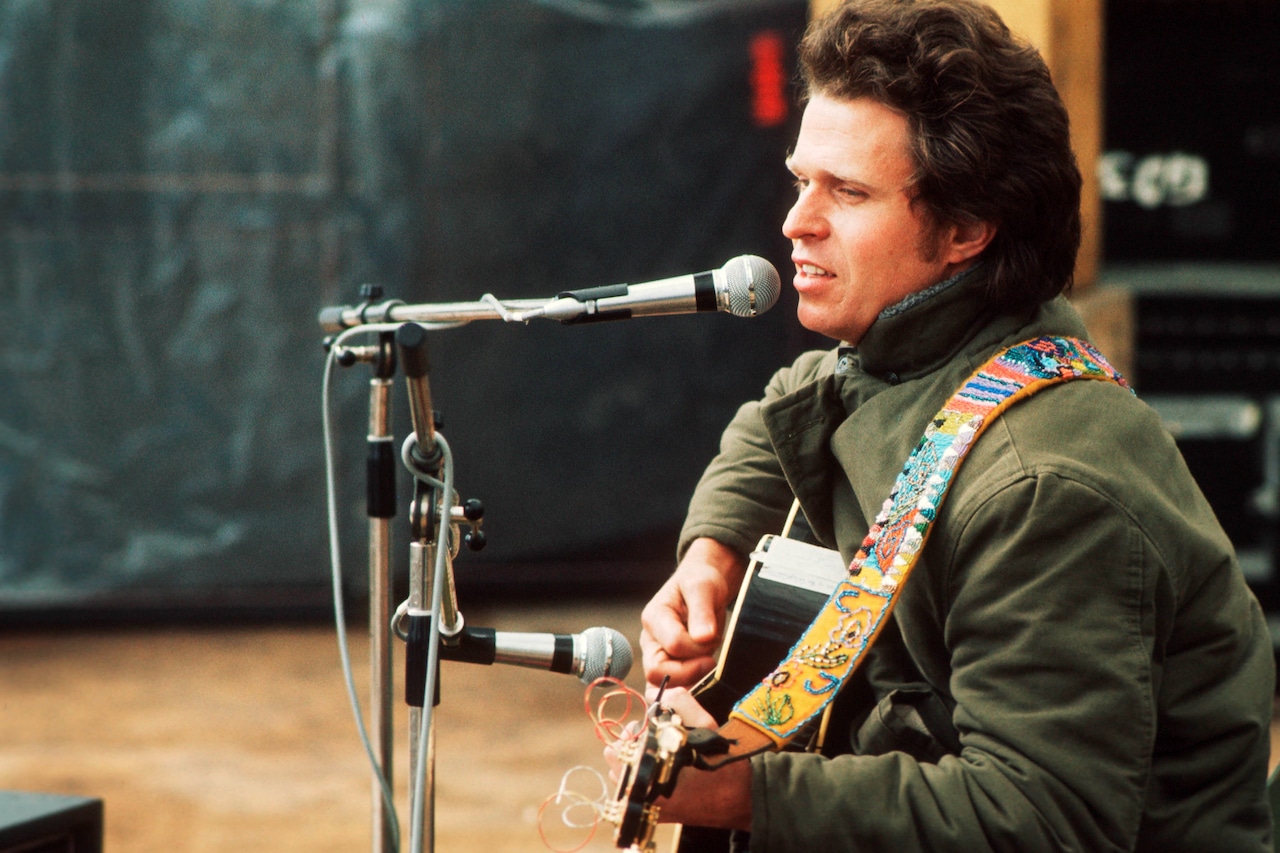
Country Joe McDonald, the iconic singer and frontman of the band Country Joe and the Fish, passed away on Saturday at the age of 84 in Berkeley, California. His death was attributed to complications from Parkinson’s disease, as confirmed by a statement on the band’s social media and sources close to his family.
McDonald, born on January 1, 1942, in Washington, D.C., is best known for his powerful anti-war anthem “I-Feel-Like-I’m-Fixin’-to-Die Rag,” which he famously performed at the Woodstock Festival in 1969. This performance included the notorious call-and-response “Fish Cheer,” where the audience participated in spelling out a controversial word at McDonald’s encouragement.
Growing up in El Monte, California, McDonald began his musical journey playing trombone in local dance bands. He served in the Navy from 1959 to 1962 before returning to college in Los Angeles. In 1965, he moved to the Bay Area, where he co-founded Country Joe and the Fish with guitarist Barry Melton.
Musical Legacy and Anti-War Activism
The band released its debut album, “Electric Music for the Mind and Body,” in 1967. Notably, this album did not include “I-Feel-Like-I’m-Fixin’-to-Die Rag,” likely due to concerns over censorship. Instead, it featured songs like “Superbird,” which criticized President Lyndon Johnson. The more provocative content emerged in their subsequent works, resonating deeply with the counterculture movement of the 1960s.
McDonald described “I-Feel-Like-I’m-Fixin’-to-Die Rag” as a song that did not place blame on soldiers for the war but rather on politicians and arms manufacturers. He emphasized, “The important thing about the ‘Fixin’ to Die Rag’ was that it had a new point of view that did not blame soldiers for war.” This perspective made the song relatable for many, including those who had served in the military.
The Woodstock audience was already familiar with “The Fish Cheer,” which had gained notoriety after McDonald faced charges for inciting lewd behavior during a performance in Massachusetts. Reflecting on the band’s origins, McDonald noted his arrival in Berkeley was influenced by the Free Speech Movement and the vibrant folk music scene that flourished at the time.
Continued Activism and Musical Contributions
McDonald’s roots in a politically active family shaped his songwriting. His parents were involved with the Communist Party during his early years, later transitioning to the Progressive Party. This background informed his views on war and peace, allowing him to craft lyrics that addressed the consequences of military conflict.
After Country Joe and the Fish disbanded in 1971, McDonald continued to release numerous solo albums, often focusing on themes of environmentalism and civil rights. He remained active in the music scene, performing at various events, including an anti-nuclear protest at Livermore Laboratory, where he revisited his signature song on the 70th anniversary of the Hiroshima bombing.
In a 2016 interview, McDonald reflected on the passage of time, stating, “I find the concept of 50 years incomprehensible… But it’s indisputable.” At that point, he released an album titled “Goodbye Blues,” marking fifty years since the debut of his first album.
McDonald expressed his commitment to activism through music, noting, “As an entertainer, I know that you can lose your audience… I consider myself a morale-booster for these causes.” He acknowledged the importance of supporting movements that lack mainstream visibility, using his platform to amplify their messages.
Though details about his family were not immediately available, McDonald mentioned in interviews that he had five children and is survived by his wife, Kathy McDonald. His legacy as a voice for peace and social change will continue to resonate with generations to come.