
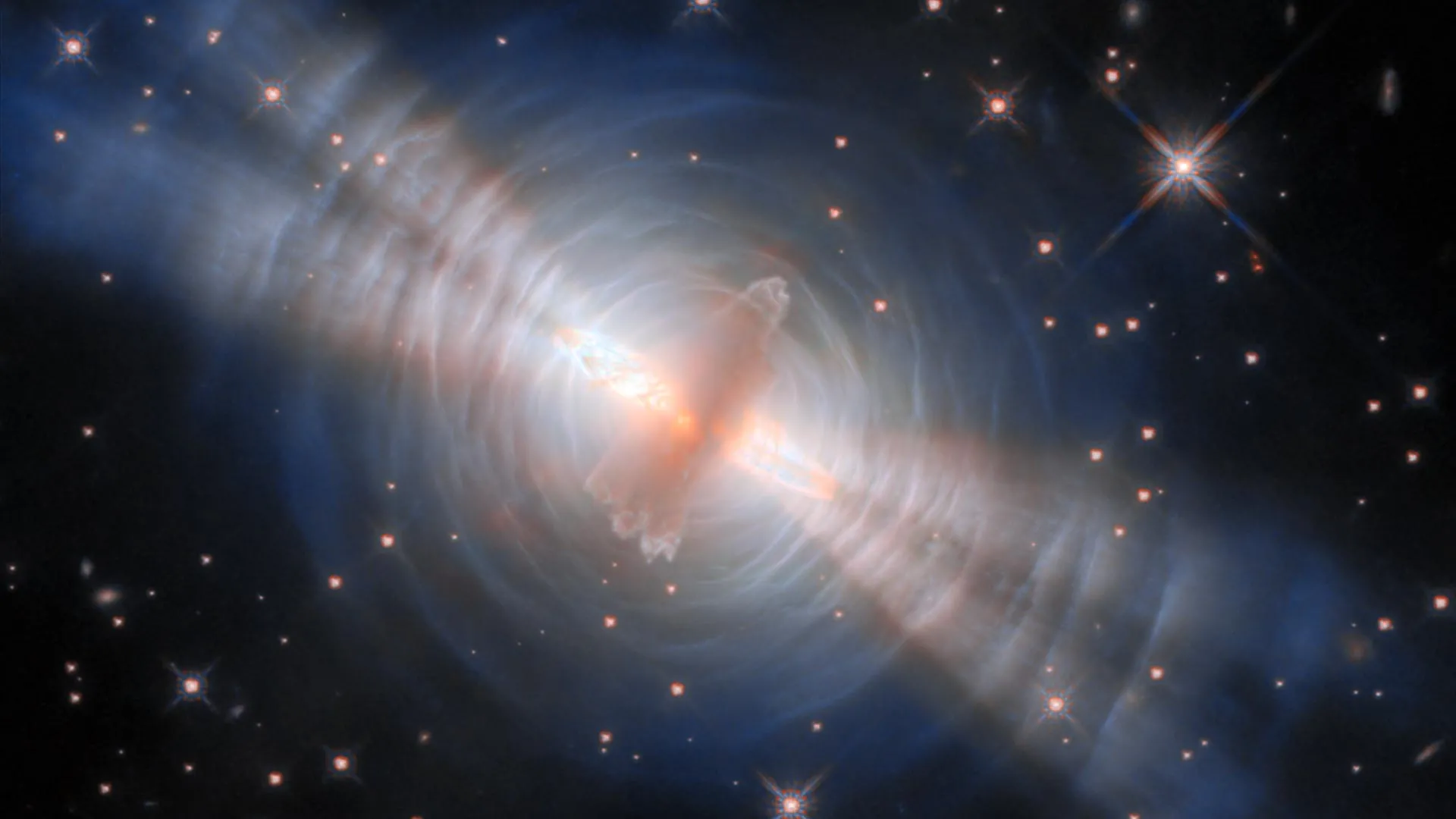
A remarkable image from the Hubble Space Telescope has unveiled the intricate beauty of the Egg Nebula, a rare and transient phase occurring in a Sun-like star’s lifecycle. Captured on February 13, 2026, this stunning visual reveals twin beams of light erupting from a hidden star, located approximately 1,000 light-years away in the constellation Cygnus. The nebula, shrouded in a dense layer of dust, showcases a unique polar opening through which the dying star emits light, forming brilliant lobes and delicate ripples in the surrounding material.
The Egg Nebula is distinguished as the first, youngest, and closest known pre-planetary nebula. This classification refers to an early stage in the formation of a planetary nebula, which arises from the ejected layers of a dying star. Notably, planetary nebulae are not related to planets, despite the term’s misleading nature.
Insights into Stellar Evolution
This early phase of the Egg Nebula presents astronomers with a valuable opportunity to study the final stages of stars akin to our Sun. At this point, the nebula reflects light from its central star, which escapes through a distinctive polar “eye” in the surrounding dust. The illuminating glow originates from a dusty disk expelled by the star only a few hundred years ago.
Hubble’s high-resolution capabilities reveal two bright beams radiating outward from the star, illuminating fast-moving polar lobes that cut through older, slower rings of material. The symmetry of these features suggests that gravitational influences from one or more concealed companion stars may play a role in shaping the nebula’s structure.
The Transition from Star to Planetary Nebula
As stars similar to our Sun exhaust their hydrogen and helium fuel, they begin to shed their outer layers. The exposed core emits intense radiation, energizing the surrounding gas, which results in the vibrant shells characteristic of planetary nebulae, such as the Helix and Butterfly nebulae. The Egg Nebula, however, is still in its transitional pre-planetary stage, a phase that lasts only a few thousand years. Observing it now allows scientists to study this ejection process while the evidence remains clear.
The patterns evident in Hubble’s latest image indicate a structured rather than chaotic formation, ruling out random events such as a supernova explosion. Instead, the arcs and lobes likely stem from a series of controlled outbursts from within the aging star’s carbon-rich core. This process generates substantial amounts of dust, which can contribute to the formation of new star systems. Notably, our own solar system, including Earth, originated from such recycled materials approximately 4.5 billion years ago.
Hubble’s observations of the Egg Nebula span several years. Initial images captured by the Wide Field and Planetary Camera 2 (WFPC2) were followed by near-infrared views from the Near Infrared Camera and Multi-Object Spectrometer (NICMOS) in 1997. Subsequent images in 2003 provided a broader view of the dusty ripples surrounding the nebula, and observations from the Wide Field Camera 3 (WFC3) in 2012 focused on the dense central cloud and the powerful outflows of gas. The latest image synthesizes data from the 2012 observations, yielding the clearest and most detailed portrayal of this cosmic marvel to date.
For over three decades, the Hubble Space Telescope has significantly advanced our understanding of the universe. Its ongoing mission is a collaboration between NASA and the European Space Agency (ESA), with operational oversight from the Goddard Space Flight Center in Maryland and additional support from Lockheed Martin Space in Denver. The Space Telescope Science Institute in Baltimore manages Hubble’s scientific operations for NASA, ensuring that this iconic observatory continues to reveal the wonders of the cosmos.