
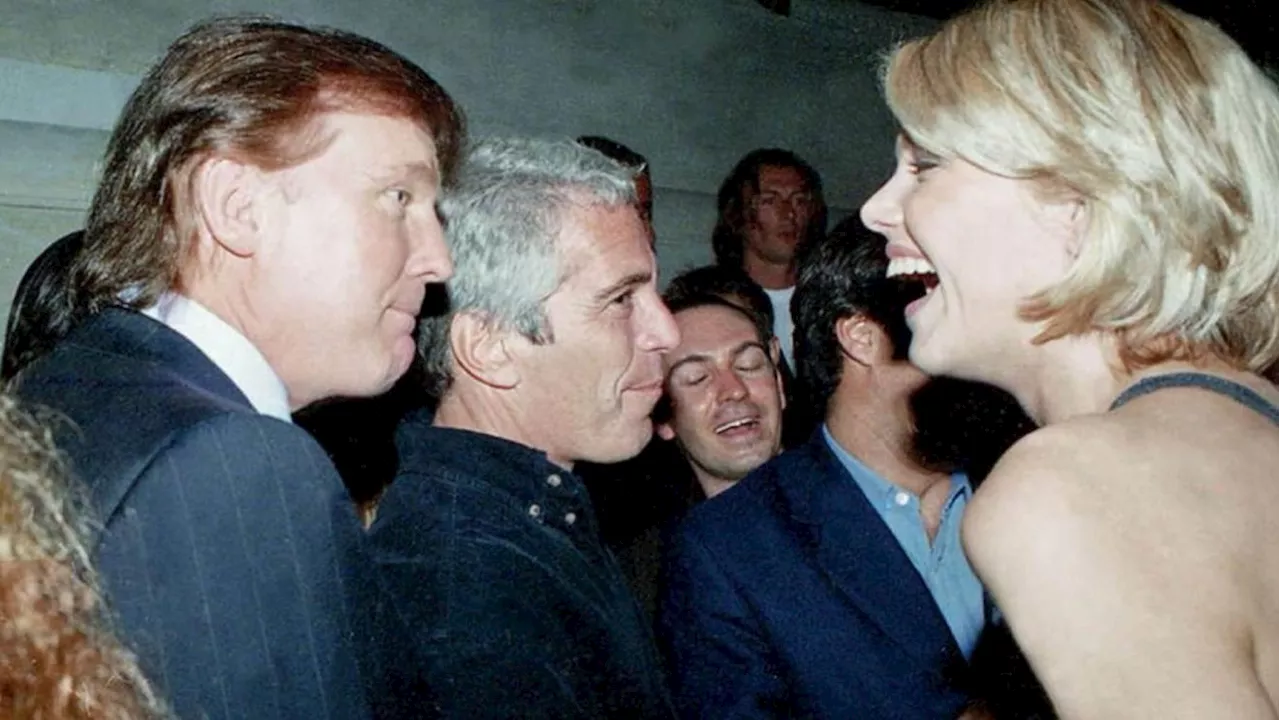
House Democrats are pressing the Department of Justice (DOJ) for clarification regarding the alleged removal of a photograph featuring former President Donald Trump from a recently released set of documents pertaining to Jeffrey Epstein. The image, which shows Trump alongside Epstein, his wife Melania Trump, and Epstein’s associate Ghislaine Maxwell, was reportedly among several photographs deleted from the DOJ’s release on December 12, 2025.
The House Oversight Committee has expressed concern over the deletion, highlighting that the photograph was included in the DOJ’s file but later removed. In a message posted on social media platform X, Democrats on the committee stated, “This photo, file 468, from the Epstein files that includes Donald Trump has apparently now been removed from the DOJ release.” They called for transparency, questioning, “What else is being covered up?”
According to reports from the Associated Press, the deleted Trump photograph was one of at least 16 images that the DOJ had recently released, only to retract. The DOJ has indicated that the public should notify the agency if they identify any files that should not have been posted. They noted that due to the sheer volume of information involved, there remains a possibility of unintentional disclosures of personal information or sensitive content.
The release of documents related to Epstein follows increasing political pressure and public calls for transparency, especially after the enactment of the Epstein Files Transparency Act. This new federal law mandated the DOJ to disclose a significant collection of investigative records associated with the convicted financier.
Democratic Representatives Ro Khanna and Thomas Massie criticized the DOJ for releasing only a fraction of the requested files, many of which were heavily redacted. Khanna remarked, “The DOJ’s document dump of hundreds of thousands of pages failed to comply with the law authored by @RepThomasMassie and me.” He cited a specific document containing 119 pages of Grand Jury testimony that was entirely redacted, stating, “There’s not a single explanation for why that entire document was redacted.”
In another video posted on X, Khanna emphasized the need for the DOJ to provide justifications for the redactions. He pointed out the lack of visibility into the allegations against other wealthy individuals implicated in Epstein’s operations, stating, “We have not seen the draft indictment that implicates other rich and powerful men who were on Epstein’s island.”
Khanna also directed his frustration towards Pam Bondi, the current Attorney General, who previously stated there were “no more documents to be seen,” yet later released a portion of previously undisclosed files. He described the release as “incomplete with too many redactions,” adding that he and Massie are considering various actions against the DOJ to ensure comprehensive disclosure of the files.
In a separate post, Massie noted that the recent document release by Bondi “grossly fails to comply with both the spirit and the letter of the law that @realDonaldTrump signed just 30 days ago.” He highlighted that the Epstein Files Transparency Act could enable future legal actions against current DOJ officials, emphasizing its significance beyond the typical Congressional subpoena, which expires at the end of each Congress.
As the inquiry continues, the House Oversight Committee’s demand for answers underscores the ongoing debate over transparency in high-profile investigations and the handling of sensitive information related to Epstein’s extensive network of associates. The scrutiny placed on the DOJ reflects broader concerns regarding accountability and public trust in governmental institutions.