
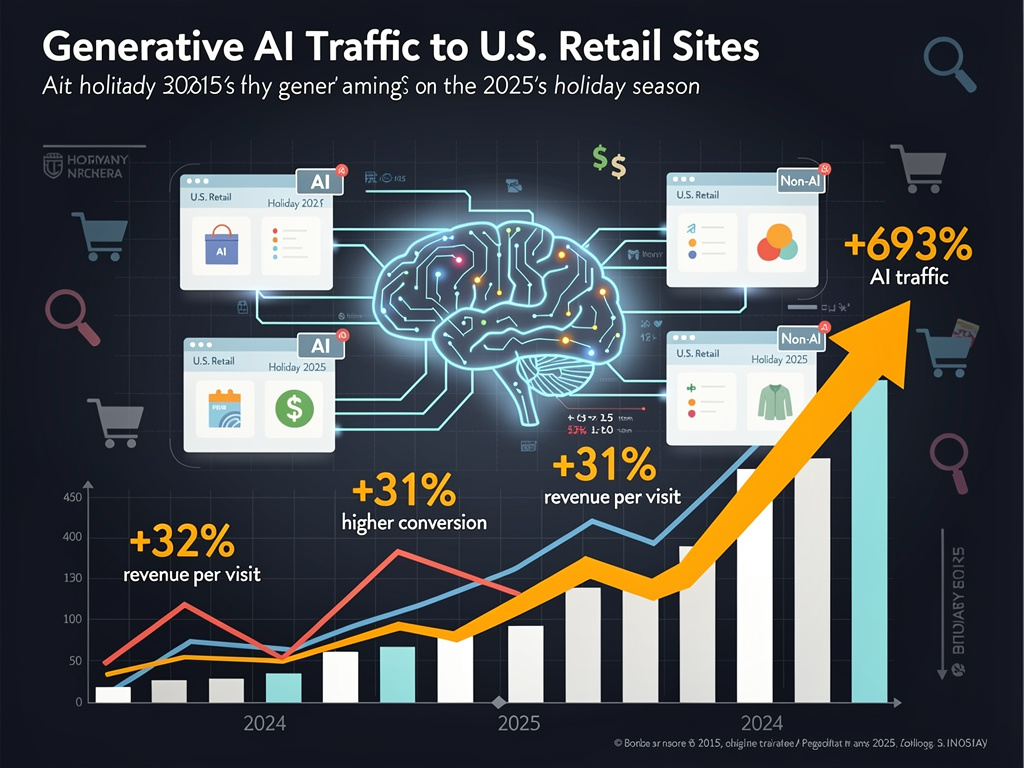
Generative AI tools such as ChatGPT, Gemini, and Perplexity fueled a remarkable 693% year-over-year increase in traffic to U.S. retail websites during the 2025 holiday season, spanning from November 1 to December 31. According to Adobe’s Quarterly AI Traffic Report, the analysis of over one trillion visits to retail sites revealed that AI referrals not only drove unprecedented traffic but also demonstrated superior performance, converting at a rate 31% higher than non-AI sources.
The holiday season of 2025 showcased a significant shift in consumer behavior, contrasting sharply with 2024, when non-AI traffic outperformed AI traffic by 51% in terms of revenue per visit. In 2025, AI-sourced visitors contributed 32% more revenue per visit, along with 14% higher engagement, 45% longer session durations, and 13% more pages viewed per session. “AI-driven traffic surged across industries. This indicates that for marketers and retailers alike, deeper engagement translates directly into higher conversion during the 2025 holiday season,” remarked Vivek Pandya, director of Adobe Digital Insights, in comments to Marketing Dive.
Record Holiday Sales Driven by AI
The retail boom extended beyond the holiday season, with remarkable triple-digit growth in AI referrals across various sectors, including travel (539%), financial services (266%), and technology/software. Total U.S. online holiday sales reached a record $257.8 billion, reflecting a 6.8% increase from $241.4 billion in 2024. This growth was driven by an impressive 25 days where daily spending exceeded $4 billion, an increase from 18 days the previous year.
AI’s evolution from a novel tool to a critical component of e-commerce accelerated following a staggering 1,300% holiday traffic spike in 2024. By mid-2025, AI revenue per visit had surged by 84% from January to July compared to non-AI sources, narrowing the value gap to 27%. Holiday data confirmed that consumers increasingly trust AI channels, with 47% of respondents expressing confidence in AI-generated results, according to a survey conducted by Adobe involving over 1,000 shoppers.
Retailers experienced the impact firsthand. On Black Friday alone, AI traffic increased by 805% year-over-year, as reported by Retail Dive. Mobile transactions dominated, accounting for 56.4% of total sales and peaking at 66.5% on Christmas Day. Additionally, the buy-now-pay-later sector recorded $20 billion in sales, marking a 9.8% increase from previous figures. Data from Salesforce echoed the trend, indicating that AI influenced 20% of U.S. holiday retail sales, translating to $262 billion globally. Shoppers arriving via AI search converted at rates nine times higher than those coming from social media referrals.
Geographic and Economic Disparities in AI Adoption
The adoption of AI tools varied significantly across demographics and regions. High-income states such as Virginia, Washington, New York, California, and Massachusetts generated engagement levels that were double the national average, accounting for 52% of U.S. AI traffic. Urban consumers showed 80% awareness of AI assistants, with 48% actively using them for shopping and 63% planning to increase their adoption in 2026. In contrast, rural areas lagged behind, with figures at 67%, 27%, and 42% respectively.
Despite high online activity in states like Mississippi, AI engagement remained low, underscoring a digital divide in the uptake of AI commerce. Nationwide, only 2% of consumers reported being unaware of AI assistants, with 46% having utilized them for shopping and 58% intending to do so in 2026. High-income regions led adoption rates, while areas in the South and Appalachia experienced slower growth.
Broader surveys reinforced the consumer enthusiasm for AI. A post-holiday poll by Talkdesk found that 88% of respondents used AI during the 2025 holidays, with 56% expressing satisfaction with the experience and 69% indicating a higher likelihood of adopting AI shopping in the future. Deloitte highlighted that 33% planned to use generative AI, double the rate from 2024, with 26% reporting increased trust in AI tools.
As AI continues to evolve, tools like Perplexity and Claude gained popularity for research, deal-hunting, and gift suggestions. Adobe noted that searches for smartphones surged 40% above 2024 averages before Thanksgiving, while toy-related inquiries rose 50% during Christmas week. In response, retailers adapted by launching conversational AI gift finders and enhancing AI tools for sellers.
Marketers are now racing to optimize their strategies for this emerging landscape. “For retailers and brands, this signals a lasting shift in how consumers discover and evaluate products. Generative AI’s role in commerce isn’t a passing trend. It’s becoming a core part of the digital shopping journey,” emphasized Pandya. According to Talkdesk, 75% of marketers plan to incorporate AI into their promotional efforts, up from 66% in 2024. Zeta Global reported a remarkable 25x growth in AI agent utilization during holiday campaigns.
Despite the impressive growth, challenges persist. High return rates of 28% have pressured profit margins, compounded by tariffs and price sensitivity. Nevertheless, the momentum for AI is projected to reach 520% growth before the next holiday season, establishing it as a critical frontier in retail.
As 2026 approaches, 58% of consumers are looking forward to more AI-driven shopping experiences. Retailers that ignore this trend risk obsolescence, while those that leverage AI technologies stand to benefit significantly. Pandya concluded, “Marketers should continue to adapt as more consumers turn to large language models to research products, compare options, and make informed purchasing decisions.” The age of AI-driven commerce is firmly here.