
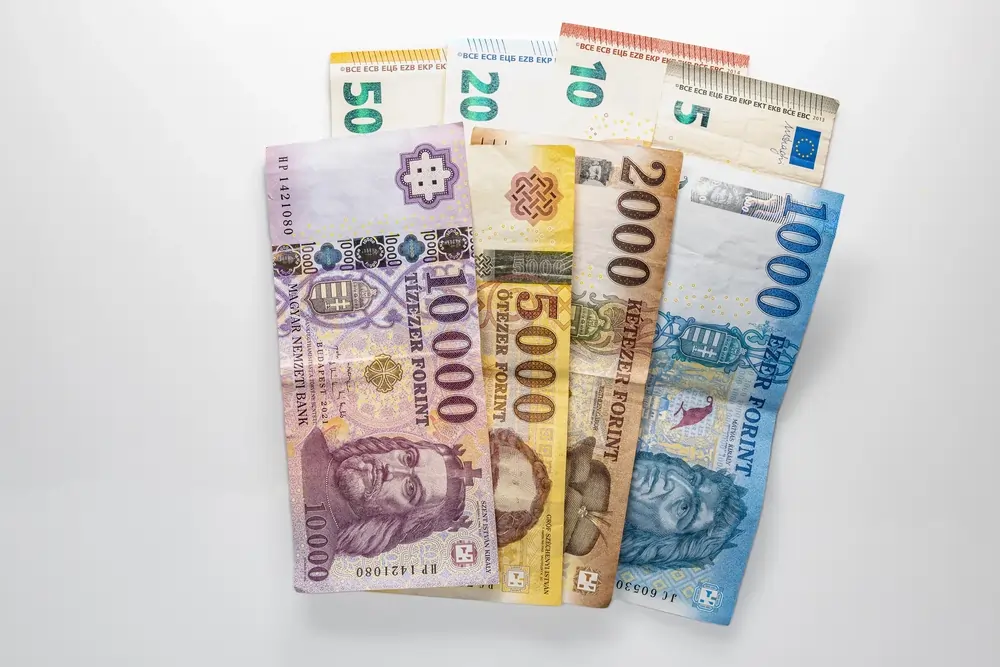
The Hungarian forint unexpectedly strengthened against the euro throughout 2025, surprising many investors who believed that holding savings in euros was the safest option amid currency volatility. By the end of the year, those who converted their funds into euros early on often found that their savings had diminished in value when measured in forints.
According to calculations from Bankmonitor, the forint appreciated by 6.77 percent against the euro during the year. This significant increase meant that money held in euros was worth less in forints by year’s end. In addition to its performance against the euro, the forint also showed resilience against the US dollar, which recently fell below 317 HUF, losing nearly three forints in a single afternoon.
Factors Behind the Forint’s Strength
At first glance, rising inflation in Hungary would typically suggest a weakening currency. However, the dynamics of currency exchange rates often hinge on a broader range of factors. One of the most notable influences in 2025 was the disparity in interest rates. Hungarian interest rates remained considerably higher than those in the eurozone, where several countries experienced rate reductions.
This interest rate gap attracted investors to forint-denominated assets, which offered the potential for enhanced returns. Analysts noted that the Hungarian Central Bank maintained elevated base rates for an extended period, while the European Central Bank and other regional central banks either reduced rates or did not raise them as significantly. As a result, the forint became more appealing to investors, leading to increased demand and a stronger exchange rate.
The mechanics of this shift were straightforward: as investors sold euros to purchase forints, they subsequently allocated their funds into forint assets with better yields. A coordinated movement in this direction can significantly influence currency strength.
International Market Dynamics
The forint’s performance was part of a broader trend among Central and Eastern European currencies, which were generally favored in international markets throughout 2025. Investors often capitalize on opportunities to borrow in low-interest currencies—like the euro—and convert those funds into currencies offering higher yields. This environment contributed to the forint’s unexpected strength.
While the forint’s rise was notable, it did not imply that holding euros was an unwise long-term strategy. Currency markets can behave unpredictably over short periods, and deriving conclusive insights from a single year can be misleading. For many savers, the key takeaway is that foreign currency does not inherently guarantee safety; it can also present risks.
In light of these developments, many individuals have opted to diversify their savings across multiple currencies rather than relying on a single exchange rate. As the political conversation about the euro’s role in Hungary continues, figures like Péter Magyar, a leading political candidate, have made significant pledges regarding the potential introduction of the euro in Hungary.
As 2025 draws to a close, the financial landscape remains complex, emphasizing the need for investors and savers alike to stay informed and adaptable in an ever-changing environment.