
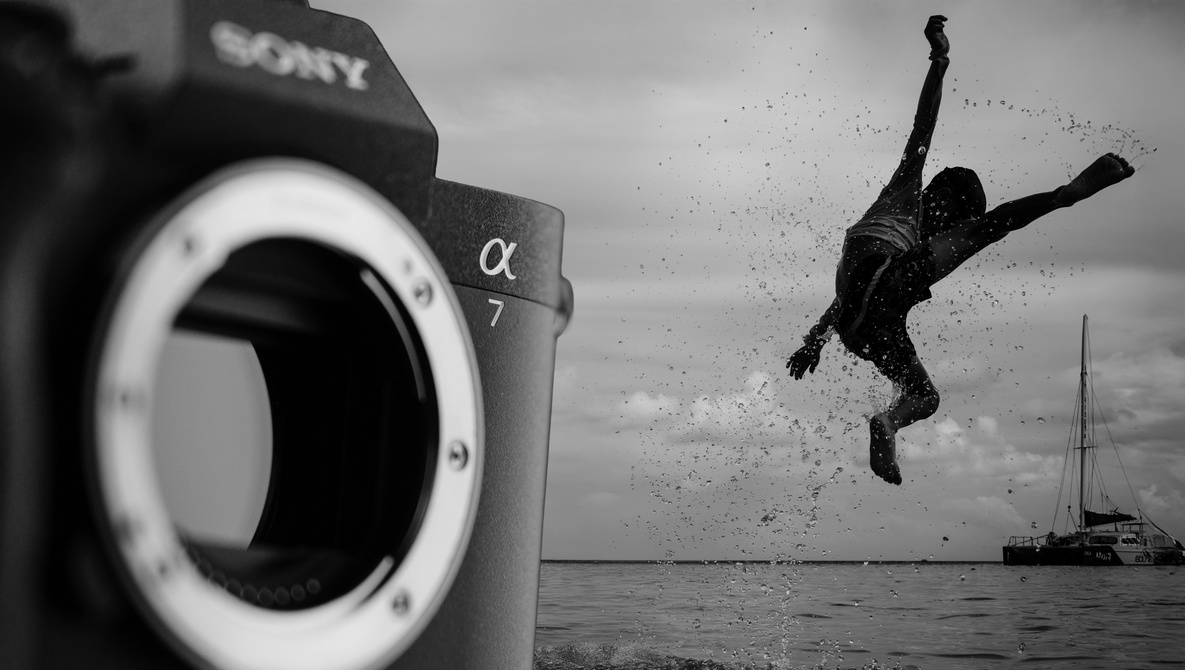
The new Sony a7 V, equipped with a 33 MP partially stacked sensor and capable of 16 stops of dynamic range, is making waves among photography enthusiasts. Following a week-long test during a family trip to Aruba, I have captured around 6,000 images and gained valuable insights into its capabilities. This review aims to evaluate its performance in real-world settings, helping potential buyers decide if this camera meets their needs.
One of the standout features of the a7 V is its silent shutter, enabled by the newly designed sensor. Traditional sensors often struggle with slow readout speeds, leading to issues like the “jello effect” when capturing fast-moving subjects. The a7 V addresses this with a partially stacked design that offers faster speeds than older models but does not quite reach the speed of high-end stacked sensors or global shutters. During my tests, I photographed my children in motion, and the results were impressive. For instance, in a shot of my son swinging a rake, the rake appeared straight without noticeable distortion, despite using a shutter speed of 1/250th of a second.
In another test, I asked my daughter to swing a plastic sword quickly. This time, some distortion was evident, but it remained minor. Throughout my time in Aruba, I primarily used the silent shutter mode. It is important to note that, due to the camera’s recent release, there was no raw support in Lightroom, so the images discussed here are JPEGs processed with one of the newer Sony film simulations called “film2.”
When it comes to capturing fast-paced moments, the a7 V excels. Even images of my nephew running into the ocean turned out well. The camera can shoot at a rate of 30 frames per second, which, while lower than the 40 frames per second of its competitor, the Canon R3, provides 14-bit raw files without blackout. Many will appreciate the balance between frame rate and image quality that the a7 V offers, especially given its flexibility with pre-capture and boost modes.
The pre-capture function buffers images before the shutter is pressed, allowing users to save moments that might otherwise be missed. The duration for this feature can be adjusted between 0.03 seconds and a full second. In my experience, setting it to between 0.2 and 0.3 seconds strikes the right balance. The boost button enhances usability by allowing a quick switch to maximum frame rates when needed.
Despite its advanced features, I found some aspects of the camera’s body design lacking. I would have preferred the more modern design incorporating the C5 button from the a9 III for better accessibility. Nevertheless, the a7 V boasts an excellent flipping and tilting screen. The addition of a “shutter type switch” enhances usability, enabling users to cycle between electronic and mechanical shutter modes without navigating through menus.
The a7 V also features an updated processing unit, utilizing a single Bionz XR2 processor with built-in AI capabilities. This upgrade leads to improved autofocus accuracy, enhanced color fidelity, and better auto white balance stability. The battery life is commendable, rated for 630 images using the electronic viewfinder and 750 images with the rear screen. In practical use, I found the battery lasting well throughout demanding shooting days.
One notable addition is the screen blackout feature, which can extend battery life by turning off the display while keeping the camera active. Unfortunately, a design flaw prevents the screen from turning off when the camera is worn on a strap due to the EVF sensor being triggered. This limitation highlights the need for an option to disable screen-off mode even when the EVF is activated.
While my primary focus is still photography, the a7 V also performs admirably for video. It offers 7K oversampled 4K60 with full pixel readout, ensuring no cropping at that frame rate. It is also capable of shooting in 4K120 or 240p in full HD, appealing to users who require high-quality video capabilities.
The a7 V offers one combo slot for CFexpress and SD cards, alongside a dedicated slot for SD cards only. This choice may raise questions among users, as many expected a second combo slot. However, the introduction of a second USB-C port—one rated for USB 3.2 Gen 2 and the other for USB 2.0—enhances tethered shooting capabilities, eliminating the necessity for dummy batteries during sessions.
Ultimately, the a7 V is an excellent option for wedding photographers and those seeking versatility in their equipment. It combines higher resolution and frame rate with superior autofocus and video capabilities, all at a lower price point compared to the Canon R3 and a9 III. For photographers who do not require extreme readout speeds or specific features like flash sync, the a7 V stands out as a strong contender.
As a wedding and portrait photographer with Vinson Images based in Bentonville, Arkansas, I am considering adding the a7 V to my arsenal for general photography. Its impressive dynamic range, higher resolution, and low ISO performance make it a compelling choice for a wide array of shooting scenarios.