
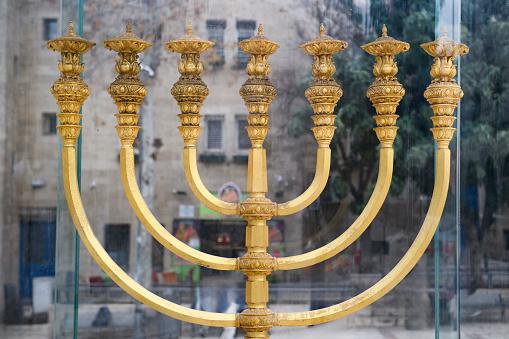
The menorah, a significant symbol of Judaism, serves as a representation of the Jewish people’s enduring identity and spiritual journey. While the Star of David has become a prominent emblem, particularly since the establishment of Israel in 1948, the menorah embodies a deeper narrative that spans from biblical times to the modern era. This ancient symbol illustrates themes of light, wisdom, and resilience, making it a central figure in Jewish tradition.
The authority of the menorah is deeply rooted in the Torah. In the portion of Exodus known as Terumah, which is read this week, Moses is instructed to “make a menorah of pure gold” (Exodus 25:31). This divine command highlights its sacred significance. Crafted from a single piece of gold, the menorah symbolizes spiritual integrity and unity stemming from complexity. It was not only a key sacred object in the Tabernacle but also in the Jerusalem Temple, representing God’s constant presence among the Israelites. The perpetual lighting of the menorah indicated an ongoing covenantal relationship and faithful service to God.
The prophet Zechariah offers a powerful vision of the menorah as a source of divine support, especially during the rebuilding of the Temple following the Babylonian exile. He conveys, “Not by might, nor by power, but by My spirit, says the Lord of hosts” (Zechariah 4:6). In this context, the menorah symbolizes spiritual resilience and divine empowerment, rather than reliance on military or political strength.
The fate of the menorah took a significant turn after the Roman destruction of the Second Temple in 70 CE. This event is famously depicted on the Arch of Titus in Rome, showcasing Roman soldiers triumphantly carrying the Temple menorah. This historical representation underscores the menorah’s importance as a symbol of Jewish identity and dominion. Even in defeat, it has come to represent continuity and hope for restoration.
In contemporary society, the menorah has also taken on national significance. The emblem of the State of Israel, adopted in 1948, features a stylized seven-branched menorah flanked by olive branches. This design draws inspiration from the Arch of Titus relief, reclaiming a symbol of exile into one of renewed sovereignty. The seven branches of the menorah carry various interpretations within Jewish tradition. The number seven represents completeness and sanctity, as reflected in the creation narrative which unfolds over seven days, culminating in the sacred rest of Shabbat.
Philo of Alexandria, a Hellenistic Jewish philosopher from the first century CE, associated the seven branches with the seven classical planets known in antiquity. He suggested that the menorah symbolizes the harmony of the cosmos under divine governance. Furthermore, in Kabbalistic tradition, the menorah is seen as a profound symbol of divine emanation and spiritual structure. Its seven branches correspond to the seven lower sefirot—chesed (lovingkindness), gevurah (strength), tiferet (beauty), netzach (endurance), hod (humility), yesod (foundation), and malchut (sovereignty)—through which divine energy flows into the world.
For many, the menorah holds personal significance. Simon Eder, co-founder of the Jewish community in the United Arab Emirates, shares his experience of lighting a monumental nine-branched menorah in the desert during Chanukah. This collective act symbolized their pioneering establishment of a Jewish community in an Arab land. Eder reflects on returning to Abu Dhabi last year to celebrate his son Jonah’s barmitzvah at the Abrahamic Family House’s Moses Ben Maimon Synagogue. He was heartened to see the menorah prominently displayed, representing a significant shift in the ability to openly practice Judaism in the region.
Beyond its historical and national dimensions, the menorah inspires spiritual reflection and serves as a call to action. It embodies the words of the prophet Isaiah, urging people to be a “light unto the nations” and to promote ethical monotheism and justice. In a world often marked by darkness and conflict, the menorah remains a beacon of hope, unity, and resilience for the Jewish people and beyond.
As societies continue to navigate complex challenges, the menorah’s enduring symbolism encourages individuals to reflect on their shared humanity and aspire towards a future filled with light and understanding.