
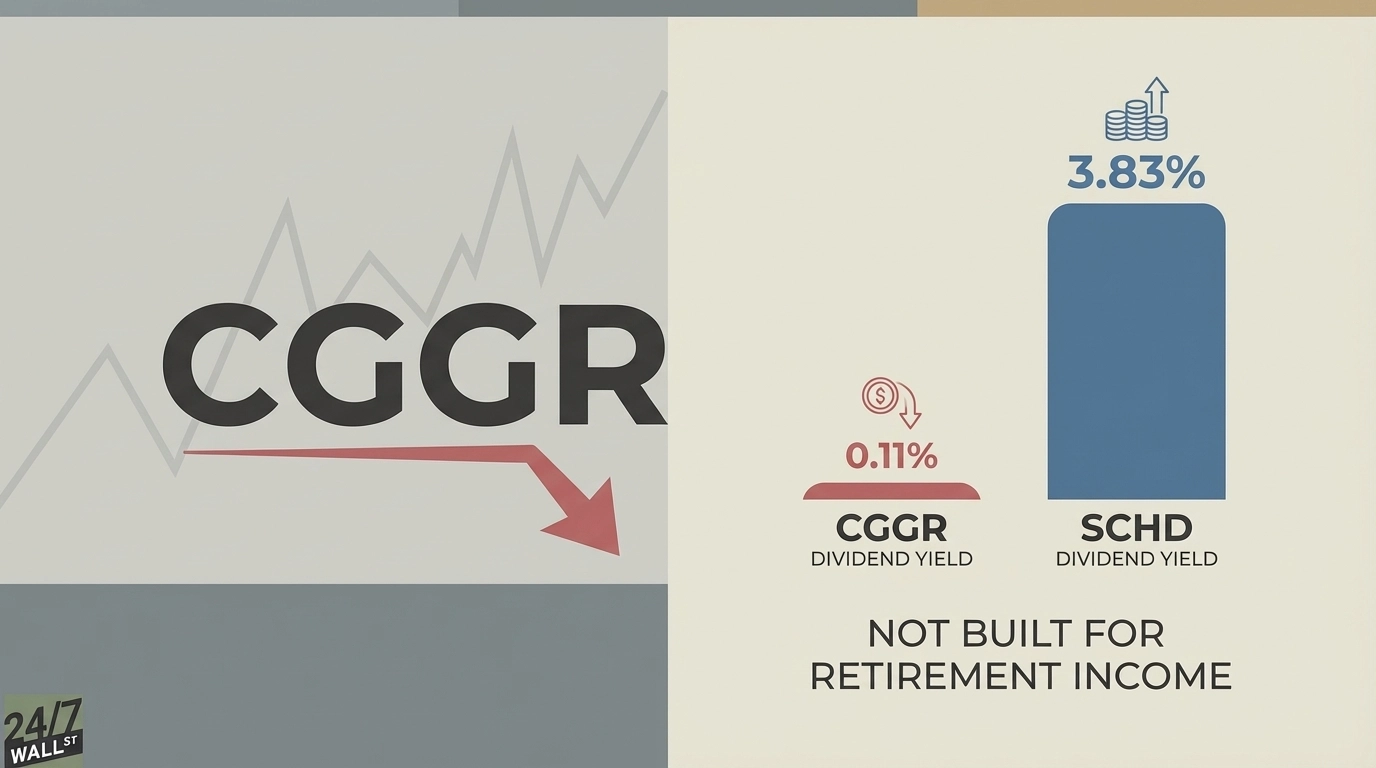
As retirees approach 2026, many are scrutinizing investment options that align with their income needs. The Capital Group Growth ETF (CGGR), which has a heavy focus on growth sectors, presents challenges for those relying on stable income. With over 57% of its assets concentrated in technology and growth industries, CGGR is not typically suited for traditional retirement portfolios that prioritize income generation from dividends.
Understanding CGGR’s Investment Focus
The primary goal of CGGR is to provide capital appreciation through investments in companies with high growth potential. This is evident in its sector allocation, with more than 57% in Information Technology, Communication Services, and Consumer Discretionary sectors. Major holdings include Meta Platforms at 7.6%, Tesla at 6%, Broadcom at 5.7%, and Nvidia at 4.9%.
Despite its impressive year-to-date return of 20.9% in 2025, outperforming the S&P 500 by approximately 3.6% percentage points, CGGR’s low 0.11% dividend yield raises concerns. An investment of $500,000 would yield roughly $550 annually, a figure that hardly covers basic living expenses such as utilities. Furthermore, the distribution for 2025 is $0.04, a significant drop of 65% from the $0.12 paid in 2024, suggesting a lack of reliable income.
Risks and Compromises for Retirees
Investing in CGGR necessitates acceptance of several key trade-offs. First, the low income generation means retirees may need to sell shares to fund their expenses, undermining their long-term investment strategy. Second, the fund’s focus on growth sectors offers minimal defensive positioning, with less than 2% in Consumer Staples and under 1% in Utilities. This lack of diversification could exacerbate financial strain during market downturns.
Moreover, the fund’s relatively short track record of 3.8 years does not provide sufficient evidence of its performance during prolonged bear markets or economic recessions, increasing the risk for conservative retirees.
CGGR is particularly ill-suited for two types of investors: traditional retirees relying on portfolio income for living expenses and conservative investors within five years of retirement. For these groups, the 0.11% yield is inadequate and the declining distribution pattern is concerning.
For retirees seeking a more stable income alternative, the Schwab U.S. Dividend Equity ETF (SCHD) merits consideration. SCHD boasts a 3.83% dividend yield, significantly higher than CGGR, and focuses on defensive sectors such as Energy, Consumer Staples, and Healthcare. With $71 billion in assets and a 0.06% expense ratio, SCHD has reliably paid dividends for 56 consecutive quarters since 2011, making it a more suitable option for retirees.
Ultimately, while CGGR may appeal to those with a higher risk tolerance and a desire for growth, its minimal yield and volatility make it a poor fit for traditional retirement income strategies. Retirees must carefully evaluate their investment choices to ensure they align with their financial needs and risk profiles.