
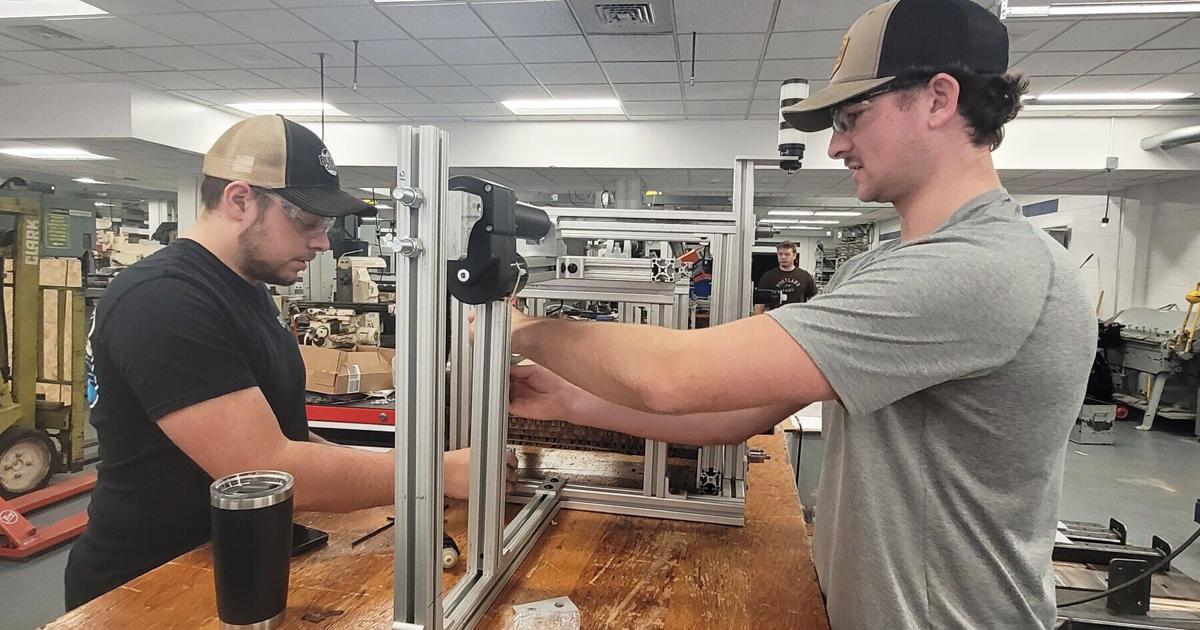
A team of engineering students at the University of Wisconsin-Stout has developed a prototype for a nonstandard pallet stacker, thanks to sponsorship from Ashley Furniture. This collaborative project aims to enhance productivity in warehouse operations, showcasing the practical application of academic knowledge in a real-world context.
The prototype was assembled by students Chase Rodewald and Riley Stiehl, who focused on creating a more efficient solution for handling pallets that do not conform to standard dimensions. Their work, alongside peers Zachary Morgan and Luke Mertens, culminated in a design that promises to improve the movement and storage of various products within warehouses.
Engineering Innovation Meets Industry Needs
The initiative reflects a growing trend of educational institutions partnering with industry leaders to foster innovation. By sponsoring this project, Ashley Furniture not only supports the students’ educational journey but also seeks to develop solutions that could potentially be integrated into their operational processes.
Utilizing digital design software SolidWorks, the students created a detailed model of the nonstandard pallet stacker. This technology enables precise simulations and adjustments, ensuring that their final product meets the rigorous demands of warehouse logistics. The collaboration emphasizes the importance of hands-on experience in engineering education, preparing students for careers in a competitive job market.
The prototype is designed to address specific challenges faced by logistics teams, such as the difficulty of handling pallets that vary in size. The enhanced design aims to reduce time spent on manual handling and increase overall efficiency, potentially leading to significant cost savings for companies relying on effective warehouse management.
Real-World Applications and Future Prospects
The project serves as a testament to the capabilities of current engineering students and their potential to drive industry advancements. By working closely with Ashley Furniture, the students not only gain valuable insights into the industry’s needs but also contribute to a product that could see widespread adoption.
The success of this prototype may pave the way for further collaborations between educational institutions and businesses. As the demand for innovative solutions in logistics continues to grow, partnerships like this could become increasingly vital in training the next generation of engineers.
In conclusion, the development of the nonstandard pallet stacker by University of Wisconsin-Stout engineering students represents a significant step forward in addressing logistical challenges. With industry backing and a focus on practical applications, this project exemplifies the future of engineering education, where theoretical knowledge meets tangible outcomes.