
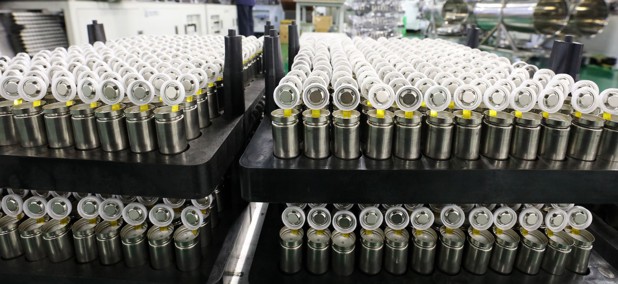
The United States Department of Energy (DOE) is pursuing significant advancements in battery technology, aiming to develop energy storage systems with four times the energy density of current lithium-ion batteries. The DOE’s Advanced Research Projects Agency-Energy (ARPA-E) is providing funding of up to $15 million to six selected teams to create prototypes of next-generation energy storage solutions over the next two years.
The initiative, named the Jumpstart Opportunities to Unleash Leadership in Energy Storage with 1K Energy Storage Systems, or JOULES-1K, marks a critical step toward enhancing energy storage capabilities. According to James Seaba, program director at ARPA-E, the goal is to create a battery system that significantly outperforms existing technologies. “We want to develop a system that has four times the energy density of lithium-ion batteries we have today,” said Seaba.
If successful, the new technology could transform applications in various fields, including military drones, robots, and advanced aircraft. The potential for increased battery life and efficiency is a key factor driving interest in this project, as scientists have long sought methods to extend battery performance.
The JOULES-1K program began 18 months ago with a total of 13 teams. Following the initial phase, which was funded with $16.9 million, only six teams have advanced to the second phase, where they are required to deliver scalable working prototypes. Seaba explained that in the first phase, teams proved various chemical compositions and components. In the second phase, they must demonstrate a viable system.
Batteries have become crucial for military operations, powering essential systems for troops and drones. However, many existing batteries rely on materials sourced from China, which is also developing its own next-generation battery technologies. This has prompted the Pentagon to seek innovative energy-storage solutions that can be produced domestically.
One of the leading participants in the JOULES-1K initiative is the Silicon Valley-based startup And Battery Aero. The company has been awarded approximately $4 million to develop its high-energy battery technology specifically for drone applications. Founder Venkat Viswanathan, who is also a professor of aerospace engineering at the University of Michigan, highlighted the company’s collaboration with multiple commercial drone partners to demonstrate enhanced endurance and payload capacity. “We had a chemistry innovation, we had a material science innovation, we scaled it up, and then we integrated that into a packaged energy storage solution,” Viswanathan explained.
Looking ahead, the next two years will focus on achieving the first demonstration flight of the new battery technology. Viswanathan emphasized the importance of overcoming scaling challenges inherent in scientific advancements. “There’s nothing like that first demonstration flight,” he said. “All of these kinds of scientific advances face scaling challenges. We know that it’s real. I think we have our work cut out for the next 24 months.”
Besides And Battery Aero, other teams participating in the JOULES-1K program include researchers from Johns Hopkins University, University of Maryland – College Park, Illinois Institute of Technology, Georgia Institute of Technology, and Precision Combustion. As these teams advance their projects, the potential for a transformative leap in energy storage technology remains a focal point for both military and commercial applications.