
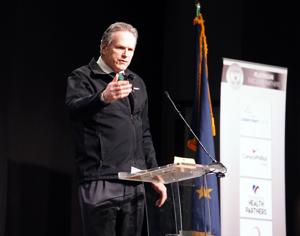
During a recent address to the Greater Fairbanks Chamber of Commerce, Governor Mike Dunleavy discussed critical topics impacting Alaska, including a looming fiscal plan and the geopolitical situation following the U.S. and Israel’s military actions against Iran. These developments have already affected global oil markets, with Iran retaliating by targeting neighboring countries, which could disrupt a significant portion of global oil and natural gas supply.
Dunleavy warned that the ongoing conflict is likely to lead to increased oil prices. “It’s going to be higher prices for oil,” he stated, underscoring that the ramifications of the war may not conclude as anticipated. While he acknowledged the potential for Alaska to be viewed as a stable energy source amid global unrest, he cautioned against relying solely on short-term financial benefits.
The governor noted that a surge in oil prices could create temporary relief for state funding but could distract lawmakers from essential long-term fiscal strategies. “Short term, the price of oil goes up, and it kind of saves the Alaska Legislature and state government,” Dunleavy remarked. “But that’s not necessarily a good thing in the long run.”
Given the volatility of oil revenues, Dunleavy introduced a proposed long-term fiscal plan, aiming to stabilize Alaska’s economy. This plan includes spending limits, a seasonal sales tax expiring in 2034, and adjustments to the oil production tax, increasing it from 4% to 5%. Furthermore, he proposed a 15-cent fee per barrel of oil and the elimination of the corporate income tax by 2031.
Dunleavy’s fiscal strategy aims to address the state’s increasing reliance on the Alaska Permanent Fund’s earnings reserves account, as oil revenue is no longer the primary source of state income. He compared Alaska’s situation to that of Texas, where sales tax accounts for 58% of revenue, contrasting with Alaska’s dependence on fluctuating oil prices.
The governor expressed his desire to leave a stronger financial foundation for his successor, recognizing the challenges faced by previous administrations. “Otherwise, you’re just going to have this scrum of the governor and Legislature rolling around on the ground fighting over what the PFD is or what we’re spending money on,” he noted, emphasizing the need for a focus on pressing issues such as education reform and affordable energy.
In terms of energy initiatives, Dunleavy highlighted the potential of the Alaska LNG project as a transformative economic opportunity. He reported that the project’s majority owner, Glenfarne Group, has made significant strides in securing non-binding agreements. “Just like the trans-Alaska oil line, the gas line will be transformational for the state,” he asserted, suggesting the project could generate jobs, stimulate the economy, and lower energy costs for the Railbelt region.
Despite these optimistic projections, the Alaska LNG project faces skepticism regarding its construction costs and the need for a substantial workforce of at least 7,000 workers. Dunleavy plans to introduce a bill aimed at providing the project with a tax break of up to 90%. He expressed concern about the project getting delayed, stating, “My biggest fear is that they get bogged down and time runs out.”
The governor acknowledged the importance of collaborating with local borough mayors, including those from the North Slope, Fairbanks North Star, and Kenai Peninsula, to ensure the project remains economically viable for Alaskans. “We want to make sure this project is as economical as possible, so those economics trickle down to the people in Alaska,” he said.
Local leaders, such as FNSB Mayor Grier Hopkins, have voiced concerns about the project’s impact on property taxes and the need for a spur line to Fairbanks. Hopkins stated, “We don’t need more gas, we need more affordable gas,” emphasizing the importance of ensuring that residents are not burdened by additional costs associated with the construction of the spur line.
In conclusion, while Governor Dunleavy presents a vision for Alaska’s fiscal future and energy independence, the path forward will require careful navigation of both local and global challenges. As the state grapples with its financial strategies and energy projects, the implications of international events will continue to shape its economic landscape.