
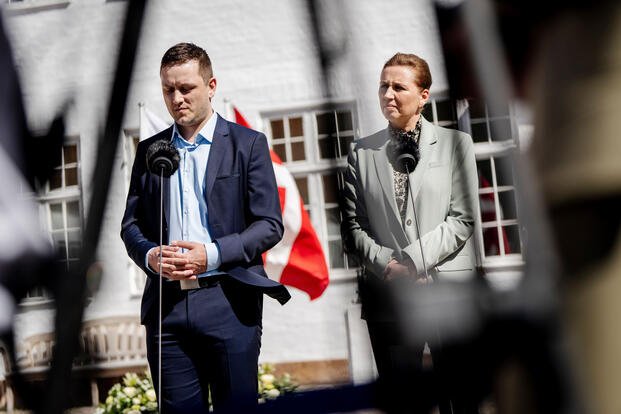
Denmark and Greenland have requested discussions with U.S. Secretary of State Marco Rubio following the Trump administration’s reaffirmation of its interest in acquiring the Arctic territory of Greenland. The renewed push from Washington has intensified diplomatic tensions, prompting a unified stance from several European leaders against what they view as a threat to Greenland’s sovereignty.
On Tuesday, the White House indicated that the “U.S. military is always an option” regarding Greenland, a statement that has drawn sharp criticism. Danish Prime Minister Mette Frederiksen cautioned that U.S. attempts to take control of the strategically significant island would jeopardize the NATO military alliance.
Leaders from France, Germany, Italy, Poland, Spain, and the United Kingdom joined Frederiksen in a statement asserting that the mineral-rich island “belongs to its people.” Their remarks highlight the self-governing status of Greenland, which is part of the Kingdom of Denmark and thus a member of NATO.
This situation is not new. Since his initial term in office, Donald Trump has expressed a desire to secure Greenland, claiming that control over the island is vital for U.S. security amid escalating tensions with China and Russia in the Arctic region. Recent U.S. military actions in Venezuela, along with Trump’s comments, have raised alarms in Europe about potential military expansionism in Greenland. “It’s so strategic right now,” Trump remarked to reporters on Sunday.
In light of these developments, Danish Foreign Minister Lars Løkke Rasmussen and Greenlandic counterpart Vivian Motzfeldt have formally requested a meeting with Rubio. The request, posted on Greenland’s government website, indicates that previous attempts to engage in dialogue have not succeeded.
Despite the support for Trump’s stance among many Republican lawmakers, there are notable dissenting voices. Senators Jeanne Shaheen and Thom Tillis, co-chairs of the bipartisan Senate NATO Observer Group, criticized the rhetoric coming from the White House. They stated, “When Denmark and Greenland make it clear that Greenland is not for sale, the United States must honor its treaty obligations and respect the sovereignty and territorial integrity of the Kingdom of Denmark.” Their statement underscores the importance of self-determination within NATO, emphasizing that coercion of a member state contradicts the alliance’s foundational principles.
In a related discussion, French Foreign Minister Jean-Noël Barrot revealed that he spoke with Rubio by phone on Tuesday. Barrot dismissed the notion of a military operation similar to that in Venezuela concerning Greenland. “In the United States, there is massive support for the country belonging to NATO – a membership that, from one day to the next, would be compromised by any form of aggressiveness toward another member of NATO,” he told France Inter radio.
When asked about a potential U.S. claim on Greenland, Barrot declined to speculate, stating that he would not engage in “fiction diplomacy.” This exchange highlights the complexities of international relations as nations navigate the implications of military posturing and territorial claims in the Arctic.
As discussions unfold, the world watches closely, aware that the fate of Greenland could significantly impact geopolitical stability in the Arctic and beyond.