
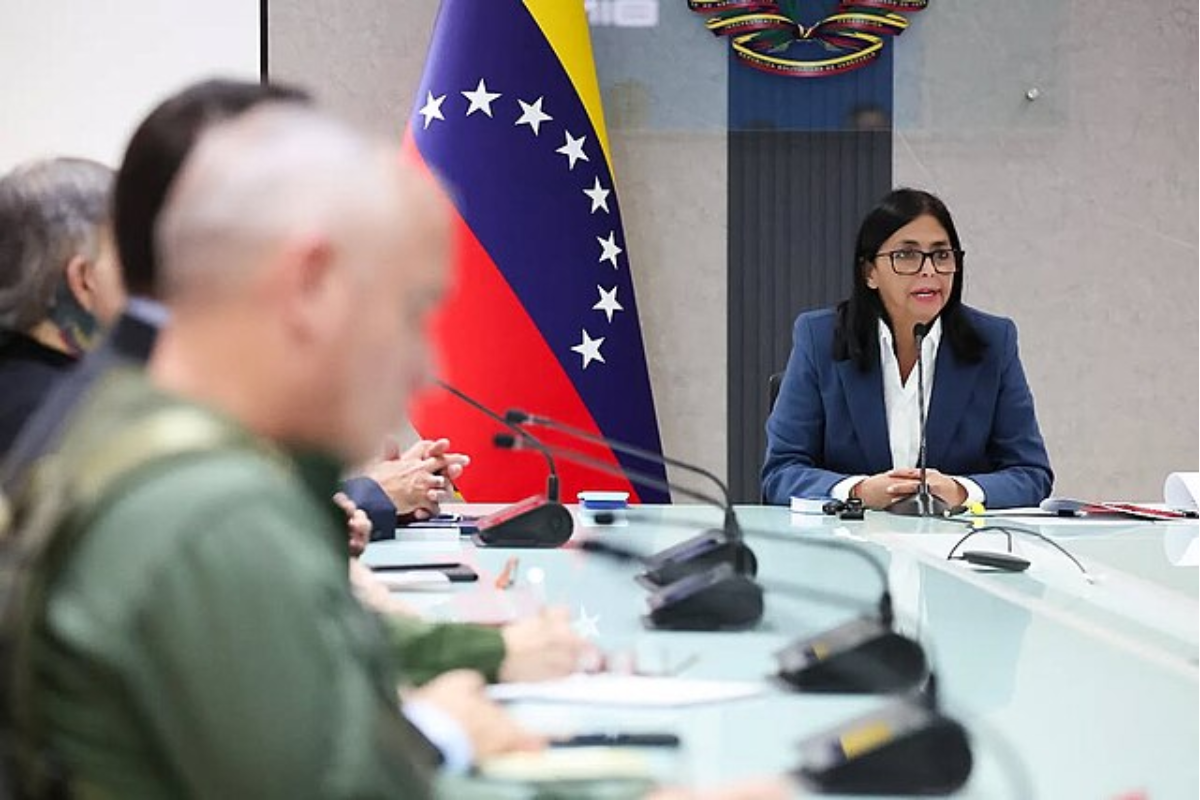
UPDATE: Venezuela’s interim leader, Delcy Rodriguez, is now at the center of a geopolitical storm after US President Donald Trump issued a stark warning: she could “pay a very big price” if she refuses to align with Washington’s plans for the oil-rich nation. This urgent development follows her assumption of power on October 21, 2023, after the Venezuelan Supreme Court appointed her acting president for a 90-day term following the unexpected capture of President Nicolas Maduro during a predawn US military operation.
Rodriguez’s rise to power comes as she faces mounting pressure from the Trump administration, which is demanding cooperation. Just hours after Maduro’s capture, Rodriguez condemned the US military action as a “blatant violation of international law,” asserting, “There is only one president in this country, and his name is Nicolas Maduro.” This declaration directly contradicts Trump’s claims that she had communicated with Secretary of State Marco Rubio about supporting US interests in Venezuela.
In an interview broadcasted on October 22, 2023, Trump indicated that Rodriguez’s decisions could have severe consequences. “If she doesn’t do what’s right, she is going to pay a very big price, probably bigger than Maduro,” he stated, signaling a tense standoff.
The implications are significant. Trump announced plans for the United States to “run” Venezuela temporarily, with major US oil companies set to invest billions in the country’s dilapidated infrastructure. Rodriguez, who also serves as Venezuela’s finance and oil minister, has established connections with US Republicans and oil industry leaders who oppose regime change.
Born on May 18, 1969, in Caracas, Rodriguez has deep roots in Venezuela’s political landscape. She is the daughter of Jorge Antonio Rodriguez, a leftist figure who was killed in police custody during the 1970s. A lawyer by training, she has rapidly ascended through political ranks, serving in key government roles under Maduro’s administration.
The current crisis has plunged Venezuela into a constitutional quandary. According to Articles 233 and 234 of the Venezuelan constitution, the vice president assumes presidential duties in the event of the president’s absence. However, it remains unclear if this rule applies in the context of foreign military intervention. The Venezuelan military has recognized Rodriguez as acting leader, while Defence Minister Vladimir Padrino Lopez endorsed the Supreme Court’s ruling.
Opposition factions, however, challenge Rodriguez’s legitimacy, claiming that the 2024 elections were fraudulent. They argue that former ambassador Edmundo González Urrutia should be recognized as the rightful leader, a position supported by several regional governments and prominent opposition figures.
As Venezuela stands on the brink of further upheaval, all eyes are on Rodriguez. Her next moves could reshape the nation’s political landscape and determine the future of US-Venezuela relations.
Stay tuned for more updates as this situation develops.