
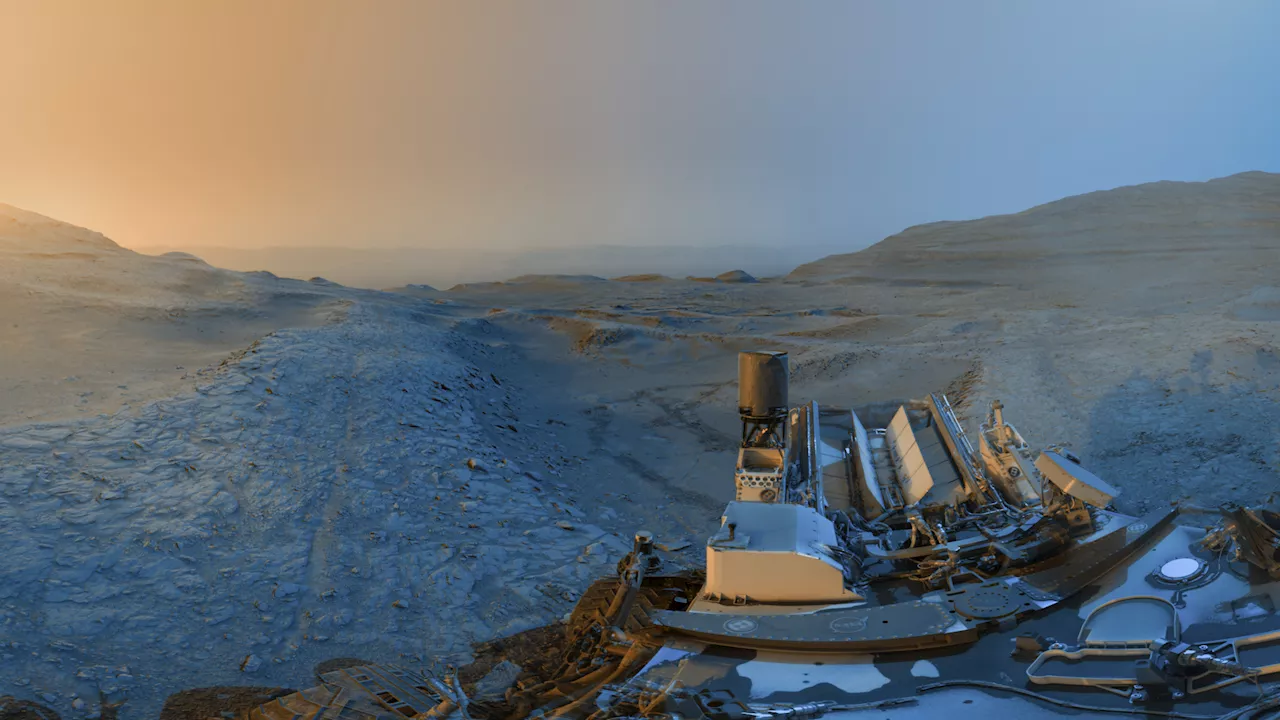
NASA’s Curiosity rover has sent back a captivating panoramic image from its exploration of Mount Sharp on Mars, revealing intricate details of the planet’s ancient landscape. This remarkable “postcard” combines images captured over two consecutive Martian days—November 4, 2025 and November 5, 2025—to showcase the rugged terrain shaped by long-vanished water.
The panoramic view illustrates how changing light conditions highlight the unique geological features of Mars. Images taken at 4:15 p.m. on the first day and 8:20 a.m. on the following day were merged and color-enhanced. NASA officials emphasized that adding color helps different landscape details emerge, enriching our understanding of the Martian environment.
Insights into Mars’ Geological History
The images emphasize the boxwork formations on the slopes of Mount Sharp, which contain complex networks of mineral-rich ridges. These features are remnants of ancient groundwater that once flowed through cracks in the rock, leaving behind hardened mineral veins after billions of years of erosion. Scientists are particularly interested in these formations as they provide vital evidence of Mars’ wet past and shifting environmental conditions.
In addition to capturing stunning visuals, the Curiosity rover continues its scientific mission by conducting in-situ analysis. Recently, the rover utilized its drill at a site known as “Nevado Sajama,” collecting samples from the top of a ridge. The panoramic view looks northward across these boxwork formations, extending down the slopes of Mount Sharp toward the crater floor. The crater’s rim is visible in the distance, approximately 25 miles away, while wheel tracks mark areas where Curiosity has previously drilled at another site called “Valle de la Luna.”
Advancements in Martian Exploration
Curiosity’s mission has lasted over 13 years, making it a vital asset in unraveling the story of Mars. The rover’s work focuses on understanding how the planet transitioned from a potentially habitable environment to its current cold and arid state. By examining rock chemistry, textures, and mineral formations, scientists continue to piece together clues about the planet’s historical climate.
Recent technological improvements have enhanced Curiosity’s efficiency. The rover can now conduct scientific observations while maintaining communication with orbiters orbiting Mars. This dual functionality maximizes the scientific output from Curiosity’s aging nuclear power source.
NASA’s commitment to exploring Mars is reflected not only in the achievements of the Curiosity rover but also in its plans for future missions. Lower-cost projects, like NASA’s ESCAPADE, are being developed to expand our understanding of the Martian environment, albeit with inherent risks and trade-offs.
As Curiosity continues to deliver breathtaking views and valuable scientific data, it reinforces the idea that Mars still has many stories left to tell. The ongoing exploration of the Red Planet fuels curiosity and inspires future generations of scientists and explorers.
In summary, the latest panoramic image from Curiosity serves not only as a stunning visual representation of Mars’ landscape but also as a reminder of the intricate history that lies beneath its surface.