
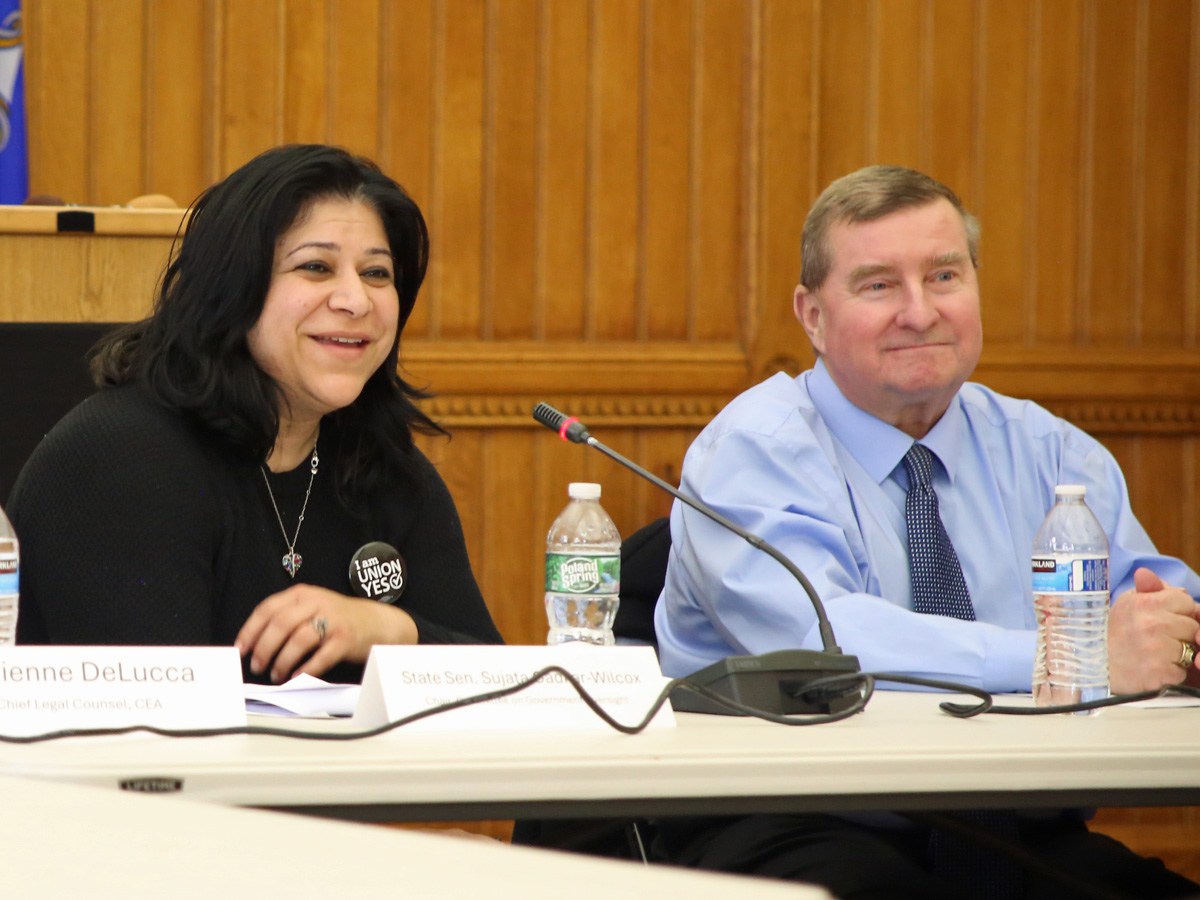
At the Connecticut Education Summit on January 28, 2024, held at the State Capitol in Hartford, a panel of lawmakers and education leaders engaged in a critical discussion regarding teachers’ rights to free speech. The panel highlighted the complex challenges educators face in expressing their opinions while navigating potential repercussions from school administrations and concerned parents.
During the session, State Senator John Kissel emphasized that teachers should not have to sacrifice their First Amendment rights for their careers. “Expanding teachers’ rights to speak, in certain forums, I would support,” he stated, advocating for greater protections for educators. Kissel was joined by Sujata Gadkar-Wilcox, a fellow state senator, as they explored the implications of free speech for teachers.
The conversation began with Kate Dias, President of the Connecticut Education Association (CEA), who posed the question of whether teachers truly have free speech rights. Adrienne DeLucca, general counsel for the CEA, clarified that the U.S. Supreme Court has made rulings that protect teachers’ speech, but with significant limitations. “Basically, you have to be speaking as a private citizen and not as an employee, and have to talk on a matter of public concern,” she explained.
DeLucca pointed out the blurred lines teachers face, especially when they have children in the same school district. “What happens if the teacher has children in the district?” she asked, highlighting the complications that arise when teachers express opinions that could upset a parent. Additionally, she mentioned that teachers can be disciplined for actions deemed disruptive to the school environment, which could occur if a single parent feels offended.
Legal counsel for the American Federation of Teachers – CT, James Demetriades, echoed these sentiments. He noted that educators are among the most educated members of society and have valuable insights into local governance. “It is so important that communities show up to support their teachers when these issues come up,” Demetriades stated. He recalled instances where teachers were hesitant to approach school boards about pressing issues, such as the fear of immigration enforcement (ICE) in schools or the impact of COVID-19 on student learning. “We say to them, be careful,” he cautioned, explaining that discussing these topics from a teacher’s perspective could limit their free speech rights.
The role of social media in complicating free speech for teachers was another focal point of the discussion. Gadkar-Wilcox noted that teachers have faced challenges when private posts on social media are shared publicly by parents. “There was an incident at a school where there was a threat attributed to a teacher even though the post was shared by a parent,” she recounted, underscoring that even private expressions can lead to serious professional consequences.
The panelists also discussed the need for improved safeguards for teachers, including measures to protect their personal information, such as home addresses, to enhance their safety. Gadkar-Wilcox remarked on the heightened risks teachers face today compared to a decade ago. “We’re in a moment where teachers are facing that risk that 15 years ago they didn’t face,” she pointed out.
Kissel shared his own experiences with public protests, noting that while such incidents are infrequent, they can be unsettling. “It’s not often, but it’s a little disconcerting,” he said, indicating that public scrutiny of educators has intensified.
The discussion at the Connecticut Education Summit highlighted the ongoing tension between educators’ rights to free speech and the potential repercussions they face in their professional environments. As this issue continues to evolve, it raises important questions about the balance between individual expression and job security for teachers across the state.