
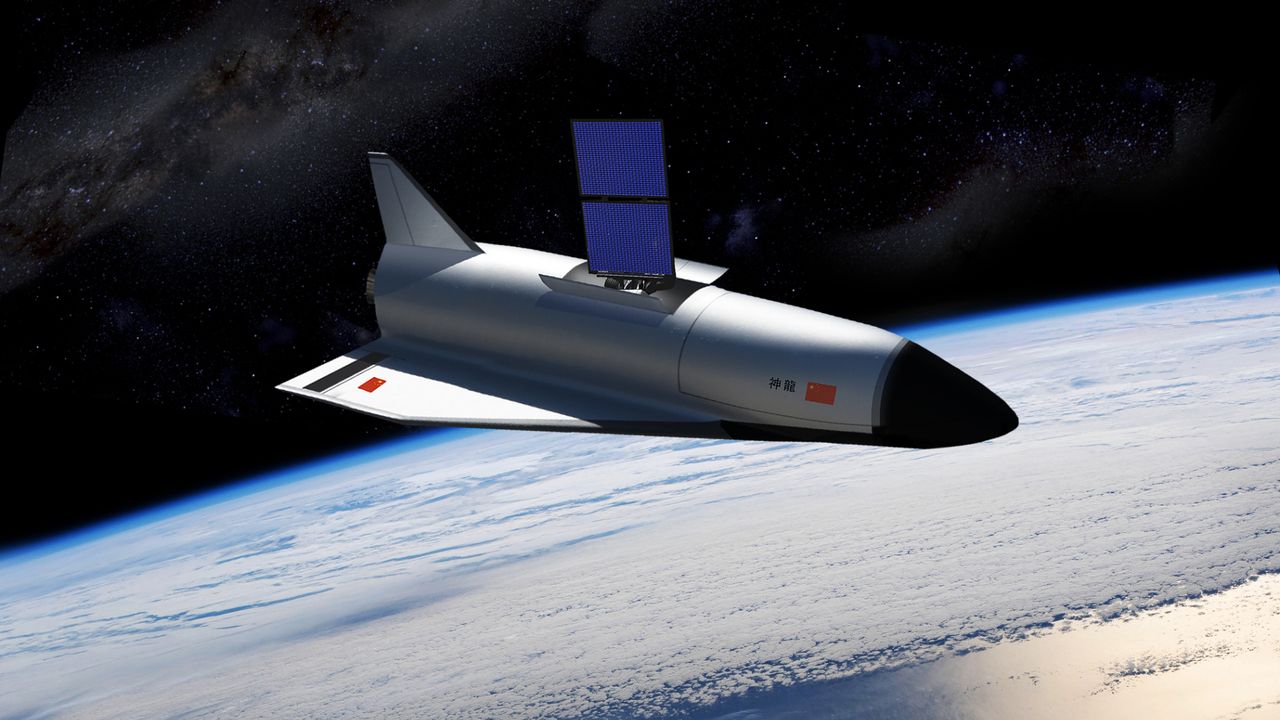
China’s reusable space plane, known as the Shenlong or “Divine Dragon,” has successfully launched on its fourth mission, marking another significant step in the nation’s space exploration efforts. The spacecraft took off from the Jiuquan Satellite Launch Center in the Gobi Desert on February 6, 2024. While the Chinese government has been tight-lipped about the specifics of this mission, it follows a pattern established by the vehicle’s previous flights.
The Shenlong spacecraft has now completed three prior missions, which occurred in September 2020, May 2023, and September 2024. Each mission has varied in duration, with the first lasting two days, the second extending to 276 days, and the third lasting 266 days. Official statements from the Chinese authorities describe the purpose of Shenlong as testing technologies for “more convenient and affordable round-trip methods for the peaceful use of space in the future.” However, the vagueness of this description has led to speculation regarding the actual objectives of the spacecraft.
The Shenlong is often compared to the United States military’s X-37B, an autonomous space plane that has also conducted multiple missions since its first launch in 2010. The X-37B, which is approximately 29 feet (8.8 meters) long, serves as a technology testbed for various applications and has been involved in classified operations. Currently, it is on its eighth mission, launched last August aboard a SpaceX Falcon 9 rocket.
While both vehicles share similarities, including size and purpose, there are distinct differences in their operational profiles. The X-37B has faced scrutiny over its potential military applications, although experts from the Secure World Foundation (SWF) assert that concerns about its capabilities might be exaggerated. According to SWF, the X-37B has never approached or interacted with other known space objects during its missions, maintaining a low orbit that is generally below most operational satellites.
In contrast, the Shenlong has engaged in rendezvous operations, deploying payloads during its prior missions. Reports indicate that during its inaugural mission, Shenlong released a satellite capable of transmission broadcasts, and a subsequent mission involved deploying a satellite with independent propulsion capabilities. Such operations suggest that the Shenlong may prioritize close maneuvers and docking procedures, a skill set that has become increasingly relevant in modern space exploration.
Concerns Surrounding Shenlong’s Capabilities
The ability to conduct rendezvous and proximity operations (RPOs) is a significant focus for many countries, including China, the United States, and Russia. Mastering RPO technology could enable operators to refuel, upgrade, or even deorbit their own satellites, as well as inspect or potentially interfere with adversarial spacecraft. Victoria Samson, chief director of space security and stability for SWF, emphasized the importance of these capabilities, stating, “If you want to have space superiority, you need to be able to conduct RPOs.”
The secrecy surrounding the Shenlong program has led to increased speculation regarding its potential military applications, including anti-satellite capabilities. Analysts are wary of the implications of such technology, particularly given the limited information available on the spacecraft’s actual missions. Samson remarked that more transparency would be beneficial to alleviate fears surrounding both the Shenlong and X-37B programs. “I think a little more transparency would help fill in some of the blanks,” she stated, noting that without additional information, assumptions often lean toward worst-case scenarios.
As the Shenlong continues its missions, the international community will be closely monitoring its activities. The ongoing developments in space technology and exploration open up discussions about military and civilian applications, and the implications for global security remain a significant point of concern. The future of space operations, particularly concerning RPOs, will likely shape the framework for international space policy and cooperation.