
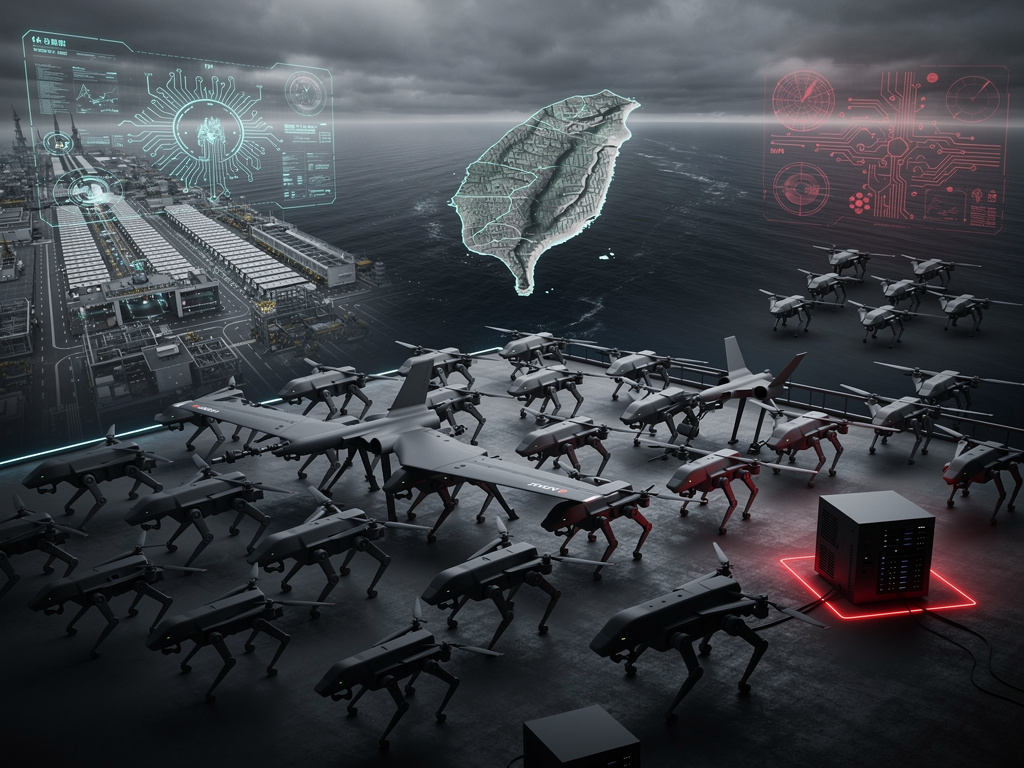
URGENT UPDATE: China is advancing its military capabilities with groundbreaking developments in AI-driven drone warfare. Engineers at Beihang University, linked to the military, have successfully trained drones to mimic hawks and doves in combat scenarios, achieving remarkable results in just **5.3 seconds** during tests. This innovative approach highlights Beijing’s commitment to integrating nature-inspired AI into its autonomous weapons systems.
As confirmed by The Wall Street Journal, the People’s Liberation Army (PLA) is aggressively pursuing advanced AI technologies for drone swarms and robotic systems to dominate the battlefield with minimal human oversight. In a striking demonstration of this capability, state media showcased the Swarm 1 system, capable of launching **48 fixed-wing drones**, emphasizing China’s production advantage of over **one million drones annually**, far surpassing the **tens of thousands** produced by the U.S.
The PLA’s ambition is evident as military theorists declared in October 2024 that the AI era marks a “new style of warfighting,” positioning unmanned systems as the primary combat force. The unveiling of the Jiutian mothership drone in **December 2024**, designed to deploy smaller drones, further emphasizes this shift.
With increasing tensions, experts are warning of the implications of such autonomous systems. Sunny Cheung, an open-source intelligence analyst, stated, “There’s a growing consensus that autonomous systems have the potential to perform better than humans.” This reflects the PLA’s concerns regarding soldier effectiveness, particularly in light of the challenges observed in Ukraine, where drone autonomy is frequently jeopardized.
The PLA’s advancements are not limited to aerial drones. The military’s recent procurement initiatives include a **2024 tender** for a mobile cognitive warfare system featuring AI deepfakes and robotic dogs for reconnaissance. With at least **930 swarm intelligence patents** filed since 2022, compared to just **60 in the U.S.**, China’s technological lead in this area is undeniable.
The integration of DeepSeek AI into weapons systems by **2025** is set to revolutionize PLA operations, enabling drones to engage multiple low-threat targets efficiently. Recent PLA drills in **August 2025** tested the effectiveness of drone swarms alongside robotic wolves, signifying a new era of collaborative combat.
In a significant demonstration on January 23, 2026, the PLA’s National University of Defense Technology showcased a soldier controlling over **200 autonomous drones** in less than **100 seconds**, a testament to the rapid evolution of military technology. This shift to “effect-based control” aims to enhance resilience against jamming.
While the U.S. attempts to keep pace, including deploying a **$35,000** kamikaze drone, experts warn that current American technologies may lag behind. Justin Bradley from North Carolina State University highlighted the challenges, noting, “We don’t have good-enough perception on these vehicles for them to know where each other are.”
The implications of these advancements are profound, particularly regarding a potential conflict over Taiwan, where drone swarms could target enemy defenses from a distance. However, risks persist, including the possibility of uncontrolled decisions from AI systems, as warned by analysts at the National Defense University.
As calls for regulations on military AI grow louder, testing continues to outpace rule-making. The U.S. is aiming for thousands of autonomous drones by **the end of 2025** to counter China’s growing capabilities. With its unmatched supply chain and rapid patent growth, China is poised to redefine modern combat through intelligent, massed machines.
Stay tuned for further updates as this situation develops, impacting global military dynamics.