
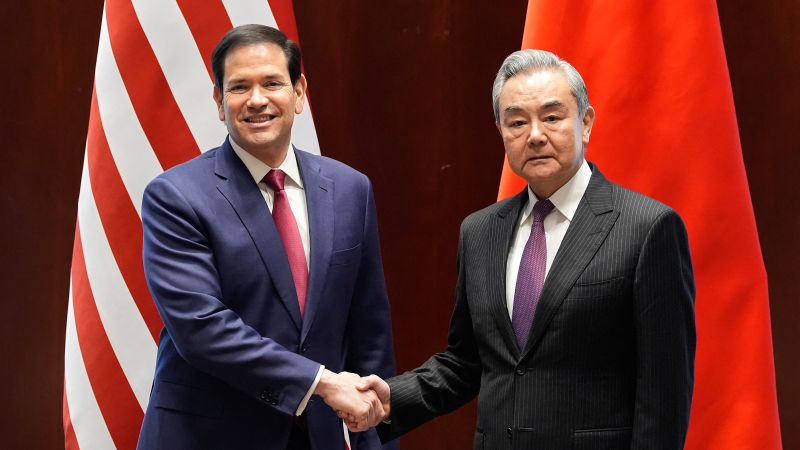
UPDATE: In a dramatic turn at the Munich Security Conference, top US diplomat Marco Rubio and Chinese Foreign Minister Wang Yi both took the stage to assert their nations’ positions in global politics. Minutes apart, Rubio emphasized the enduring bond between the United States and Europe, while Wang sought to woo European partners with a message of collaboration.
During his address, Rubio proclaimed, “The US and Europe belong together,” underlining America’s commitment to its alliances amidst shifting global dynamics. This comes as China intensifies its efforts to reshape its relationship with Europe, asserting that “China and the EU are partners, not rivals,” Wang stated on Saturday.
The stakes are high: the US has been undergoing a significant overhaul in foreign policy, leading to uncertainty among its long-standing allies. The era of US-backed global security appears to be fading, and both powers are racing to influence the future of international relations.
Wang’s message was clear: “As long as we grasp this point, we will make the right choices in the face of challenges.” He criticized the current international system, attributing its problems to “certain countries” that prioritize a “country-first approach,” seemingly targeting US policies.
Rubio’s speech was not just a reassurance for European leaders; it was a call to action. He warned that the international system needs to be “rebuilt” to address these challenges. The timing of both speeches is critical as Donald Trump is expected to visit China later this spring, with the potential to stabilize the turbulent US-China relationship.
China’s outreach comes as it navigates a complex web of international relations, particularly with the US. Wang expressed optimism about the upcoming Trump visit, highlighting two potential paths for US-China relations: one of cooperation and understanding, and another leading to conflict. He cautioned that a failure to engage constructively could escalate tensions, particularly around sensitive issues like Taiwan.
“The latter path would likely push China and the United States toward conflict,” Wang warned during his remarks.
Rubio echoed this sentiment, stating that it would be “geopolitical malpractice” for the US and China not to communicate effectively. Their discussions at the conference indicate a willingness to explore areas of mutual interest, even as both nations prepare for a turbulent geopolitical landscape.
However, Wang’s message may not resonate as strongly as hoped in Europe. With leaders increasingly wary of China’s assertive military actions in regions like the South China Sea and its implications for Taiwan, European nations are approaching China with caution. The backdrop of China’s support for Russia during its invasion of Ukraine further complicates the relationship.
On Sunday, Taiwan’s foreign minister Lin Chia-lung countered Wang’s portrayal of China as a peaceful power, criticizing its recent military provocations that contradict international norms. The ongoing tensions over Taiwan highlight the stakes involved as both the US and China vie for influence in Europe.
As the conference unfolds, the question remains: how receptive will Europe be to China’s overtures? Beijing is aware that European leaders are recalibrating their foreign policies in light of a shifting relationship with the US. Recent visits by leaders from US-allied countries to Beijing signal a potential shift in dynamics.
The conference organizers highlighted that the US-led international order established post-World War II is “now under destruction,” with the US being seen as a significant disruptor. European leaders may have exhaled in relief after Rubio’s speech, but lingering concerns over Trump’s previous threats, including taking control of Greenland—a NATO ally’s territory—still echo in their minds.
As China pushes its narrative of stability and partnership, Europe will need to navigate these complex waters carefully, balancing its interests in both the US and China. The outcomes of these discussions could shape the future of global alliances and power dynamics for years to come.