
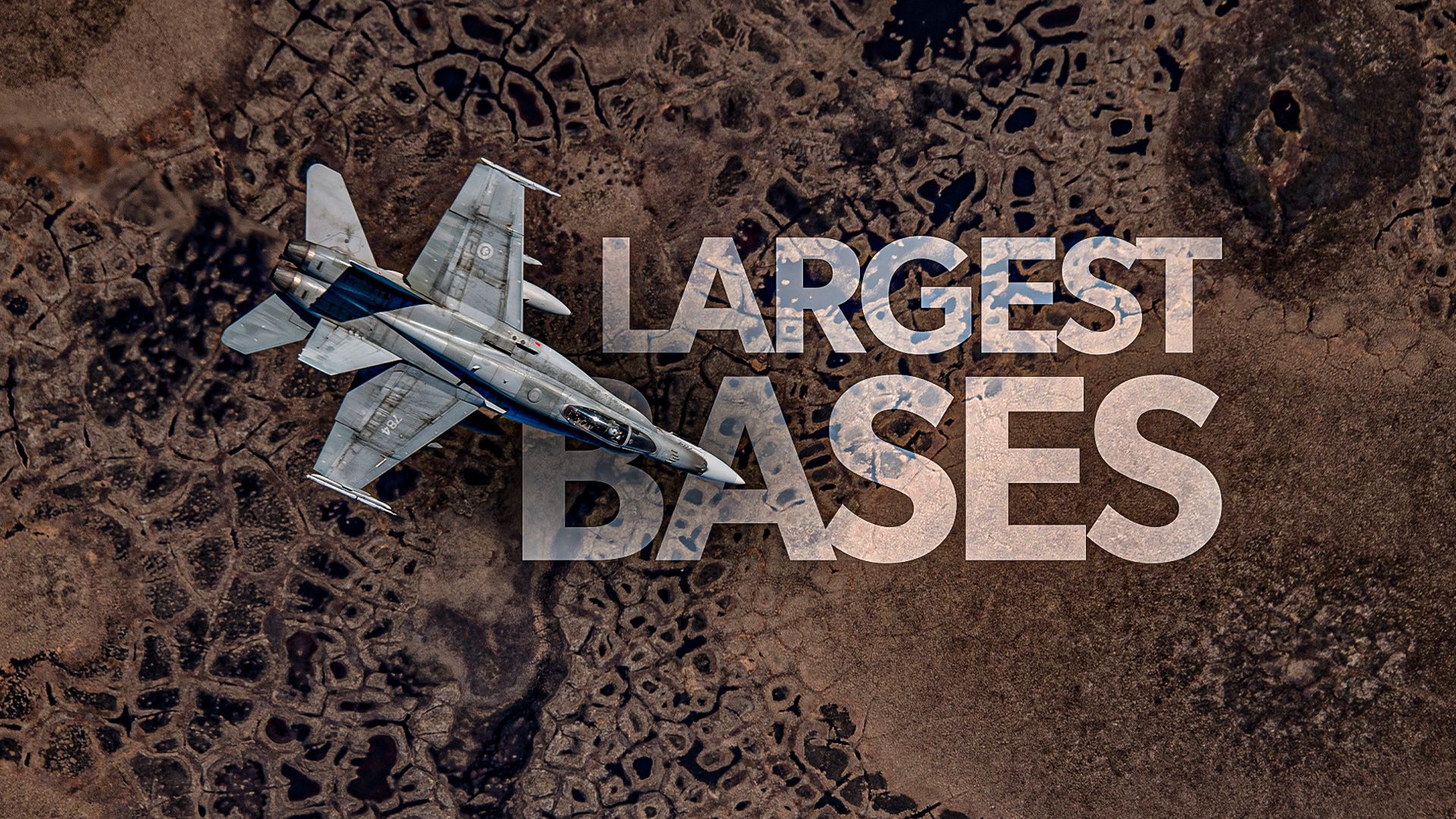
The Royal Canadian Air Force (RCAF) plays a vital role in Canada’s national defense, operating various airbases across the country. These installations support advanced military aircraft, including fighter jets and transport planes, and are essential for fulfilling the RCAF’s commitments to both national and international security. Among the many bases, seven stand out due to their size, operational capacity, and strategic importance.
Overview of Canada’s Largest Air Bases
Canada’s extensive airbase network is critical for supporting operations under the North American Aerospace Defense Command (NORAD). The RCAF collaborates closely with the United States Armed Forces and other NATO partners, enhancing its operational capabilities. While the RCAF has established Operational Support Hubs (OSHs) overseas in locations such as Germany and Kuwait, the majority of its largest airbases are located within Canada.
According to the Global Firepower Index, Canada ranks approximately 28th out of 145 nations in military strength. This ranking reflects the RCAF’s commitment to maintaining a modern, capable military force. The following are the seven largest airbases by land area, showcasing their unique roles and contributions.
1. CFB Goose Bay: The Largest Training Area
Canadian Forces Base Goose Bay is the largest airbase in terms of land area, encompassing over 50,000 square miles (130,000 square kilometers). Located in Labrador, this base is renowned for its extensive military flight training areas, which are crucial for NORAD and allied training exercises. Its main runway, over 11,000 feet long, is among the longest in Eastern Canada, accommodating a range of aircraft.
Goose Bay serves as a hub for international military collaborations, hosting NATO partners for winter warfare training. The facility’s unique capabilities include ultra-low-level flight training, enabling forces to practice radar evasion tactics in rugged terrain. CFB Goose Bay also supports Operation BOXTOP, a mission dedicated to resupplying CFS Alert, the world’s northernmost permanently inhabited settlement.
2. CFB Cold Lake: Canada’s Busiest Fighter Base
CFB Cold Lake spans over 4,500 square miles (11,700 square kilometers) and is the busiest fighter base in Canada. Located in Alberta, it is home to the Cold Lake Air Weapons Range (CLAWR), which is considered one of the premier fighter training facilities globally. The base supports the 401 and 409 Tactical Fighter Squadrons, both of which operate the CF-18 Hornet.
Currently, Cold Lake is undergoing significant infrastructure upgrades to prepare for the arrival of the F-35A Lightning II stealth fighter jets. Projects include building new hangars and modernizing existing facilities. The first F-35s are expected to arrive in 2028.
3. CFB Greenwood: Maritime Operations Hub
Located in Nova Scotia, CFB Greenwood covers an area of 5.5 square miles (14 square kilometers) and serves as the primary hub for the RCAF’s maritime patrol and search and rescue operations on the East Coast. The base is preparing to receive the Boeing P-8A Poseidon, which will replace the CP-140 Aurora fleet.
Recent investments of $97 million aim to build new residential units for personnel, while a new $33 million aircraft refueling facility is scheduled for completion. Greenwood also oversees extensive military exercise areas for anti-submarine warfare and sovereignty patrol training.
4. CFB Bagotville: Key Fighter Operations
CFB Bagotville is one of Canada’s two main fighter bases, situated in Quebec and covering 4 square miles (10 square kilometers). Under the command of 3 Wing, Bagotville plays a crucial role in Canada’s air defense strategy and is responsible for protecting airspace over eastern Canada.
The base is currently undergoing a major transformation to accommodate the new F-35A Lightning II fighter jets. Facilities are being upgraded to include advanced hangars and flight simulators. It also shares its runways with Bagotville Airport, allowing for dual-use operations.
5. CFB Trenton: The Hub for Air Mobility
Located in Ontario, CFB Trenton occupies an area of 2.12 square miles (5.5 square kilometers) and is recognized as the busiest air force base in Canada. As the primary hub for air mobility and transport operations, Trenton houses almost all fixed-wing airlifters in the RCAF.
The base is currently undergoing an $850 million modernization to support the CC-330 Husky strategic tanker fleet. It plays a vital role in providing aerial refueling and transport capabilities for NORAD and NATO missions.
6. CFB Comox: The Pacific Coast Installation
CFB Comox, located on Vancouver Island, covers 1.93 square miles (5 square kilometers) and serves as the RCAF’s main installation on the West Coast. It supports NORAD operations and conducts anti-submarine warfare along the Pacific coastline.
The base is home to the 442 Transport and Rescue Squadron, which operates in one of the most challenging search and rescue regions, from the ocean to the Rocky Mountains. CFB Comox shares its airfield with civilian flights and features the Comox Air Force Museum.
7. CFB Moose Jaw: Training New Aviators
Canadian Forces Base Moose Jaw, also known as 15 Wing, occupies approximately 1.54 square miles (4 square kilometers) in Saskatchewan. It serves as the primary training hub for new aviators through the 2 Canadian Forces Flying Training School.
Moose Jaw is also home to the 431 Air Demonstration Squadron, famously known as the Snowbirds. The base plays a significant role in the $11.2 billion Future Aircrew Training program, modernizing training infrastructure and preparing pilots for advanced aircraft like the F-35.
These seven airbases illustrate the RCAF’s commitment to maintaining a robust defense posture and ensuring readiness for both domestic and international operations. Each base plays a unique role in supporting Canada’s military objectives, contributing to the country’s overall security strategy.