
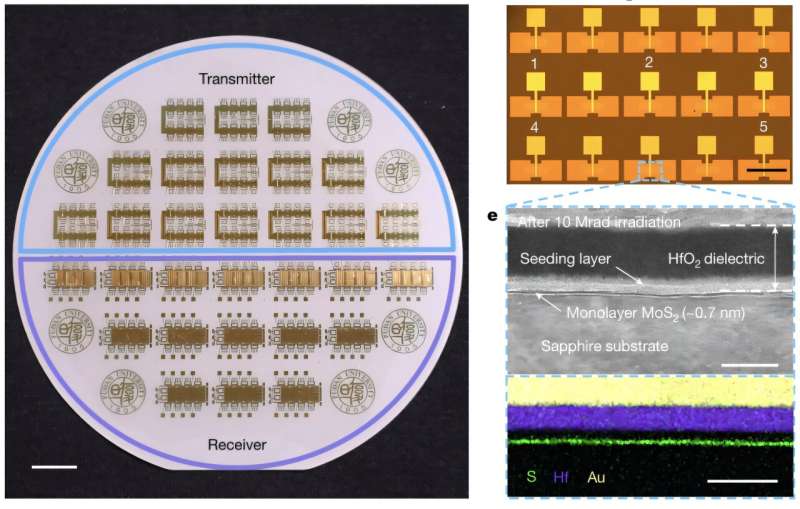
Researchers at Fudan University in China have made significant strides in developing radiation-resistant electronics suitable for space applications. Their study, published on February 20, 2026, in the journal Nature, demonstrates that electronics constructed from atom-thick layers of molybdenum disulfide (MoS2) can withstand the harsh radiation conditions of outer space without significant performance degradation.
Spacecraft electronics are particularly vulnerable to cosmic rays and heavy ions once they venture beyond Earth’s protective magnetic field. Traditional shielding methods, while effective, add weight and occupy valuable space within spacecraft, which can increase launch costs and limit the payload capacity for scientific instruments. This new research suggests a more efficient solution: using materials that inherently resist radiation damage.
The research team, led by Peng Zhou, focused on the capabilities of MoS2, which is only about 0.7 nanometers thick. Previously, laboratory studies indicated that this material is resilient to radiation-induced defects. In their latest experiments, the researchers fabricated a radio-frequency communications system using monolayer MoS2 and subjected it to intense gamma ray bursts, simulating conditions encountered in space.
To evaluate the effects of radiation, the team employed advanced imaging techniques, including transmission electron microscopy and energy-dispersive spectroscopy. This thorough analysis revealed no significant structural or chemical damage to the MoS2 after exposure. Moreover, the electrical performance of the circuits remained nearly unchanged, exhibiting high on-off ratios and minimal current leakage when voltage was applied.
The promising results prompted the researchers to take their experiments to the next level. They launched the MoS2-based circuit into low-Earth orbit, approximately 500 kilometers above the Earth, a typical altitude for many communication satellites. Over a period of nine months, the device reliably transmitted data, achieving an exceptionally low error rate. Ultimately, it successfully received and transmitted the complete Anthem of Fudan University with remarkable clarity.
Based on their findings, Zhou’s team estimates that electronics made from this atomically thin material could potentially survive for around 271 years in geosynchronous orbit. This longevity far surpasses that of conventional silicon-based technologies, which typically have a much shorter lifespan in space conditions.
If further validated in upcoming missions, the intrinsic radiation resistance of MoS2 could lead to lighter and longer-lasting electronics for both deep-space exploration and high-orbit communications. The implications of this research extend beyond just improved durability; it could revolutionize spacecraft design by enabling more efficient use of space and resources.
The work done by Zhou and his colleagues not only highlights the potential of MoS2 in aerospace applications but also represents a significant step forward in the quest for more resilient electronics in the face of ever-increasing challenges posed by space environments. This development underscores the importance of innovative materials science in advancing technology for future exploration.