
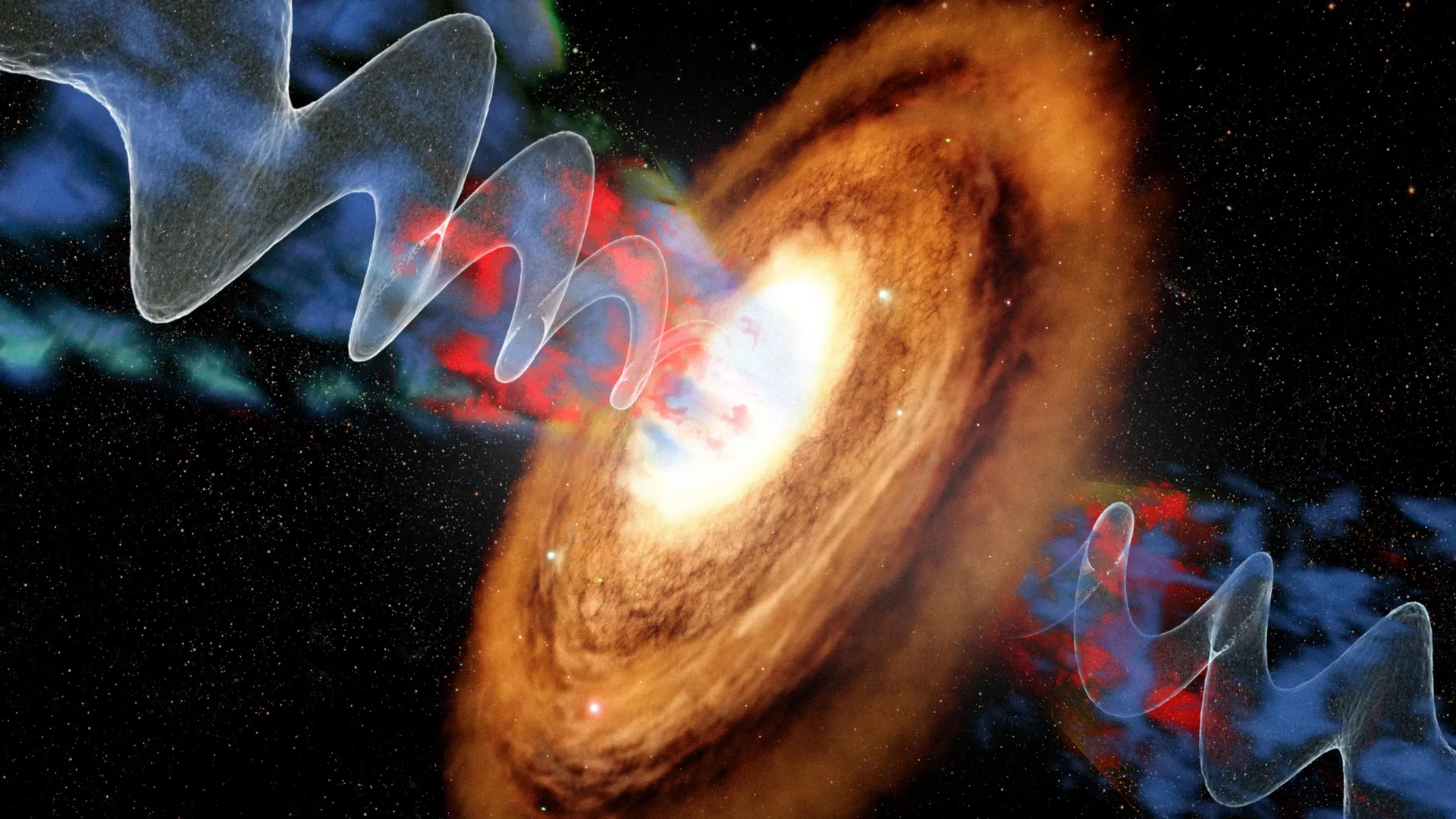
Scientists at the University of California, Irvine have identified an extraordinary outflow of super-hot gas erupting from a nearby galaxy, driven by a powerful black hole at its core. This discovery, made using data from NASA’s James Webb Space Telescope, reveals a massive stream of gas that is depleting the galaxy’s ability to form new stars at an alarming rate.
Remarkable Findings from VV 340a
The galaxy, known as VV 340a, displays an unprecedented stream of super-heated gas, marking what researchers believe to be the largest such structure ever recorded in the universe. The discovery was documented in a recent issue of the journal Science. The Webb telescope’s capabilities allowed astronomers to penetrate thick dust surrounding the galaxy, revealing extensive clouds of extremely hot gas ejecting from both sides.
These gas streams create two elongated nebulae, each stretching at least three kiloparsecs in length, a distance that far exceeds the thickness of the galaxy’s disk, which measures about three kiloparsecs. “In other galaxies, this type of highly energized gas is almost always confined to several tens of parsecs from a galaxy’s black hole; our discovery exceeds that by a factor of 30 or more,” said Justin Kader, a postdoctoral researcher in physics and astronomy at UC Irvine.
Jets and Their Impact on Star Formation
Radio observations from the Karl G. Jansky Very Large Array in New Mexico revealed that these jets are formed when gas spiraling into a supermassive black hole reaches extreme temperatures. The interaction with powerful magnetic fields launches energized material outward at incredible speeds, creating a spiral-like path through space. This phenomenon, known as “jet precession,” indicates a gradual shift in the jets’ direction over time, akin to the wobble of a spinning top.
“This is the first observation of a precessing kiloparsec-scale radio jet in a disk galaxy,”
Kader added. “It represents a major milestone in our understanding of these energetic phenomena.”
The jets exert a significant influence on the galaxy, forcing surrounding material away from the center and heating it to extreme temperatures. This results in the formation of what scientists call coronal line gas, a highly ionized and super-hot plasma, which is unusual for such gas to extend far beyond the vicinity of the black hole.
The energy produced by this outflow is staggering, calculated to be equivalent to 10 quintillion hydrogen bombs detonating every second. “We found the most extended and coherent coronal gas structure to date,” said Vivian U, a former UC Irvine research astronomer now at Caltech’s Infrared Processing and Analysis Center. “We were surprised to see such highly collimated and extended emission in our initial observations.”
Data from multiple telescopes were essential to piece together the full picture of this violent outflow. The Keck II Telescope in Hawaii revealed cooler gas extending up to 15 kiloparsecs from the black hole, indicating a historical record of previous jet activity.
The Role of the James Webb Space Telescope
The James Webb Space Telescope, located approximately one million miles from Earth, is the largest space telescope ever constructed. Its ability to observe the universe in infrared light is crucial for studying objects obscured by dust, such as VV 340a. While traditional telescopes struggled with visibility, Webb’s infrared capabilities allowed it to unveil the coronal gas clearly.
The findings have profound implications for our understanding of galaxy evolution. VV 340a is losing enough gas each year to form 19 stars like our sun. Kader noted, “The black hole’s jets significantly limit the process of star formation in the galaxy by heating and removing star-forming gas.”
While there are no similar jet activities observed in the Milky Way today, Kader pointed out that evidence suggests our supermassive black hole likely experienced a feeding event around two million years ago, possibly visible to early human ancestors.
With this groundbreaking discovery, researchers plan to investigate other galaxies for similar features, aiming to understand how such powerful black hole activity shapes the long-term evolution of galaxies like our own. “We are excited to explore these never-before-seen phenomena at different scales of galaxies and anticipate uncovering more intriguing findings,” U concluded.
Funding for this research was provided by NASA and the National Science Foundation.