
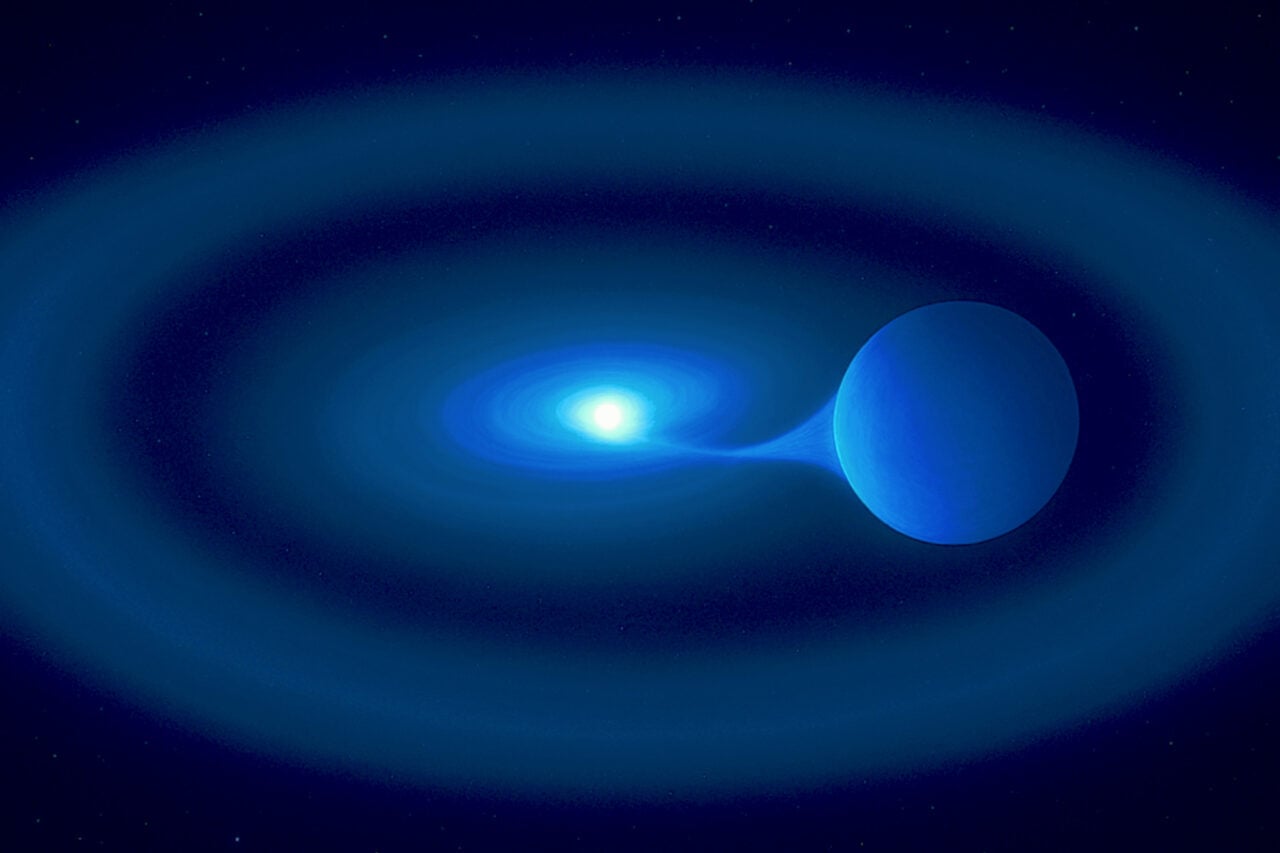
A significant discovery in the field of astronomy reveals that a binary star system known as V Sagittae is on a path to a spectacular explosion. Research published in August 2023 in the journal *Monthly Notices of the Royal Astronomical Society* highlights the unique characteristics of this system, located approximately 10,000 light-years from Earth. The findings indicate that one star, a super-dense white dwarf, is consuming its larger companion at an unprecedented rate, setting the stage for an extraordinary supernova event visible from Earth during the day.
The research team, led by astronomers from the University of Southampton and the University of Turku, has unraveled a mystery that has puzzled scientists since the system’s discovery in 1902. According to Phil Charles, a co-author of the study, the extreme brightness of V Sagittae is attributed to the white dwarf feeding on its companion star. “The white dwarf is sucking the life out of its companion star, using the accreted matter to turn it into a blazing inferno,” he stated in a university release. This process is so intense that it is causing thermonuclear reactions on the surface of the white dwarf, resulting in an extraordinary luminosity.
Insights from Observations
The research team utilized the European Southern Observatory’s Very Large Telescope in Chile to observe this dynamic duo, which orbits each other every 12.3 hours. During their observations, they also discovered a large ring of gas surrounding the binary stars, composed of debris produced by the intense energy generated by the white dwarf. Pasi Hakala, co-lead author of the study, explained, “The white dwarf cannot consume all the mass being transferred from its hot star twin, so it creates this bright cosmic ring.”
This revelation not only provides insight into the life cycle of stars but also indicates that the system is in a state of rapid change. The intense brightness of V Sagittae serves as a frantic sign of its eventual demise.
Future Explosive Events
Looking ahead, the researchers predict that the accumulation of material on the white dwarf could lead to a nova outburst in the near future. Pablo Rodríguez-Gil, another co-lead author and researcher at the Instituto de Astrofísica de Canarias, noted that this outburst would make V Sagittae visible to observers on Earth without any telescopes. He stated, “But when the two stars finally smash into each other and explode, this would be a supernova explosion so bright it’ll be visible from Earth even in the daytime.”
This imminent explosion not only promises to be a stunning astronomical event but also enhances our understanding of stellar behaviors and the processes that govern their life cycles. As V Sagittae heads towards its fiery conclusion, scientists eagerly anticipate the insights it will provide into the nature of binary star systems and the phenomena surrounding them.