
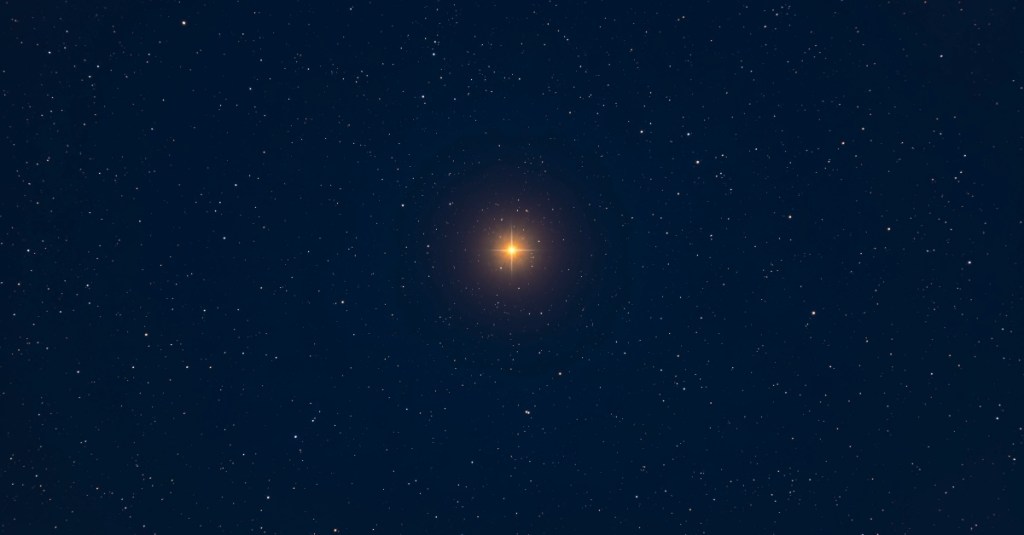
A recent breakthrough in astronomy has revealed that Betelgeuse, the well-known red supergiant star, is accompanied by a previously unnoticed companion star. This discovery sheds light on the unusual brightness fluctuations of Betelgeuse, which have puzzled scientists for years. The findings come after nearly eight years of observations using the Hubble Space Telescope and ground-based observatories in Arizona and the Canary Islands.
Understanding Betelgeuse’s Pulsations
Betelgeuse is famous for its variability, pulsing roughly every 400 days due to internal processes typical of aging stars. However, astronomers also noted a second cycle occurring approximately every 2,100 days, which did not align with existing theories about stellar behavior. This longer cycle could not be attributed to known pulsations, leading researchers to theorize the existence of a dim companion star.
After extensive research, conducted by a team led by Andrea K. Dupree from the Harvard-Smithsonian Center for Astrophysics, the theory has been confirmed. The companion star, now officially named Siwarha, has been found to influence Betelgeuse’s emissions indirectly, altering the star’s ultraviolet light and emissions from ionized iron.
New Insights from Observations
The groundbreaking study revealed that as Siwarha orbits Betelgeuse, it creates a dense trail of gas that moves through the red giant’s atmosphere, much like a boat navigating through water. This “wake” alters Betelgeuse’s light in a way that can be detected from Earth. When Siwarha passes in front of Betelgeuse, astronomers observe a sharp increase in brightness, followed by a decrease as the gas trail absorbs radiation.
“The companion star creates a ripple effect in Betelgeuse’s atmosphere that we can actually see in the data,” said Dupree in an official NASA release.
This pattern of brightness changes occurs every 2,109 days, perfectly matching the mysterious long-term cycle that had confounded scientists for decades. The discovery marks a significant advancement in understanding the dynamics of Betelgeuse and its newly identified companion.
Following its recent observations, Siwarha has now moved behind Betelgeuse and will not be visible again until August 2027. Astronomers plan to continue monitoring the ripples and effects of Siwarha on Betelgeuse’s brightness until it reappears. This discovery not only enhances our knowledge of Betelgeuse but also opens avenues for further research into stellar interactions in the universe.