
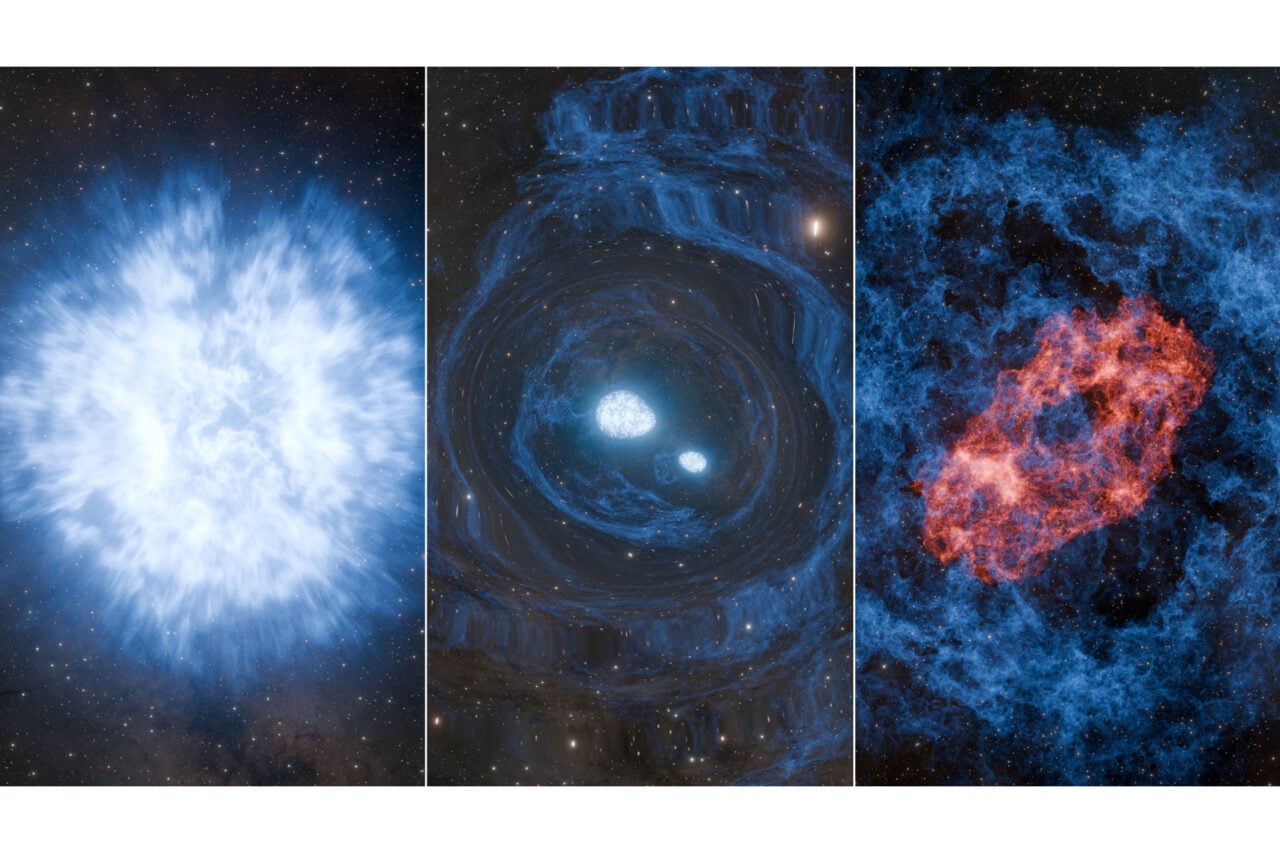
A remarkable cosmic event has captured the attention of astronomers: a stellar explosion that may represent a new category of astronomical phenomenon known as a ‘superkilonova.’ Researchers from the California Institute of Technology detailed their findings in a recent paper published in The Astrophysical Journal Letters. This unique fusion of a supernova and kilonova could provide insights into the life cycles of massive stars and the formation of heavy elements in the universe.
The phenomenon, designated as AT2025ulz, likely began with a supernova explosion that birthed two neutron stars, which subsequently merged to create a kilonova. If confirmed, AT2025ulz would be the second kilonova ever detected, following the historic event observed in 2017. This latest discovery stands out for its complex formation process, pushing the boundaries of current astronomical understanding.
Understanding Stellar Explosions
When massive stars reach the end of their lifespans, they typically explode in a spectacular display known as a supernova. These explosions are crucial for seeding the universe with heavier elements such as carbon and iron. In contrast, kilonovas are less frequent and occur when two neutron stars collide, creating even heavier elements like gold and uranium. Such events send ripples through spacetime, producing gravitational waves that can be detected on Earth by observatories like LIGO.
In August 2023, LIGO detected a signal reminiscent of the earlier kilonova event, prompting astronomers to investigate further. Shortly after the alert, other telescopes confirmed the presence of rapidly fading red lights, indicative of heavy element production consistent with kilonova activity. As observations continued, the source flared again, this time emitting blue light typical of a supernova.
Mansi Kasliwal, the study’s lead author and an astrophysicist at Caltech, remarked on the evolving nature of the eruption: “At first, for about three days, the eruption looked just like the first kilonova in 2017. Everybody was intensely trying to observe and analyze it, but then it started to look more like a supernova, and some astronomers lost interest. Not us.”
New Insights into Stellar Evolution
Kasliwal and her team remained focused, noting that AT2025ulz did not conform to the standard characteristics of either a typical supernova or the previously recorded kilonova. The gravitational wave data indicated the merger of two neutron stars, at least one of which had an unusually low mass.
Brian Metzger, a theoretical physicist at Columbia University and co-author of the study, pointed out the significance of these findings: “No neutron star had ever been observed before with a mass less than that of the Sun, and it was believed to be theoretically impossible.” Yet, LIGO’s data suggested the existence of a sub-solar neutron star involved in this explosive merger.
Metzger theorized that these lightweight neutron stars could be remnants of a rapidly spinning massive star that split apart during a supernova event. The chaotic nature of the explosion could have forced the newly formed neutron stars into a fatal spiral, culminating in the observed kilonova.
Despite the tantalizing nature of these findings, researchers emphasize the need for further investigation. Kasliwal noted, “We do not know with certainty that we found a superkilonova, but the event nevertheless is eye-opening.” AT2025ulz, if validated as a kilonova, highlights the potential for future events to challenge existing classifications and expand our understanding of stellar phenomena.
The discovery of AT2025ulz opens new avenues for research and underscores the dynamic nature of astronomical study. As technology advances, scientists anticipate more such events, which may blur the lines between established categories of stellar explosions.