
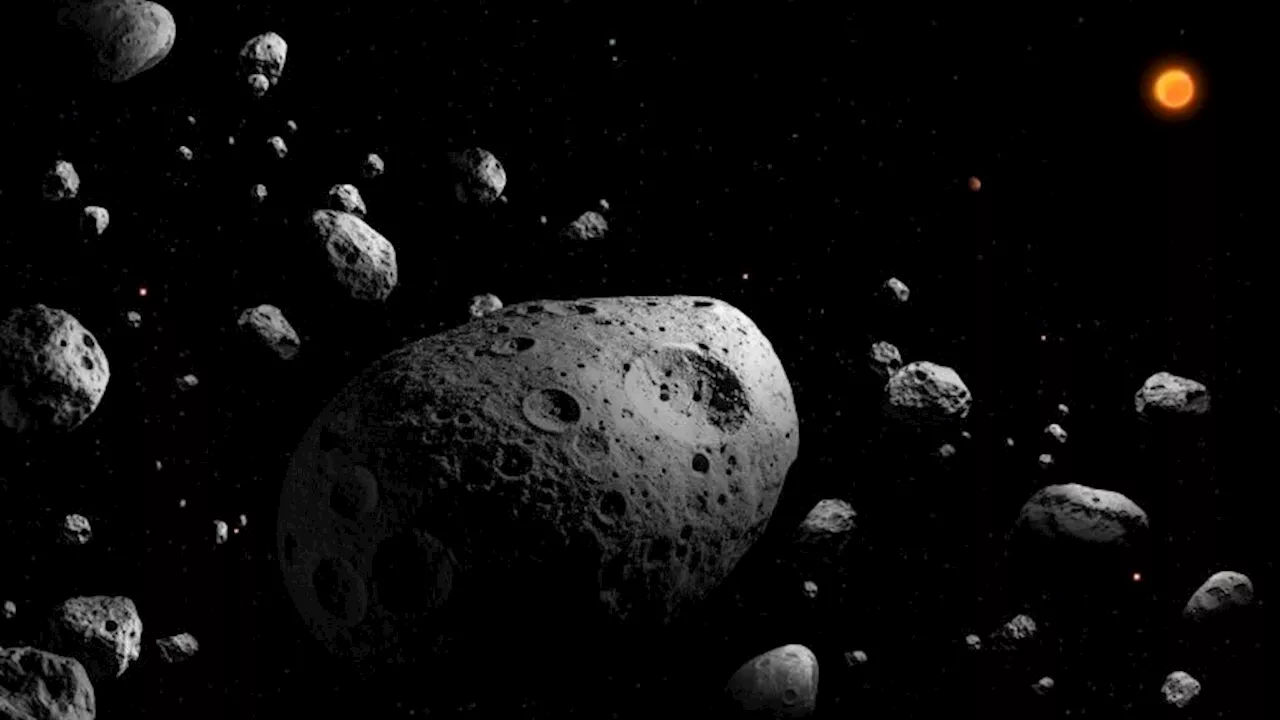
The recently discovered asteroid MM45 has made headlines as the fastest rotating asteroid larger than 500 meters. The discovery, made by the **Vera C. Rubin Observatory**, highlights the advances in astronomical observation techniques, revealing an object that completes a full rotation in approximately **1.88 minutes**. This finding adds to the growing catalog of nearly **2,000 asteroids** identified by the observatory last year, which is operated by the **National Science Foundation** (NSF) and the **SLAC National Accelerator Laboratory**.
Among the asteroids detected, 19 are classified as “super-fast” or “ultra-fast” rotators. A study examined **76 asteroids**, including **16 super-fast rotators** with rotation periods ranging from **13 minutes to 2.2 hours**. Notably, three ultra-fast rotators, including MM45, complete their spins in less than five minutes. This rapid rotation poses intriguing questions about the asteroid’s composition and internal structure.
Significance of Fast Rotation
The extreme spin rate of MM45 is particularly noteworthy because most asteroids are typically considered “rubble piles,” composed of smaller rocks held together by gravity. According to **Sarah Greenstreet**, a researcher with NOIRLab, the asteroid’s ability to maintain its structure during such rapid rotation suggests a composition of exceptionally strong materials. Greenstreet explained, “Clearly, this asteroid must be made of material that has very high strength in order to keep it in one piece as it spins so rapidly. We calculate that it would need a cohesive strength similar to that of solid rock.”
This discovery not only provides insight into the physical characteristics of MM45 but also emphasizes the capabilities of the Vera C. Rubin Observatory. The observatory has made these findings in remarkably short time frames, conducting over **10 hours of observations** to identify the asteroids rather than the months typically required.
The Future of Asteroid Research
The **Legacy Survey of Space and Time (LSST)**, a major initiative of the Vera C. Rubin Observatory, aims to create the most comprehensive astronomical movie of the Southern Hemisphere night sky over a **10-year period**. As the observatory prepares for full operations anticipated in **2026**, astronomers are eager to see what additional discoveries will emerge.
**Aaron Roodman**, Deputy Head of LSST and a professor of particle physics and astrophysics at SLAC, remarked on the observatory’s potential, stating, “We have known for years that Rubin would act as a discovery machine for the Universe, and we are already seeing the unique power of combining the LSST Camera with Rubin’s incredible speed. Together, Rubin can take an image every **40 seconds**.”
The powerful capabilities of the Vera C. Rubin Observatory signal a new era in asteroid research, with MM45 serving as a prime example of the exciting discoveries that await in our exploration of the cosmos. As astronomers continue to unlock the secrets of these celestial objects, the implications for our understanding of the Solar System and the materials that compose it are profound.