
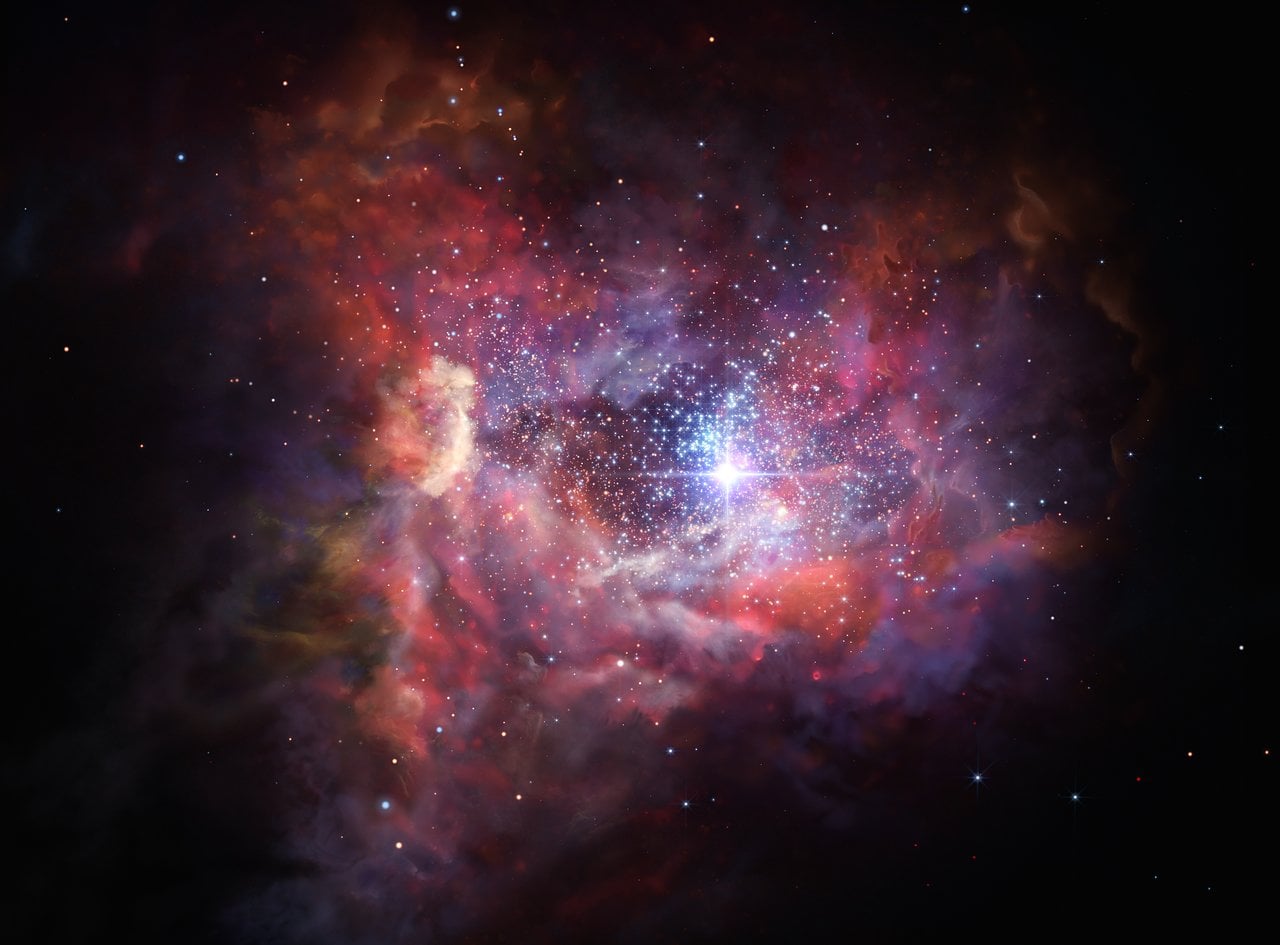
A new study led by Andreas Faisst from Caltech reveals that early galaxies are evolving more rapidly than previously thought. Presented at the recent American Astronomical Society Meeting and published in The Astrophysical Journal Supplement, the research tracks eighteen early galaxies, showcasing their growth and formation of essential materials over 12.5 billion years ago, a time when the universe was still in its infancy.
By integrating data from various telescopes, including the Hubble Space Telescope, the James Webb Space Telescope (JWST), and the Atacama Large Millimeter Array, researchers have been able to observe these galaxies in different wavelengths. This comprehensive approach has highlighted significant findings regarding the metallicity of these galaxies. Traditionally, astronomers assumed that early galaxies were relatively poor in metals, which are defined in astrophysics as elements other than hydrogen and helium formed through stellar fusion. However, this new research indicates that these galaxies show a surprising level of metal content, suggesting a faster evolutionary process.
New Insights into Galaxy Formation
The research challenges existing models of galaxy formation, particularly regarding how quickly these early cosmic structures transformed their original hydrogen and helium into heavier elements like carbon and oxygen. The study also reveals that the metallicity between galaxies from the Post-Reionization epoch, occurring 1-1.5 billion years after the Big Bang, and those from the subsequent Cosmic Noon period, did not differ significantly, prompting astronomers to reconsider their theories on stellar evolution.
Additionally, the paper highlights the presence of numerous Active Galactic Nuclei (AGN) within these galaxies. AGNs are regions surrounding supermassive black holes that actively accrete matter. The JWST has identified a notable number of AGNs in the early universe, suggesting they may be commonplace in star-forming galaxies during this epoch. The galaxies selected for this study were initially chosen because they lacked obvious AGNs, making them ideal candidates for monitoring across various wavelengths.
Star Formation Patterns and Future Research
Another noteworthy observation from the study is the variable nature of star formation in these early galaxies. The research indicates that star formation occurs in bursts, with periods of rapid star creation alternating with phases of little to no activity. This variability can be tracked using different indicators, such as the H-alpha line, which reflects star formation within the past 10 million years, and ultraviolet/infrared spectra, which provide insights over the last 100 million years. Discrepancies between these indicators reveal the intermittent nature of star formation in early galaxies.
This study is part of a broader investigation into early galaxies, with future publications expected to delve deeper into aspects such as galaxy rotation and the distribution of metals within them. As telescopes continue to advance, the potential for uncovering further insights into the universe’s formation and evolution grows, promising exciting developments in our understanding of cosmic history.