
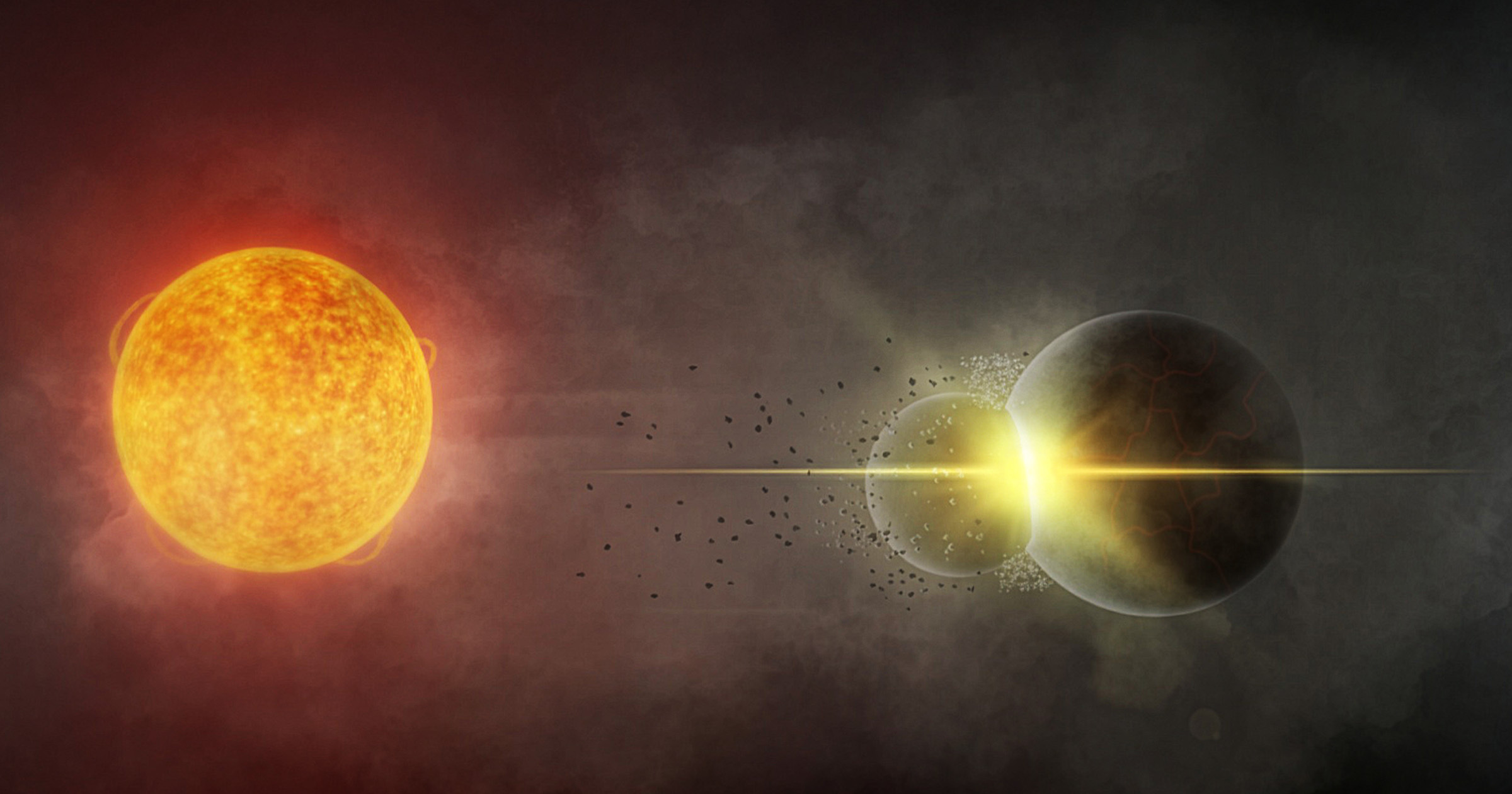
Astronomers have uncovered evidence of a devastating collision between two distant planets, shedding light on cosmic events that could inform our understanding of the evolution of the solar system. The findings, published in The Astrophysical Journal Letters, indicate that this cataclysmic event may also provide insights into the formation of Earth and its Moon.
The study revolves around a star designated Gaia20ehk, which initially exhibited a consistent brightness similar to that of our Sun. However, starting in 2016, the star began to show irregular flickers in its light output, culminating in dramatic fluctuations observed around 2021. Lead author Anastasios Tzanidakis, an astronomer at the University of Washington, expressed surprise at these observations, stating, “Stars like our Sun don’t do that.”
Upon further investigation, astronomers determined that the flickering was not indicative of the star’s demise. Instead, the light variations were attributed to vast streams of rock and dust obstructing the star’s light. The sheer volume of debris suggested a significant planetary collision, as only a massive amount of material could cause such dimming.
Using advanced telescopic observations, researchers confirmed that the material blocking the star was emitting infrared light, implying it was extremely hot. This heat signature aligns with a collision between two substantial celestial bodies. Tzanidakis elaborated, “At first, they had a series of grazing impacts, which wouldn’t produce a lot of infrared energy. Then, they had their big catastrophic collision, and the infrared really ramped up.”
The real-time observations of this cosmic impact are noteworthy. Tzanidakis highlighted the rarity of such events, noting that there are only a few recorded planetary collisions, and none that closely resemble the impact believed to have formed our Moon. “If we can observe more moments like this elsewhere in the galaxy, it will teach us lots about the formation of our world,” he added.
This discovery is not isolated. In a 2023 study, astronomers documented the aftermath of a collision between two ice giants in a newly formed star system. That event produced a toroidal debris cloud, further illustrating the violent nature of planetary interactions.
In a fascinating parallel, the latest findings echo a significant event in Earth’s history. Approximately 4.5 billion years ago, a planet hypothesized to be the size of Mars, known as Theia, is thought to have collided with Earth. This collision resulted in the obliteration of Theia and the formation of the Moon from the remnants that coalesced in Earth’s orbit.
Interestingly, the dust cloud surrounding Gaia20ehk orbits at a distance comparable to that between Earth and the Sun, or one astronomical unit. This positioning suggests that the debris could potentially cool and coalesce similarly to how our Moon formed. Tzanidakis remarked on the implications of these findings for astrobiology, noting that the large size of our Moon relative to Earth plays a crucial role in creating conditions suitable for life.
The research underscores the rarity of planetary collisions that yield moons of significant size, suggesting that such events may also indicate the rarity of life-supporting planets. Tzanidakis stated, “Right now, we don’t know how common these dynamics are. But if we catch more of these collisions, we’ll start to figure it out.”
This groundbreaking study not only enhances our grasp of celestial mechanics but also poses questions about the broader universe. Understanding these cosmic events could ultimately reshape our perspective on planetary formation and the conditions necessary for life.