
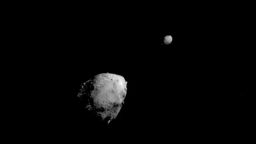
Recent observations have confirmed that asteroid 2024 YR4, once considered a significant threat to both Earth and the moon, will safely pass by the lunar surface. Initially discovered in December 2024, this asteroid posed a 3.1% risk of impacting Earth on December 22, 2032. However, subsequent studies quickly ruled out that possibility. By June 2025, concerns shifted to a potential 4.3% chance of YR4 colliding with the moon, raising alarms about possible threats to lunar infrastructure and astronauts.
Researchers anticipated that further assessment of YR4’s trajectory would not be possible until the asteroid returned into view in 2028. However, astronomers Dr. Andy Rivkin from Johns Hopkins University and Julien de Wit, an associate professor at the Massachusetts Institute of Technology, seized an opportunity to use the James Webb Space Telescope (JWST) for an earlier examination.
Early Observations Yield Positive Results
On February 18 and 26, 2025, Rivkin and de Wit successfully captured images of YR4, revealing that it would pass by the moon at a distance of approximately 14,229 miles (22,900 kilometers). This finding effectively ruled out the possibility of a lunar impact, which would have been a rare spectacle for humanity to witness. The observations marked one of the faintest detections of an asteroid ever made by the JWST, showcasing the telescope’s capabilities in planetary defense.
NASA and the European Space Agency recognized the challenges faced by the research team, as YR4 is around 60 meters (200 feet) in diameter and located millions of miles from the telescope. Rivkin described the challenge as akin to spotting a dust particle against a backdrop of stars. The team had to innovate new techniques to optimize the JWST’s instruments, allowing them to track the nearly invisible asteroid effectively.
Innovations in Asteroid Tracking
The JWST has primarily been used to observe massive cosmic structures, but its capabilities extend to detecting faint objects within our solar system. In December 2024, de Wit demonstrated that the telescope could identify 138 new asteroids in the asteroid belt, which were previously undetectable by ground-based telescopes. When focusing on YR4, the team faced the additional challenge of tracking a rapidly moving target.
The asteroid appeared extremely faint, reflecting light comparable to that of a single almond at the distance of the moon. The team developed a specialized observing strategy that allowed the JWST to accurately track the asteroid while maintaining precise positional measurements against distant stars. The successful detection relied on meticulously timed exposures that enabled the team to discern the asteroid’s position with remarkable accuracy.
Rivkin noted that three independent analyses of the data corroborated the findings, further solidifying the accuracy of their observations. De Wit expressed enthusiasm about adapting the JWST’s instruments for asteroid tracking, highlighting the potential for future applications in planetary defense.
Dr. Paul Wiegert, a professor of astronomy and physics at Western University in London, Ontario, commented on the significance of these observations. While he expressed disappointment at missing the opportunity to study a lunar impact, he acknowledged the important advancements in scientific techniques that will aid in future risks.
The precise distance of YR4’s closest approach, although small in astronomical terms, is significant compared to the moon’s size. Rivkin mentioned that while subsequent observations may slightly adjust the estimated distance, the probability of a lunar impact remains negligible.
In light of these findings, multiple new space observatories are being developed by NASA, including the Near-Earth Object Surveyor and the Nancy Grace Roman Space Telescope. These instruments will enhance our ability to monitor and assess potentially hazardous asteroids. The observations of YR4 have demonstrated the JWST’s role in planetary defense, showcasing the importance of continual monitoring and innovation in tracking space objects.