
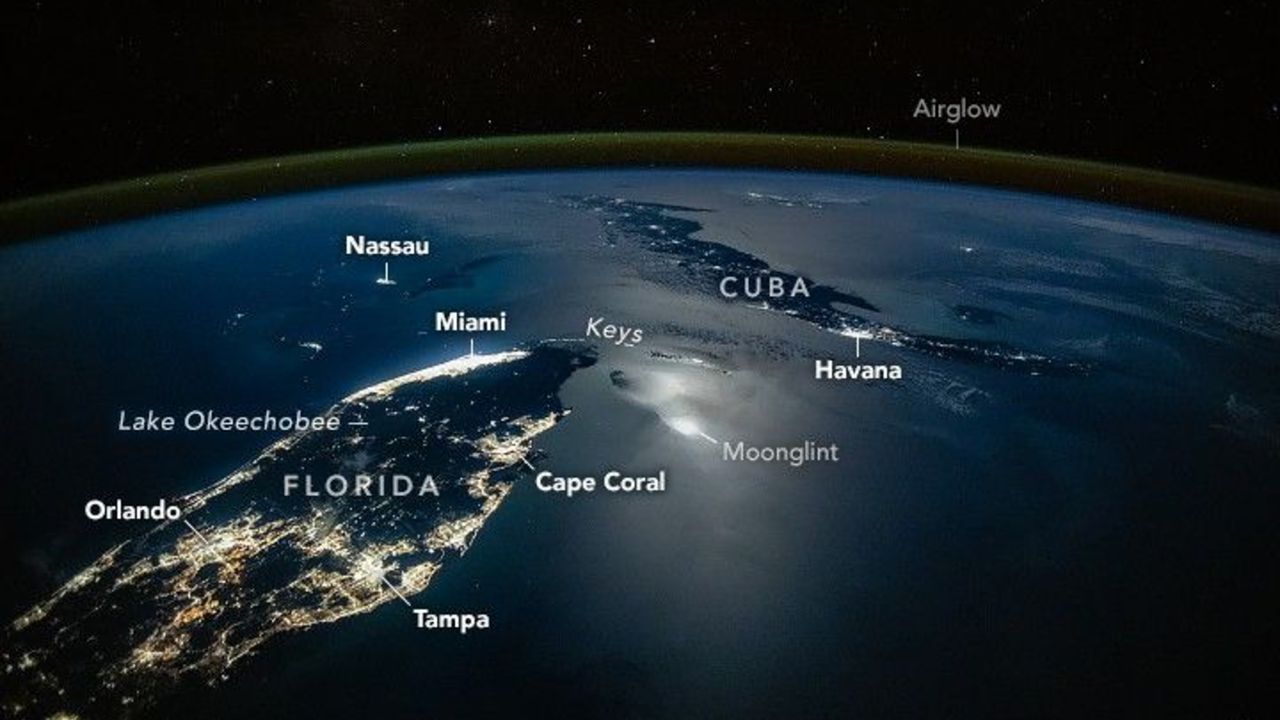
At 02:23 Eastern Time on March 19, 2025, an astronaut aboard the International Space Station (ISS) captured a breathtaking nighttime photograph of Earth. The image reveals the Florida Peninsula, parts of the Caribbean, and Central America illuminated by city lights, with shimmering moonlight reflecting off the ocean’s surface.
The photograph highlights prominent urban areas, including the vibrant corridor stretching from Miami to Fort Lauderdale along Florida’s southeastern coast. Additionally, the photograph showcases the Tampa and St. Petersburg areas on the Gulf Coast, as well as the bustling Orlando metropolitan region located in the central part of the peninsula. Smaller clusters of light can also be seen marking the Florida Keys, the Bahamian capital Nassau, and cities across Cuba, including Havana.
Understanding Moonglint and Airglow
What makes this image particularly remarkable is the presence of moonglint, the nighttime equivalent of sunglint. Moonglint occurs when moonlight reflects off the water’s surface at a precise angle, creating a brilliant display. At the time of the photograph, the moon was in a waning phase, approximately 78% illuminated, which enhanced the reflective quality of the light across the sea, particularly near the Florida Keys and Cuba.
Taken with a Nikon Z9 digital camera fitted with a 28-millimeter lens, the photo provides a wide field of view akin to that of the human eye. This perspective allows viewers to appreciate the curvature of the planet, emphasized by a delicate green layer of airglow along the horizon. This soft glow is a reminder of Earth’s atmosphere, shining gently against the dark backdrop of space.
Scientific Significance of Nighttime Imagery
Nighttime images of Earth play a crucial role in revealing patterns of human settlement, infrastructure, and land use that are often obscured during daylight. Scientists utilize such observations to analyze urban growth, energy consumption, and light pollution, while also studying the interplay between human activity and natural environments.
The presence of moonglint in the photograph is particularly valuable for researchers. Reflections of moonlight can assist in studying sea-surface conditions, such as roughness and wave patterns, even at night. These observations, when combined with other data sources, enhance the understanding of ocean-atmosphere interactions and refine models used in climate and environmental research.
This stunning image not only showcases the beauty of Earth from space but also highlights the importance of nighttime photography in advancing scientific knowledge. As astronauts aboard the ISS continue to capture these extraordinary views, they provide invaluable insights into our planet’s dynamics, fostering a deeper understanding of the complex relationship between human civilization and the natural world.