
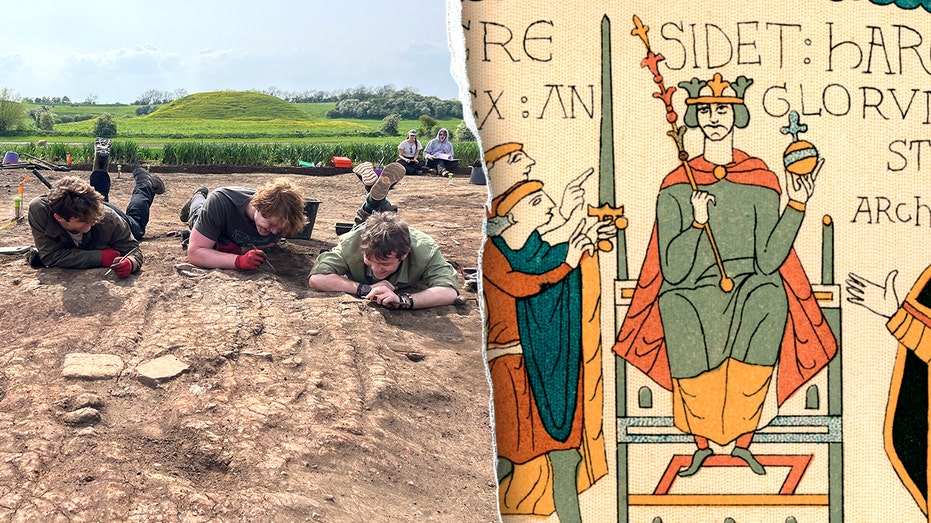
Archaeologists from the University of York have made a significant discovery of an elite Anglo-Saxon site near Skipsea in East Yorkshire. This site, located on land that once belonged to Harold II, the last Anglo-Saxon king of England, features remains that date back to between 750 and 850 A.D.
Excavations revealed several remarkable structures, including a large timber hall, a malthouse, and a distinct tower. The finds underscore the status of the site, indicating that it was once a center of significant activity. The excavation team, co-led by Jim Leary, noted the presence of a sunken structure potentially used as a watchtower, bell tower, or even a church.
This area has historical significance as it is located less than 1,000 feet from Skipsea Castle, a well-known Norman motte-and-bailey castle. Although the land was owned by Godwinson, there is no documented evidence suggesting that he ever visited Skipsea, a fact that researchers acknowledge may remain unproven.
Historical records indicate that Godwinson was killed in the Battle of Hastings in 1066, an event that culminated in Norman control of England. The findings at the excavation site suggest that it may have been occupied prior to Godwinson’s ownership, particularly given that radiocarbon dating shows the malthouse predates his time. Nevertheless, some structures might have existed during his reign.
The presence of a malthouse and large hall signifies that the site was not a typical settlement. Leary remarked on the evidence of extensive craft activities, including metalworking and hornworking, suggesting a high-status location. The site was further delineated by an enclosing ditch and bank, reinforcing its status as a “lordly center.”
Archaeologists also discovered a wattle-and-daub building, a traditional structure made of woven wooden sticks coated with mud. The area where these structures were found would have been adjacent to a now-nonexistent lake, hinting at prehistoric activity. Finds include evidence of feasting and the use of flint tools, which adds another layer of historical significance to the site.
Leary highlighted the size of the timber hall, which measures approximately five meters (about 16 feet) wide and 16 meters (about 52 feet) long, as notable for its type. The malthouse, which played a crucial role in the brewing process, involved drying cereal after it had been steeped in water.
Despite the exciting discoveries, Leary noted that definitive evidence of Godwinson’s presence at the site remains elusive. “Finding archaeological evidence that he visited the site would be nearly impossible,” he stated, adding that there are no documentary references to him ever visiting Skipsea.
The excavation project is set to continue annually for the next three years, providing opportunities for undergraduate students to engage in fieldwork. This significant discovery follows another related find a year earlier in Bosham, where researchers uncovered evidence of one of Godwinson’s residences, linked to an ancient toilet.
The continued exploration of this site not only sheds light on the Anglo-Saxon era but also enriches our understanding of early medieval England’s socio-political landscape. As excavations progress, archaeologists are hopeful to unveil further insights into the life and times of Harold Godwinson and his contemporaries.