
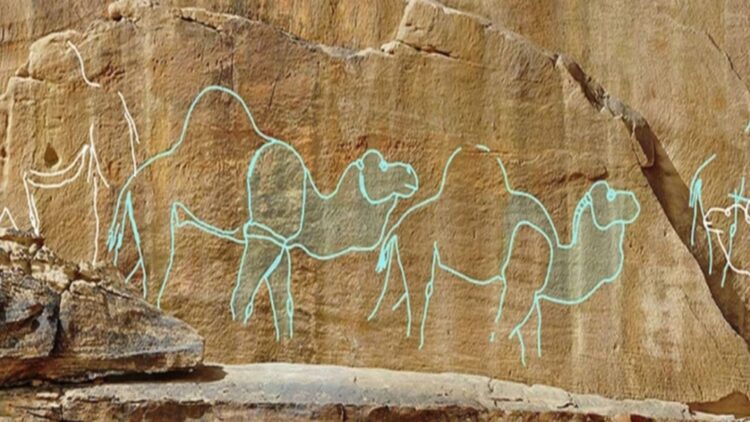
An international team of archaeologists has made a remarkable discovery in the Nefud Desert of Saudi Arabia, uncovering evidence of ancient human settlement dating back more than 12,000 years. The findings, published in the journal Nature Communications, include over 170 engravings on rock panels, featuring depictions of camels and other large animals. This research significantly alters previous understandings of early human culture in the Arabian Peninsula.
Significant Discoveries in Unexplored Areas
The engravings were located across three previously unexamined sites: Jebel Arnaan, Jebel Mleiha, and Jebel Misma. The team identified more than 60 rock art panels, including a total of 130 distinct engravings of animals such as camels, goats, and gazelles. Maria Guagnin, a researcher involved in the project, described one of the notable panels: “The rock art panel showed two large camels, one on top of the other. The older camel looked as if it were in motion and about to stand up, the other as if it were walking on the rocky surface.”
The artifacts discovered alongside the engravings include small arrowheads and stone beads, providing further context for the lifestyle of the artists. The researchers employed luminescence dating to determine that the sediment layer containing the engravings had not been exposed for over 12,000 years, confirming the age of the artworks.
Implications for Understanding Human Movement
This groundbreaking study sheds light on the cultural connections between ancient communities across a vast area. The evidence suggests that the creators of these rock engravings were connected to people living in the Levant, approximately 400 kilometers to the north, sharing similar stone tools and jewelry. This discovery highlights the existence of extensive cultural networks that spanned the region during a time when the environment was drastically different.
Furthermore, the research indicates that the newly explored sites were once seasonal lakes around 15,000 years ago, prior to becoming part of the arid desert landscape seen today. This transition reflects a significant climatic shift, as surface water returned to the Arabian Peninsula after an extremely dry period, allowing human populations to settle in these areas.
The findings not only establish an older timeline for figurative rock art but also suggest that the region served as a critical survival point for early humans. This research will undoubtedly prompt further exploration and study into the history and development of human societies in the Arabian Peninsula and beyond.