
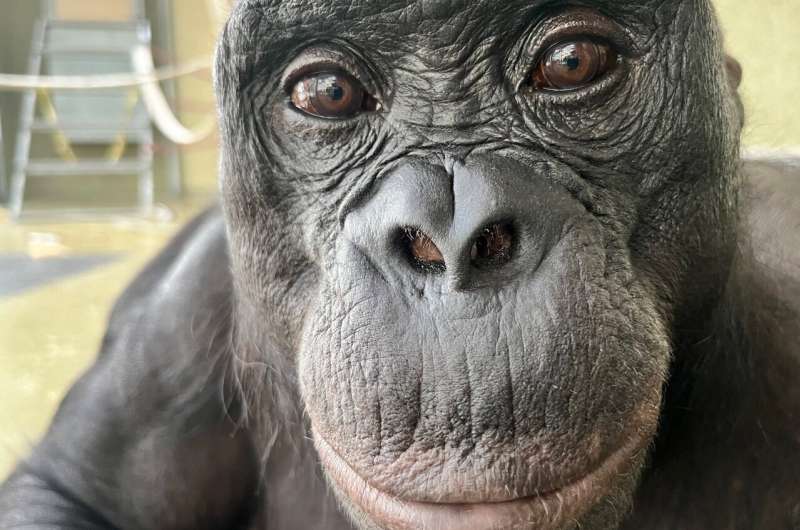
Researchers at Johns Hopkins University have made a significant discovery, demonstrating that apes can engage in imaginative play, a behavior previously thought to be exclusive to humans. In a series of innovative experiments, a bonobo named Kanzi interacted with imaginary juice and grapes, challenging long-standing beliefs about animal cognition.
The findings, published on February 5, 2026, in the journal Science, reveal that Kanzi consistently responded correctly when asked about the location of pretend objects. This marks the first controlled study investigating the capacity for pretense in nonhuman animals, a topic that has received little empirical attention despite anecdotal evidence suggesting similar behaviors in wild and captive settings.
Imagination Unveiled Through Experimentation
In these experiments, Kanzi, who resides at the Ape Initiative and has a history of engaging in imaginative play, participated in scenarios reminiscent of a child’s tea party. The research team, led by Christopher Krupenye, an assistant professor in the Department of Psychological and Brain Sciences, aimed to explore whether Kanzi could comprehend and interact with pretend objects.
The first experiment involved an experimenter pouring imaginary juice into two transparent cups. When asked, “Where’s the juice?” Kanzi accurately pointed to the cup that was designated to contain the pretend juice, even when its position was altered. The success of this task indicated that Kanzi could recognize and track an imaginary object within a structured setting.
In a subsequent test, a cup containing real juice was placed alongside the pretend cup. Kanzi consistently pointed to the real juice when prompted, reinforcing the notion that he understood the difference between real and imaginary items. A third experiment mirrored this approach but utilized grapes instead of juice, with similar results showcasing Kanzi’s ability to identify the location of the pretend grape.
Implications for Animal Cognition and Human Understanding
The results of this study suggest that the ability to engage in pretend play may not be unique to humans. “It really is transformative that their mental lives go beyond the here and now,” Krupenye remarked. The implications of this research echo those of previous discoveries, such as Jane Goodall‘s findings on chimpanzee tool use, which reshaped our understanding of human uniqueness.
Amalia P. M. Bastos, a former postdoctoral fellow at Johns Hopkins and co-author of the study, emphasized the significance of Kanzi’s ability to generate concepts of imaginary objects while simultaneously recognizing their non-existence. “It’s extremely striking and very exciting that the data seem to suggest that apes, in their minds, can conceive of things that are not there,” she stated.
This research opens new avenues for studying the cognitive capacities of not only apes but potentially other animals as well. The team plans to further investigate whether other species can also engage in pretend play and explore additional facets of imagination, such as future thinking and understanding the perspectives of others.
Krupenye concluded by urging a reevaluation of how we perceive the mental lives of animals. “We should be compelled by these findings to care for these creatures with rich and beautiful minds and ensure they continue to exist.” The study challenges the notion that imagination and complex cognitive processes are solely human traits, inviting a broader understanding of animal intelligence and behavior.
The research contributes to an evolving perspective on the cognitive abilities of nonhuman animals, reinforcing the idea that the roots of imagination may extend beyond humanity. This not only enhances our appreciation for other species but also invites a reconsideration of what it means to be human in the context of cognitive evolution.